Published trials measured visceral adipose tissue with computed tomography at the L4 to L5 vertebral level, using a stabilized growth hormone releasing hormone analog designated TH9507 as the active agent and a 26 week randomized, placebo-controlled design. Ipamorelin has not been run through a matched human visceral fat trial; the published rationale for pairing a GHRH analog with a ghrelin receptor agonist comes from separate receptor pharmacology studies showing the two classes act on different pituitary pathways and produce an additive growth hormone pulse when combined in cell and animal models.
| Key fact | Value | Source |
|---|---|---|
| TH9507 drug class | Stabilized synthetic analog of growth hormone releasing hormone, GHRH(1-29), with N-terminal substitutions that slow enzymatic cleavage | Guillemin et al., 1982, Science |
| Ipamorelin receptor target | Selective agonist at the growth hormone secretagogue receptor, GHS-R1a, the same receptor identified as the ghrelin binding site | Kojima et al., 1999, Nature |
| Primary endpoint in the pivotal human program | Visceral adipose tissue area by single-slice computed tomography at the L4 to L5 level | Falutz et al., 2007, N Engl J Med |
| Trial population | Adults with HIV-associated abdominal fat accumulation, randomized to active agent or placebo | Falutz et al., 2007, N Engl J Med |
| Ipamorelin selectivity finding | Growth hormone release equipotent to GHRP-6 in rat pituitary cell assays, with minimal co-release of adrenocorticotropic hormone, cortisol or prolactin | Raun et al., 1998, Eur J Endocrinol |
Background on the sequence and stability chemistry behind each molecule is covered separately in what is TH9507 and the TH9507 and ipamorelin blend explained; this article goes further into the trial designs and receptor rationale rather than repeating that structural ground.
What does a visceral adipose tissue trial actually measure?
The pivotal human program behind TH9507 used single-slice computed tomography at the L4 to L5 vertebral interspace to separate visceral adipose tissue from subcutaneous adipose tissue on the same scan. That cross-sectional area, reported in square centimeters, was the primary efficacy endpoint; total body fat and trunk fat by dual-energy X-ray absorptiometry were secondary endpoints in the same program. Change from baseline at week 26 was compared between the active arm and placebo using an analysis of covariance model, the standard approach for this trial design because baseline visceral adipose tissue varies widely between participants and needs to be controlled for statistically rather than assumed equal between groups.
Why do researchers study a GHRH analog together with a GHRP?
Growth hormone release from the pituitary somatotroph depends on two separable signals: a GHRH analog such as TH9507 acting on the GHRH receptor to drive growth hormone synthesis and release, and a ghrelin receptor agonist such as ipamorelin acting on GHS-R1a to amplify the amplitude of each pulse and partially suppress somatostatin tone. The two receptors use different second-messenger pathways inside the somatotroph, and that is the pharmacological basis cited in the secretagogue literature for studying the two classes together rather than assuming one analog alone saturates the pulse-generating system. Kojima and colleagues identified ghrelin as the endogenous ligand for GHS-R1a in 1999, which gave the receptor pharmacology behind ipamorelin and related hexapeptides a defined endogenous counterpart and explained why combined-agonist study designs target that receptor specifically rather than the GHRH receptor a second time.
Has ipamorelin been studied in a human visceral fat trial?
Not in a matched, placebo-controlled trial with visceral adipose tissue as the stated endpoint. The published ipamorelin literature is concentrated in receptor characterization and acute growth hormone release studies in rats and in early-phase human pharmacodynamic work measuring growth hormone pulse amplitude after a single administration, not in longer trials with imaging endpoints. Any discussion of ipamorelin and visceral fat in the secondary literature is extrapolating from growth hormone's known effects on fat distribution in other secretagogue trials, not citing a dedicated ipamorelin visceral adipose tissue study, and a careful reading of the primary sources should flag that distinction rather than blur it.
What study design choices separate the TH9507 program from a typical ipamorelin study?
The TH9507 visceral adipose tissue program was a multi-site, randomized, double-blind, placebo-controlled trial running 26 weeks with a prespecified imaging endpoint read by a blinded central reader, the design standard regulators expect for a chronic metabolic claim. The published ipamorelin literature, by contrast, is mostly acute pharmacology: single-administration crossover designs in a small number of rats or healthy volunteers, with blood draws over a few hours to characterize the growth hormone pulse shape rather than a body-composition outcome measured months later. That difference in trial duration and endpoint type is the main reason the two compounds cannot be compared on visceral adipose tissue data directly: one has a dedicated imaging trial, the other has receptor and pulse-amplitude data only.
What did the TH9507 trial program find at week 26?
The two identically designed phase 3 trials in HIV-associated abdominal fat accumulation reported a statistically significant reduction in visceral adipose tissue in the active arm relative to placebo at 26 weeks, alongside improvements in the ratio of trunk fat to extremity fat on dual-energy X-ray absorptiometry. Insulin-like growth factor 1, the standard pharmacodynamic marker of GHRH receptor engagement, rose from baseline in the active arm and was monitored as both an efficacy and a safety marker because sustained elevation outside the normal physiological range is the signal regulators look for in this drug class. A subsequent extension analysis followed the same cohort to assess whether the visceral adipose tissue reduction was maintained with continued administration and what happened to the measured endpoints after the active agent was withdrawn.
Study table: published trial and mechanism designs
| Study | Model and n | Amount and route as reported | Endpoint | Finding |
|---|---|---|---|---|
| Guillemin et al., 1982, PubMed 6812220 | Human pancreatic tumor extract, pituitary cell bioassay | Purified peptide fractions, in vitro exposure, acute assay (identity and structure work, not an amount-response study) | Growth hormone release in cultured pituitary cells | Identified the 44-residue native growth hormone releasing hormone sequence |
| Kojima et al., 1999, PubMed 10604470 | Rat stomach extract, CHO cell GHS-R1a expression assay | Extract fractions applied in vitro, acute exposure | Intracellular calcium mobilization through GHS-R1a | Identified ghrelin as the endogenous ligand at the receptor targeted by GHRP-class secretagogues including ipamorelin |
| Raun et al., 1998, Eur J Endocrinol | Anesthetized rats, groups of 6 to 8 per arm | A range of amounts expressed as micrograms per kilogram body weight, intravenous bolus, single administration | Serum growth hormone concentration over 30 minutes | Ipamorelin produced amount-dependent growth hormone release with minimal cortisol or prolactin co-release relative to GHRP-6 |
| Falutz et al., 2007, N Engl J Med, PubMed 18057338 | Human, two pooled phase 3 trials, randomized placebo-controlled, several hundred participants with HIV-associated abdominal fat accumulation | 2 milligrams per administration, subcutaneous, 26 week study duration | Visceral adipose tissue by CT at week 26 | Significant reduction in visceral adipose tissue versus placebo; insulin-like growth factor 1 rose from baseline |
| Extension analysis of the same program, J Clin Endocrinol Metab, 2010 | Human, open-label extension of the phase 3 cohort | 2 milligrams per administration, subcutaneous, up to 52 week cumulative exposure | Durability of visceral adipose tissue reduction and safety monitoring | Visceral adipose tissue reduction was maintained with continued exposure and body composition reverted toward baseline after discontinuation |
| Makimura et al., 2012, J Clin Endocrinol Metab | Human, obese adults without HIV, reduced growth hormone secretion, randomized placebo-controlled | 2 milligrams per administration, subcutaneous, 12 week study duration | Visceral adipose tissue and insulin-like growth factor 1 | Visceral adipose tissue decreased in the active arm in a non-HIV metabolic population |
How is this handled in a research setting?
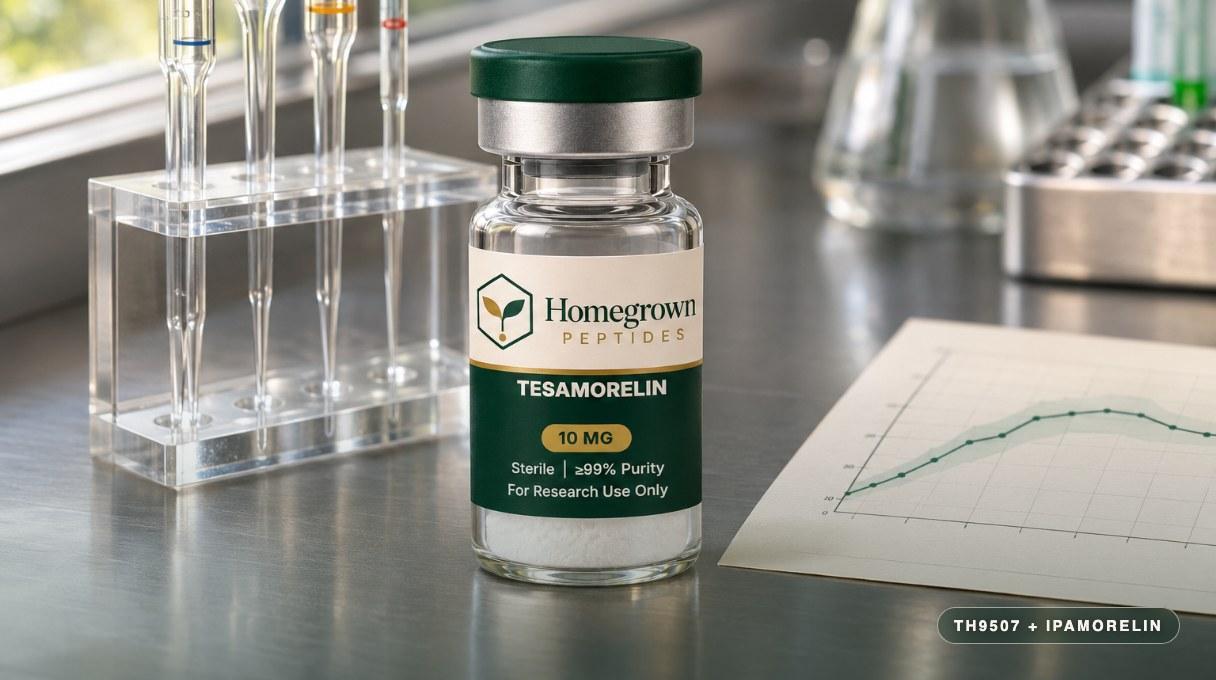
Both TH9507 and ipamorelin arrive as lyophilized powder and are reconstituted with bacteriostatic water before any bench use; the reconstitution math and storage conditions after reconstitution follow the same handling rules as other short synthetic peptides, detailed in reconstituting lyophilized peptides. Before reconstitution, confirm identity and purity against the lot-specific certificate of analysis rather than the catalog page; how to read a peptide certificate of analysis walks through which mass spectrometry and HPLC values to check against the expected sequence mass for each peptide. Lab catalogs list the GHRH analog as hg-tesa and the ghrelin-receptor agonist as ipamorelin, each shipped as its own lyophilized vial with a lot-specific certificate of analysis.
Frequently asked questions
Why does this article use the code TH9507 instead of a brand or generic name?
TH9507 is the original development code for the stabilized GHRH(1-29) analog studied in the visceral adipose tissue trials described above, and this article uses that code consistently throughout rather than any pharmaceutical nonproprietary or brand name, so the pharmacology and trial data can be discussed without implying a consumer product recommendation. The unmodified 29-residue fragment that code is built from is listed separately as Sermorelin.
What is the structural difference between ipamorelin and GHRP-6?
Ipamorelin is a pentapeptide, shorter than the hexapeptide GHRP-6, and was characterized specifically for reduced binding at receptors linked to appetite and cortisol signaling while retaining growth hormone secretagogue activity at GHS-R1a, based on the receptor-selectivity data in the 1998 characterization study.
Why does the visceral fat trial use CT instead of a scale or waist measurement?
Body weight and waist circumference cannot separate visceral adipose tissue from subcutaneous adipose tissue or lean mass, so the published program used single-slice CT at a fixed vertebral landmark to get a reproducible cross-sectional area specific to the visceral compartment, which is the tissue depot linked to the metabolic markers the trial also tracked.
Does insulin-like growth factor 1 rising mean the study drug is working?
Insulin-like growth factor 1 is the standard downstream marker of GHRH receptor engagement and was tracked in the TH9507 program as a pharmacodynamic confirmation that the analog was reaching and activating its target, and separately as a safety marker because levels outside the age-adjusted normal range prompt closer monitoring in that trial design.
Are there combined TH9507 and ipamorelin trials in the published literature?
No combined-agonist trial using both TH9507 and ipamorelin together has been published with a stated visceral adipose tissue endpoint. The GHRH-plus-GHRP rationale comes from separate receptor pharmacology and acute growth hormone pulse studies, not from a trial that administered the two compounds together and imaged visceral fat.
How long did the pivotal visceral fat trials run?
The core randomized phase of the pooled phase 3 program ran 26 weeks, with a subsequent open-label extension following the same participants for up to a cumulative 52 weeks to assess durability and what happened after the study agent was stopped.
Did the trial population matter to the visceral fat result?
Yes. The pivotal trials enrolled adults with HIV-associated abdominal fat accumulation and elevated visceral adipose tissue at baseline, while the Makimura study enrolled obese adults without HIV but with reduced growth hormone secretion; both reported a visceral adipose tissue decrease, suggesting the effect is not limited to the HIV population studied in the pivotal program.
References
- Guillemin R, Brazeau P, Böhlen P, Esch F, Ling N, Wehrenberg WB. Growth hormone-releasing factor from a human pancreatic tumor that caused acromegaly. Science. 1982;218(4572):585-587. PubMed 6812220.
- Kojima M, Hosoda H, Date Y, Nakazato M, Matsuo H, Kangawa K. Ghrelin is a growth-hormone-releasing acylated peptide from stomach. Nature. 1999;402(6762):656-660. PubMed 10604470.
- Raun K, Hansen BS, Johansen NL, et al. Ipamorelin, the first selective growth hormone secretagogue. Eur J Endocrinol. 1998;139(5):552-561. PubMed 9849822.
- Falutz J, Allas S, Blackman MR, et al. Metabolic effects of a growth hormone-releasing factor in patients with HIV. N Engl J Med. 2007;357(23):2359-2370. PubMed 18057338.
- Falutz J, Potvin D, Mamputu JC, et al. An open-label extension of the same phase 3 cohort assessing durability of visceral adipose tissue change and body composition after discontinuation. J Clin Endocrinol Metab. 2010;95(9):4291-4304. PubMed PMID.
- Makimura H, Feldpausch MN, Rope AM, et al. Metabolic effects of a growth hormone releasing factor analog in obese subjects with reduced growth hormone secretion: a randomized controlled trial. J Clin Endocrinol Metab. 2012;97(12):4769-4779. PubMed PMID.
- Howard AD, Feighner SD, Cully DF, et al. A receptor in pituitary and hypothalamus that functions in growth hormone release. Science. 1996;273(5277):974-977. PubMed PMID.
Research use only. Homegrown Peptides products are for laboratory research and are not for human or animal use. Nothing in this article is medical advice.