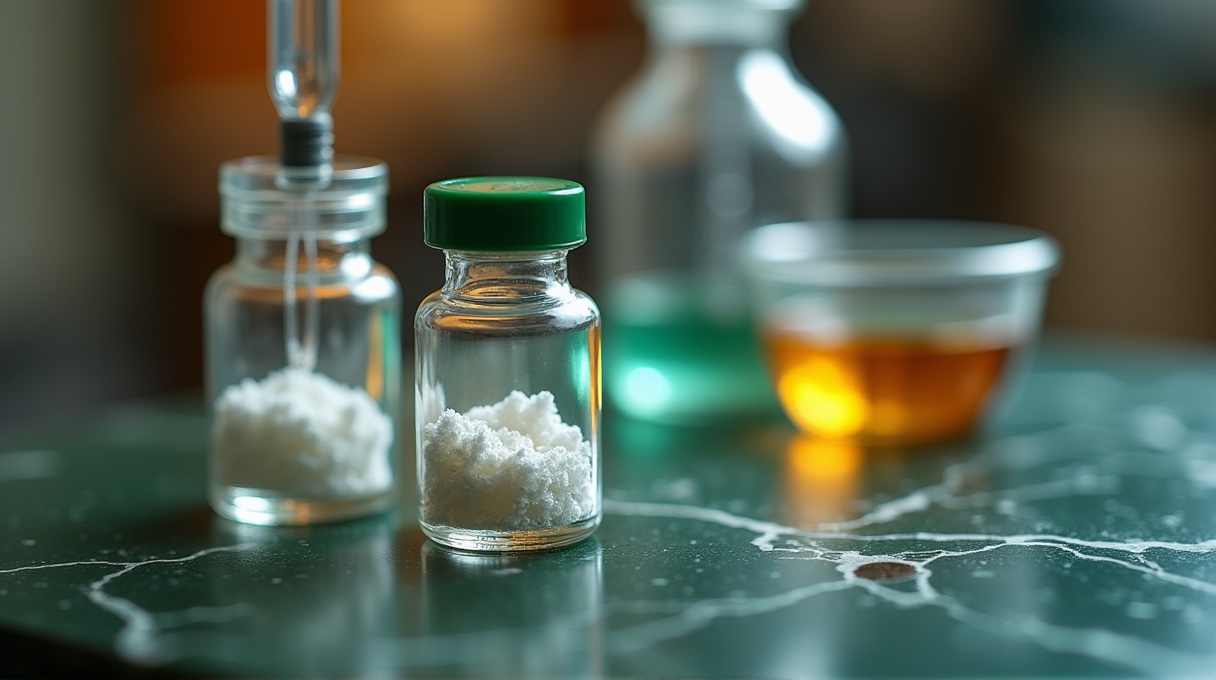
Research peptides ship as lyophilized powder: freeze-dried, sealed under an inert gas or vacuum, and stable in that state. Before use, the powder is dissolved in a diluent. The only hard part is the arithmetic, and it is not hard once you set it up the same way every time. This guide gives you that setup and three worked examples.
The three numbers
- Mass in the vial, from the label, in milligrams. A BPC-157 vial labeled 10 mg contains 10 mg of compound.
- Diluent volume, the amount of liquid you add, in milliliters.
- Final concentration, what you get, in milligrams per milliliter or micrograms per microliter, which are the same number.
The relationship is simple: concentration equals mass divided by volume. Pick any two and the third follows.
Worked example 1: a fixed volume
A 10 mg vial reconstituted with 2 mL of diluent gives 10 divided by 2, which is 5 mg/mL, equivalent to 5 micrograms per microliter. A 100 microliter draw from that solution contains 500 micrograms.
Worked example 2: a target concentration
You want a 2 mg/mL stock from a 5 mg vial. Volume equals mass divided by concentration: 5 divided by 2, which is 2.5 mL of diluent.
Worked example 3: a blend vial
A blend such as the Wolverine Blend lists both components, 10 mg BPC-157 and 10 mg TB-500, in one vial. Reconstituted with 2 mL, the solution is 5 mg/mL of each component, not 10 mg/mL total of one thing. Track each component separately in your notes.
Choosing the diluent
Bacteriostatic water, sterile water with 0.9% benzyl alcohol, is the standard choice for a multi-draw vial because the benzyl alcohol suppresses bacterial growth after the stopper is first punctured. Plain sterile water is appropriate for single-use preparations. The difference is explained in our comparison. Our 30 mL reconstitution solution and the reconstitution kit cover both the diluent and the sterile consumables.
Technique that protects the peptide
- Let the vial reach room temperature before opening so condensation does not form on cold powder.
- Wipe the stopper with an alcohol prep pad.
- Add the diluent slowly down the inside wall of the vial rather than jetting it onto the powder. Peptides are long molecules and shear can cause aggregation.
- Swirl gently or roll the vial. Do not shake. Foam is a sign of protein denaturation.
- Allow a few minutes for complete dissolution. A clear, colorless solution is expected for most peptides. Cloudiness that does not clear is a reason to stop and note the lot.
After reconstitution
Once in solution the compound is far less stable than as a powder. Refrigerate at 2 to 8 °C, protect from light, and record the date. Freeze-thaw cycles damage peptides, so if a solution must be frozen, aliquot it first. More in the storage and stability guide.
A note on net peptide content
The mass on the label is compound mass. Lyophilized powder also contains bound water and counter-ions, so the powder weighs a little more than the peptide it contains. For most bench calculations the label mass is what you use, and the Certificate of Analysis states the net peptide content if your work needs the correction. See how to read a COA.
Building a reconstitution table for the bench
Most labs keep a one-page table taped near the balance so nobody does the division under pressure. The pattern below works for any compound; fill it in once per vial size.
| Vial mass | Diluent added | Concentration | Mass in 100 µL |
|---|---|---|---|
| 5 mg | 1 mL | 5 mg/mL | 500 µg |
| 5 mg | 2 mL | 2.5 mg/mL | 250 µg |
| 10 mg | 2 mL | 5 mg/mL | 500 µg |
| 10 mg | 5 mL | 2 mg/mL | 200 µg |
| 15 mg | 3 mL | 5 mg/mL | 500 µg |
The last column is the one people actually use at the bench, so keep it visible. For very small draws, a lower concentration and a larger volume is more accurate than a high concentration and a tiny volume, because syringe graduation error is a fixed fraction of the draw.
Recording what you did
Write four things on the vial or in the notebook at the moment of reconstitution: the date, the diluent and its lot, the volume added, and the resulting concentration. A vial labeled only with the compound name is a problem a week later when three people have used it. The certificate of analysis lot number belongs in the same entry.
The same two-component bookkeeping applies to secretagogue pairs such as CJC-1295 with ipamorelin, which are supplied as one co-lyophilized vial with both masses on the label. The pairing logic behind those vials is explained in growth hormone secretagogues in research.
If you would rather have the arithmetic done for you, the site's calculator handles it, and this guide covers the unit traps that catch people when they use one.
Frequently asked questions
Does more diluent hurt anything?
No. More diluent means a lower concentration, which can be easier to measure accurately with small draws. The only cost is vial space.
Can I reconstitute directly in a buffer?
Many labs do, for cell-culture work. Match the buffer to the assay, and note that some peptides are sensitive to pH. Bacteriostatic water is the general-purpose default.
How long does reconstitution take?
Most short peptides dissolve within a minute of gentle swirling. Larger or more hydrophobic compounds can take several minutes.
References
- Wang W. 1999. Instability, stabilization, and formulation of liquid protein pharmaceuticals. International Journal of Pharmaceutics.
- Manning MC, et al. 2010. Stability of protein pharmaceuticals: an update. Pharmaceutical Research.
- Carpenter JF, et al. 1997. Rational design of stable lyophilized protein formulations: some practical advice. Pharmaceutical Research.
Research use only. This article describes laboratory technique. It is not a protocol for use in humans or animals, and Homegrown Peptides products are not for such use.