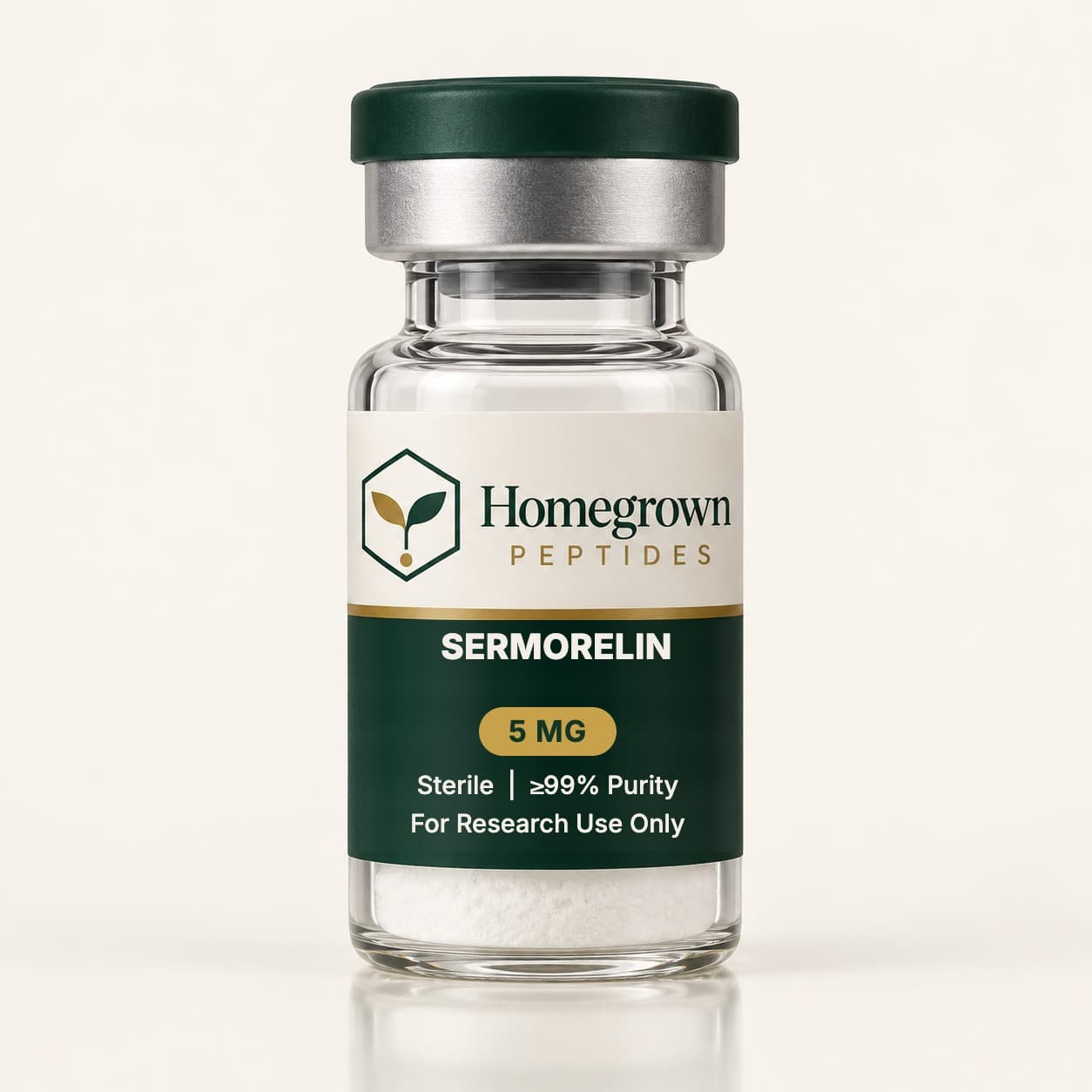
SERMORELIN
Lot SERMO5-0318 · 99.8 %- Lot-matched certificate of analysis, identity and purity by HPLC and mass spec
- Ships within 1 business day from the U.S., tracked, in protective packaging
- Research use only. Not for human or animal use
- Ships within 1 business day, tracked, protective packaging
- 2-Day $12.99, free at $1,000 and over
- Overnight $250
- Certificate of analysis available on request
- ≥99% purity specification, HPLC & mass-spec verified at source
- Ships from a U.S. facility within 1 business day
- Secure card checkout on our payment partner's page, 20% already in the total
Complete your setup
Lyophilized peptides need bacteriostatic water and sterile lab supplies to reconstitute. Add the essentials in one click.
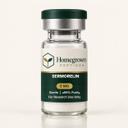 SERMORELINIn your order
Sermorelin is a synthetic 29-residue fragment of growth hormone-releasing hormone, supplied as a lyophilized powder with a confirmed C-terminal amide sequence (GRF 1-29 NH2). Published pharmacology work examines how this GHRH fragment stimulates pituitary growth hormone release and how exogenous administration shifts growth hormone and IGF-1 levels in research cohorts, making it a reference compound in growth hormone secretagogue literature.
Sermorelin is a 29-amino-acid peptide corresponding to the active portion of growth hormone-releasing hormone. It is the reference GHRH analog for studying pituitary growth hormone release.
Common research applications include:
- GHRH receptor research
- Pituitary secretion models
- Endocrine-axis studies
Specifications
- Class: GHRH(1-29) analog
- Form: lyophilized powder in a sealed glass vial
- Available sizes: 5 mg
- Purity: verified at 99% or higher by HPLC, identity confirmed by mass spectrometry
- Testing: every lot is third-party tested, with a lot-matched Certificate of Analysis available on request
- supplied by a U.S. lab
- Storage: keep sealed, cool, dry and away from light; refrigerate after reconstitution
For laboratory research use only. This product is not for human or veterinary use, is not a drug, food or cosmetic, and is not intended to diagnose, treat, cure or prevent any disease.
What the Literature Studies
A 1992 paper by Corpas and colleagues in the Journal of Clinical Endocrinology & Metabolism compared healthy younger and older men, finding that the older cohort had lower spontaneous growth hormone release and IGF-1 levels at baseline. Over a two-week research period, GHRH-(1-29) administration raised 24-hour growth hormone profiles, peak amplitude, and IGF-1 levels in the older men to values resembling the younger group, while responses to an acute GHRH stimulation test did not differ between age groups either before or during the study. Mechanistically, the 29-residue fragment retains the receptor-binding region of native GHRH and acts on pituitary somatotroph GHRH receptors to trigger pulsatile growth hormone secretion, which is why the molecule is used as a tool for probing age-related changes in the growth hormone axis in research settings.
Specification and Handling
This lot is supplied as a lyophilized powder with the sequence Tyr-Ala-Asp-Ala-Ile-Phe-Thr-Asn-Ser-Tyr-Arg-Lys-Val-Leu-Gly-Gln-Leu-Ser-Ala-Arg-Lys-Leu-Leu-Gln-Asp-Ile-Met-Ser-Arg-NH2, corresponding to GRF(1-29)NH2, with molecular formula C149H246N44O42S and a molecular weight of 3357.93. CAS number is 86168-78-7. Purity is verified at 99% or greater by HPLC, identity confirmed by mass spectrometry, with a certificate of analysis available per lot. The powder is soluble in bacteriostatic water; consult the COA for solvent specifics. Unreconstituted vials are stored at -20°C, protected from light and moisture; once reconstituted, the solution is kept refrigerated at 2-8°C. These are physical storage and solubility parameters only, drawn directly from the product specification sheet and lot certificate.
Buying Notes
Sermorelin ships in a single 5 mg lyophilized vial, the standard fill size this catalog carries for this GHRH fragment. The certificate of analysis for this lot reports the HPLC purity trace and a mass spectrometry identity check against the theoretical molecular weight of 3357.93, confirming the amino acid sequence matches GRF(1-29)NH2 rather than a truncated or modified variant. Researchers comparing growth hormone secretagogues against this one should see the SERMORELIN research page for reconstitution and testing detail specific to this lot, and the SERMORELIN VS TH9507 VS CJC 1295 article for a structural comparison against related GHRH-class and ghrelin-receptor compounds carried elsewhere in this catalog's lineup.
Lots on file for SERMORELIN
One row per size. Purity by RP-HPLC, measured content against the stated amount, and the date the independent laboratory issued the certificate. Printed minimum ≥ 99.0 %.
| Size | Lot | Purity (RP-HPLC) | Measured content vs label | Certificate date | Results |
|---|---|---|---|---|---|
| 5 mg | SERMO5-0318 | 99.8 % | 6.36 mg · stated 5 mg | Apr 3, 2026 | Lot results → |
What the certificate shows
Line by line, with the real numbers from the certificate on file for SERMORELIN.
Lot SERMO5-0318 · 5 mg
| Line on the certificate | What this lot reports | How to read it |
|---|---|---|
| Identity | Confirmed against reference (LC-MS/MS) | The laboratory matched the sample's mass against a reference standard. This is the line that says the vial holds this peptide and not a cheaper one with a similar retention time. |
| Overall purity | 99.8 % by RP-HPLC (214 nm) | The share of the chromatogram that is the target peak. Everything else is process residue or related peptide. Read it next to the printed minimum on the label, not on its own. |
| Measured content | 6.36 mg against a stated 5 mg (HPLC quantitation) | What the laboratory actually weighed in the vial, quantified against the peptide standard. A figure at or above the stated amount means the fill is not short. |
| Laboratory and dates | Bioviridian · sample received Mar 26, 2026 · issued Apr 3, 2026 | Who ran the assay and when. A certificate with no issuing laboratory and no dates cannot be checked by anyone. |
| Verification code | COA3372 | The laboratory's own reference for this document, so the result can be confirmed with the laboratory rather than taken from this page. |
Full results for lot SERMO5-0318How certificates work hereLook up a lot number
Research background: sermorelin
GRF(1-29)NH2 is the reference GHRH fragment. Here is what the published studies measured, in which cohorts, over which periods.
Sermorelin is GRF(1-29)NH2, the 29-residue amidated fragment of growth hormone releasing hormone. Molecular weight is 3357.93 and the CAS number is 86168-78-7. A 1998 structure-activity study in Journal of Medicinal Chemistry scanned the fragment residue by residue with alanine replacements. 1 Positions 1, 3, 5, 6, 10, 11, 13, 14 and 23 lost nearly all potency. Alanine at positions 8, 9, 15, 22 and 28 gave analogues 2 to 6 times more potent than the hGHRH(1-40) standard in vitro. That map is why the 1-29 fragment, and not a shorter one, is the working unit across this literature.
The first human comparisons are from the mid 1980s. A 1985 study in Peptides gave GHRH(1-29)NH2 and its D-Ala2 analogue as single intravenous administrations to five men across an ascending range. 2 Peak growth hormone responses fell at 15 or 30 minutes, molar potency matched GHRH(1-40) and GHRH(1-44), and the D-Ala2 analogue was about twice as potent. Prolactin, TSH, LH, FSH, ACTH, insulin, glucagon, glucose, cortisol and free thyroid hormones were unchanged at every level tested.
A 1994 study in Journal of Clinical Endocrinology and Metabolism infused both peptides in 10 men at a constant rate and measured clearance directly. 3 Metabolic clearance was 21 mL per kilogram per minute for the D-Ala2 analogue against 39.7 for the parent fragment. Disappearance half-time was 6.7 minutes against 4.3 minutes. The unmodified 1-29 fragment is short-lived by design, which is the reason longer-acting analogues exist and the reason study designs repeat administration rather than relying on one event.
Two cohort studies in older volunteers are the most cited records. A 1992 study in Journal of Clinical Endocrinology and Metabolism compared 9 younger men, mean age 26.2 years, with 10 older men, mean age 68.0 years. 4 Baseline 24-hour growth hormone profiles and IGF-I were lower in the older group. The older group then went through two 14-day periods of twice-daily administration, separated by a 14-day interval with nothing given. Across those periods the 24-hour profiles, peak amplitude and IGF-I moved toward the younger range. Acute intravenous stimulation tests did not differ between the groups before or during the study.
A 1997 study in Metabolism ran 6 weeks in 11 ambulatory men aged 64 to 76 with low baseline IGF-I. 5 It sampled growth hormone in blood drawn every 20 minutes from 8 pm to 8 am. It also added phosphorus magnetic resonance spectroscopy of muscle energy metabolism, plus muscle histology, muscle strength and body composition. A 1997 study in Journal of Clinical Endocrinology and Metabolism used a 5-month single-blind placebo controlled design in 19 older volunteers with a norleucine-27 analogue. 6 Integrated 12-hour growth hormone secretion rose 107 percent in men and 70 percent in women by week 4. Serum IGF-I rose 28 percent, and the growth hormone change held through week 16.
Pulsatility is the mechanism endpoint, and three studies address it. A 1990 study in Clinical Endocrinology used continuous subcutaneous delivery for up to one year in eight pre-pubertal children with partial growth hormone insufficiency. 7 In the five followed for a full year, growth velocity rose from a mean 4.6 cm per year to 7.0 cm per year. Profiles repeated every three months showed sustained pulsatile secretion, with no sign of desensitisation. Growth rates returned to pre-study values once administration stopped. A 1994 study in the same journal ran 12 months in 18 short pre-pubertal children with idiopathic short stature. Overnight profiles and stimulation tests were repeated at 0, 3, 6 and 12 months. 8 A 1999 study used a peptide clamp of continuous GHRH(1-29)NH2 against intermittent somatostatin(1-14) to separate the two hypothalamic signals in healthy volunteers and in survivors of childhood brain tumours. 9
Route is documented too. A 1993 study in Acta Paediatrica Supplement gave the fragment intravenously or intranasally to 30 healthy men aged 19 to 43. 10 Growth hormone rose after the lowest intravenous amount tested, and levels stayed raised for about 3 hours even though the peptide itself cleared quickly. Nasal bioavailability was only 3 to 5 percent. The nasal route still produced release that scaled with the amount given, and the response was sustained when administration was repeated across a day. For a lyophilized vial, the practical consequence is that the material has to be what the label says before any of those designs can be repeated.
Research use only. Nothing above is guidance for use, and none of these studies describe this product. Every reference below was checked against its PubMed record before it was published here.
References
- Human growth hormone-releasing hormone hGHRH(1-29)-NH2: systematic structure-activity relationship studies Journal of medicinal chemistry, 1998. PubMed 9513600
- Growth hormone responses to growth hormone-releasing hormone (1-29)-NH2 and a D-Ala2 analog in normal men Peptides, 1985. PubMed 2866496
- Incorporation of D-Ala2 in growth hormone-releasing hormone-(1-29)-NH2 increases the half-life and decreases metabolic clearance in normal men The Journal of clinical endocrinology and metabolism, 1994. PubMed 7962295
- Growth hormone (GH)-releasing hormone-(1-29) twice daily reverses the decreased GH and insulin-like growth factor-I levels in old men The Journal of clinical endocrinology and metabolism, 1992. PubMed 1379256
- Effects of single nightly injections of growth hormone-releasing hormone (GHRH 1-29) in healthy elderly men Metabolism: clinical and experimental, 1997. PubMed 9005976
- Effects of [norleucine27]growth hormone-releasing hormone (GHRH) (1-29)-NH2 administration on the immune system of aging men and women The Journal of clinical endocrinology and metabolism, 1997. PubMed 9360512
- Continuous subcutaneous GHRH(1-29)NH2 promotes growth over 1 year in short, slowly growing children Clinical endocrinology, 1990. PubMed 2140733
- Treatment with GHRH(1-29)NH2 in children with idiopathic short stature induces a sustained increase in growth velocity Clinical endocrinology, 1994. PubMed 7955460
- The relative roles of continuous growth hormone-releasing hormone (GHRH(1-29)NH2) and intermittent somatostatin(1-14)(SS) in growth hormone (GH) pulse generation: studies in normal and post cranial irradiated individuals Clinical endocrinology, 1999. PubMed 10594518
- Pharmacokinetics of growth hormone-releasing hormone(1-29)-NH2 and stimulation of growth hormone secretion in healthy subjects after intravenous or intranasal administration Acta paediatrica (Oslo, Norway : 1992). Supplement, 1993. PubMed 8329825
How to compare suppliers
Sermorelin listings rarely show their work. Six checks separate a documented vial from a product photo.
- A certificate tied to a lot, not a brochure. Ask which lot is in the box, then ask to see that lot's results. Every vial here is labelled with its lot number, and each public lot has its own results page.
- A named laboratory on the document. A certificate should say who ran the assay. The certificates on file name Bioviridian as the issuing laboratory, with a verification code and a dated release.
- Identity as well as purity. Purity by RP-HPLC answers what share of the sample is the peptide. Identity by LC-MS/MS answers whether it is the right molecule. One figure without the other answers half the question.
- Measured content against the stated amount. A vial sold as 10 mg should come with a measured content figure, so the fill can be read against the label instead of assumed.
- Shipping terms you can plan around. Orders here ship to United States addresses only, within one business day, with tracking sent by email. Standard shipping is a flat 12.99 dollars under 1,000 dollars and free at 1,000 dollars or more.
- A person who replies. Certificate requests, bulk questions and size questions all go to support@homegrownpeptides.com, and a person answers them.
This listing ships in one 5 mg size, and lot SERMO5-0318 results are on file and linked above.
Also in the catalog
Frequently Asked Questions
Is sermorelin peptide available for purchase for research?
Yes. The 5 mg lyophilized vial is listed above for laboratory research use only. It is not a drug, supplement or cosmetic and is not for human or animal use. The vial carries a lot number that maps to its own certificate of analysis.
What does the sermorelin certificate report?
Lot SERMO5-0318 reports 99.8 percent purity by RP-HPLC at 214 nm, identity confirmed against reference by LC-MS/MS, and 6.36 mg measured content against a stated 5 mg. The laboratory was Bioviridian and the certificate was issued on April 3, 2026. Endotoxin and heavy-metal panels were not part of this certificate and are available on request.
Why is sermorelin only 29 residues instead of the full sequence?
A 1998 alanine-scan study in Journal of Medicinal Chemistry mapped which positions in the fragment carry potency. The 1-29 segment retains the receptor-binding region of the 44-residue native hormone. Research groups use the shortened amidated fragment because it is practical to synthesise at high purity while staying active in the models studied.
How do CJC-1295 and sermorelin compare in the published literature?
Both are growth hormone releasing hormone analogues acting at the GHRH receptor, and they differ in how long they persist. Sermorelin is the unmodified 1-29 fragment with a disappearance half-time measured at 4.3 minutes in a 1994 infusion study. Longer-acting analogues carry substitutions chosen to slow clearance. The two product pages summarise their own records.
Which studies used this exact sequence?
The 1992 cohort study in Journal of Clinical Endocrinology and Metabolism used GHRH-(1-29), the same 29-residue sequence supplied here. So did the 1990 and 1994 growth-velocity studies in Clinical Endocrinology. Every reference in the research background section links to its PubMed record.
What part of the growth hormone axis does sermorelin research target?
Sermorelin is a fragment of GHRH designed to engage pituitary somatotroph receptors. Published work uses it to study how this receptor interaction drives pulsatile growth hormone release.
How is the lyophilized powder different from the reconstituted form?
The lyophilized powder is a stable solid held at -20°C until a solvent is introduced. Once reconstituted with bacteriostatic water it becomes a solution that is handled and stored differently, at 2-8°C.
How does sermorelin compare with ipamorelin in the published work?
They act at different receptors. Sermorelin is a fragment of growth hormone releasing hormone acting at the GHRH receptor. Ipamorelin was placed at a GHRP-like receptor in its 1998 pharmacology paper, confirmed with receptor antagonists. The two literatures therefore measure different things, and each product page summarises its own.
How is sermorelin shipped and stored?
Orders ship to United States addresses within one business day, with tracking sent by email. Store the lyophilized powder at minus 20 degrees Celsius, protected from light and moisture. Reconstituted solution is held at 2 to 8 degrees Celsius.
What does Research Use Only mean?
This product is supplied strictly for laboratory and research use only. It is not a drug, food, supplement or cosmetic, is not approved by the FDA, and is not for human or veterinary consumption.
Learn more about SERMORELIN
From the research blog
Sermorelin Over Time: What the Trials Measured at Week 4, 8 and 12 (IGF-1, Body Composition, Sleep Architecture)
What published sermorelin (GHRH 1-29) trials measured at successive weeks, covering IGF-1, body composition and sleep-architecture endpoints over time.
Read the article →
Sermorelin vs Ipamorelin vs CJC-1295 + Ipamorelin: Three GH-Axis Study Designs Compared
How the sermorelin, ipamorelin and CJC-1295 literatures differ in species, receptor target, study design and what each trial actually measured.
Read the article →
Sermorelin in Published Studies: Models, Amounts Reported, Routes and the Endpoints Measured
What models, amounts, routes and endpoints has published sermorelin research reported, from early GHRH characterization work through human growth-axis studies.
Read the article →