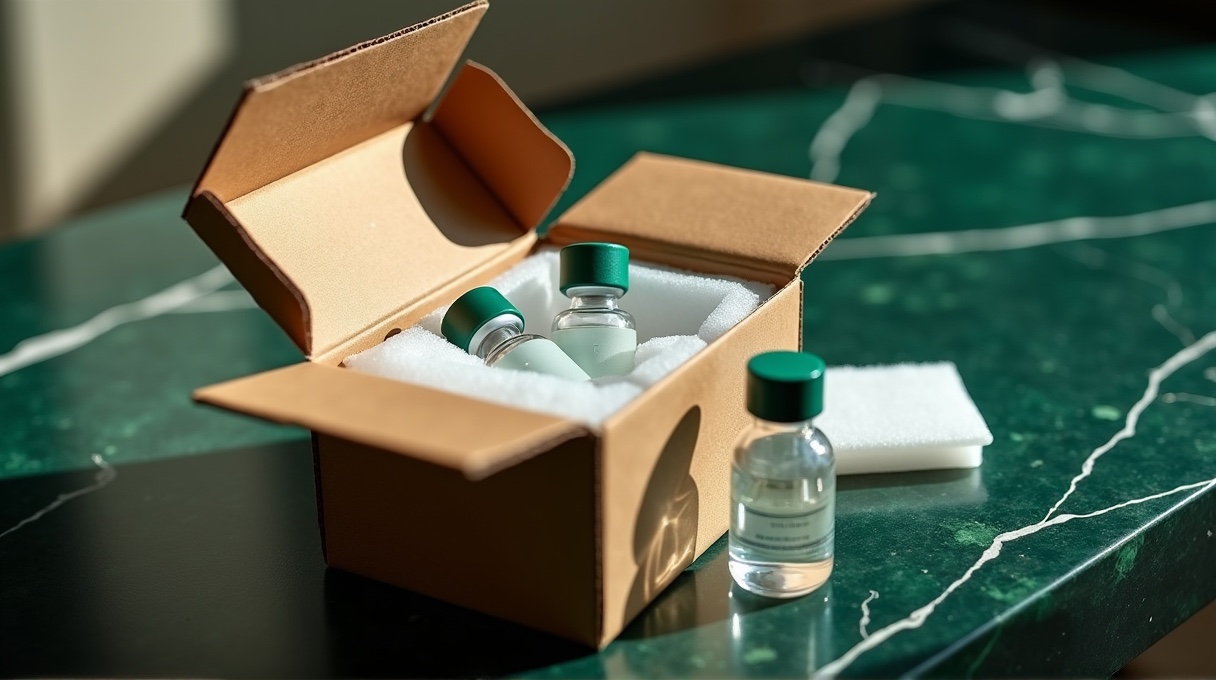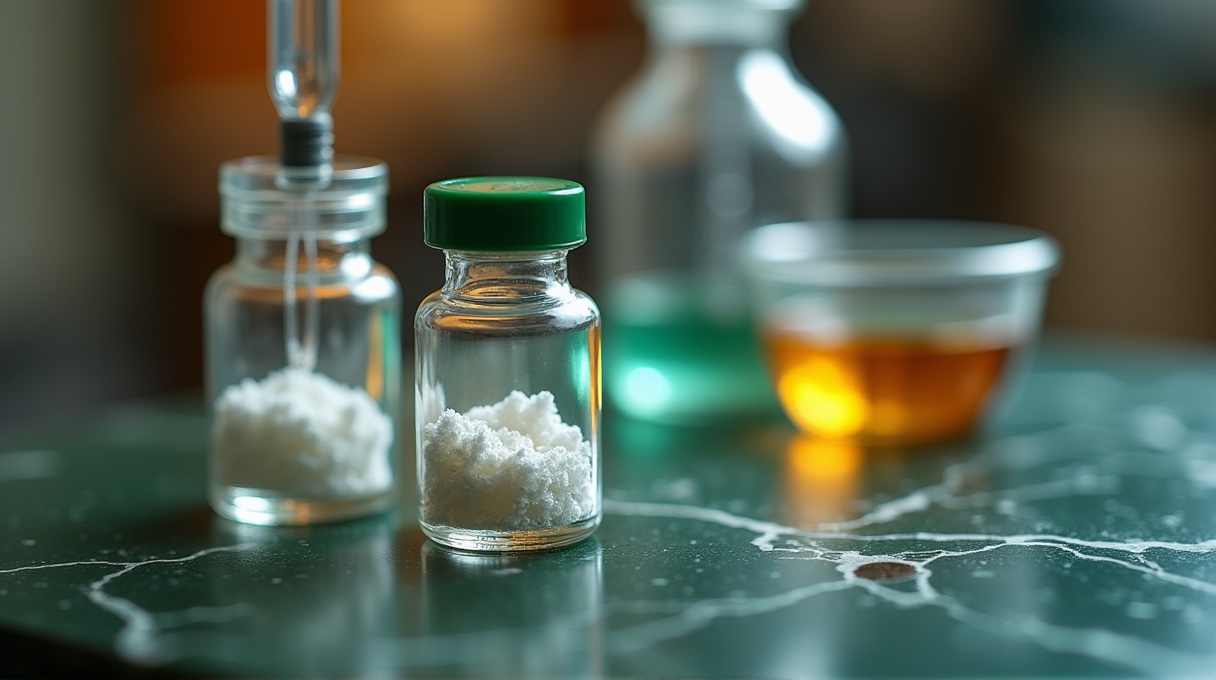
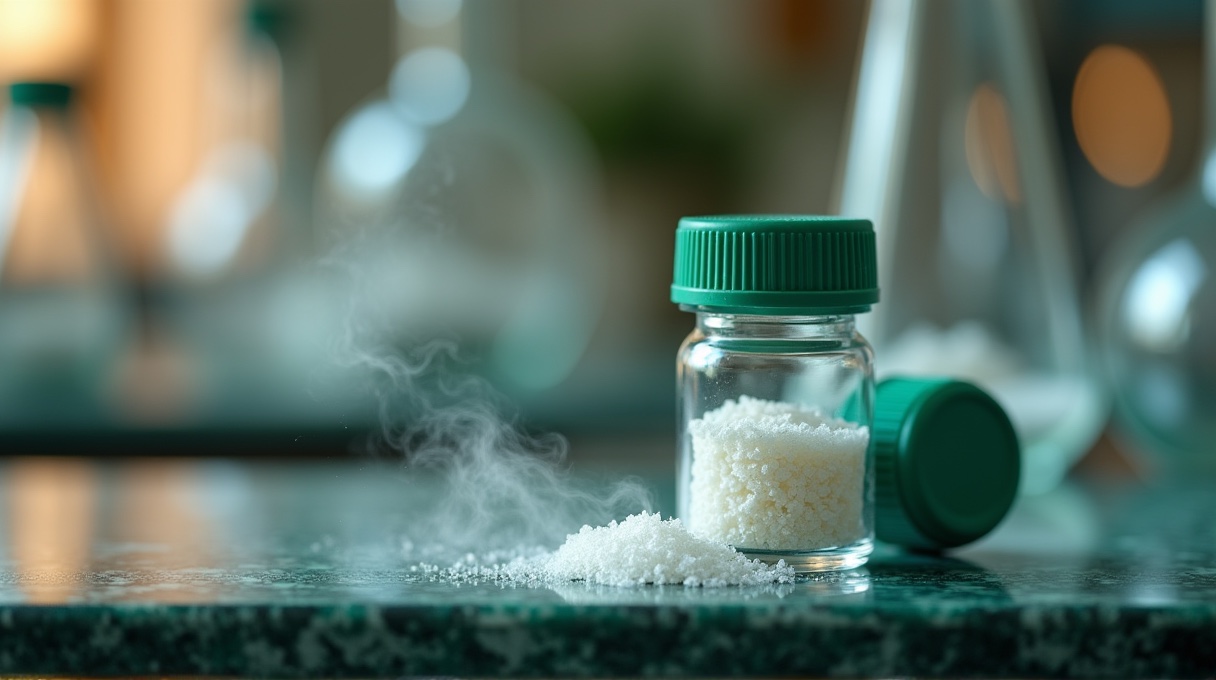
Open a shipment of research peptides and each vial holds a small white disc, a fine dusting on the glass, or sometimes nothing the eye can easily find. That material is lyophilized peptide: dissolved, frozen, and dried under vacuum until almost no water remains. Lyophilization is the reason a synthetic peptide can sit sealed for years rather than degrading over weeks. This article covers how the process works, why the cake looks the way it does, and what it tells a lab before the stopper is punctured.
Why peptides do not ship in solution
Water is not a neutral bystander. It is a reactant. In solution a peptide is exposed to hydrolysis of the backbone, deamidation of asparagine and glutamine, oxidation of methionine and cysteine, and aggregation as chains find each other. Add the temperature swings of a shipping lane and the freeze-thaw cycles that come with them, and a liquid vial has several degradation routes running at once. Remove the water and nearly all of that chemistry slows to a crawl, because the molecules can no longer move.
The same logic applies to microbial risk. A dry solid does not support growth, which is why the diluent, our 30 mL bacteriostatic reconstitution solution, is supplied separately and added at the bench.
Stage one: freezing
The peptide is dissolved in water, filtered, and filled into vials. The vials go onto cooled shelves and the solution is frozen. As ice forms, the peptide and any excipient are excluded from the growing crystals and concentrate into the shrinking liquid between them. That concentrated phase eventually solidifies, either as a eutectic mixture or as an amorphous glass.
Cooling rate matters more than it sounds. Slow cooling grows large ice crystals, which leave large pores after drying. Large pores dry faster and reconstitute faster. Fast cooling grows small crystals, giving a finer, denser cake that resists collapse but dries more slowly. The ice structure set in this stage determines almost everything about the finished cake.
Stage two: primary drying by sublimation
The chamber pressure is dropped well below the vapor pressure of ice and the shelves are warmed slightly. Under those conditions ice converts directly to vapor without passing through a liquid phase. The vapor travels to a condenser held far colder than the product and freezes there. This is sublimation, and it removes the great majority of the water in the vial, typically more than ninety percent of it.
Primary drying is the long step, often running many hours or several days. The governing constraint is product temperature. Every formulation has a collapse temperature, the point at which the freeze-concentrated solid softens enough to lose its structure. Stay below it and the cake keeps the shape of the ice that was there. Cross it and the structure slumps.
Stage three: secondary drying
When the ice is gone, water still remains, bound to the solid and never frozen in the first place. Secondary drying raises the shelf temperature further and pulls that residual water off by desorption. The target is usually a residual moisture of roughly one to three percent by weight, measured afterward by Karl Fischer titration or loss on drying.
Why the cake looks the way it does
The cake is a porous replica of the ice that was removed. Its appearance depends mostly on how much solid was in the vial to begin with.
| What you see | Usual explanation | Action |
|---|---|---|
| Firm white puck filling the vial base | A bulking excipient such as mannitol was included, or the fill mass is high | Normal |
| Thin translucent film or faint ring on the glass | Low fill mass with no bulking agent, common at 2 to 5 mg | Normal |
| Loose powder dispersed on the vial wall | Vibration in transit moved a light cake | Normal, tap down before reconstituting |
| Shrunken glassy puck pulled away from the wall | Collapse during primary drying | Note the lot, check the certificate |
| Yellow or brown tint | Oxidation or a reaction with a reducing sugar excipient | Stop and query the lot |
A near-invisible cake is the single most common concern we hear, and it is almost always a low-mass fill behaving exactly as expected. A 5 mg vial of BPC-157 contains five thousandths of a gram of solid spread across the bottom of a glass vial. There is not much to see.
Residual moisture and why it is on the specification
Water left in the cake is mobility, and mobility is reaction rate. Degradation climbs as residual moisture rises above a few percent, because water acts as both reactant and plasticizer, lowering the glass transition temperature of the amorphous solid. A dry cake stored cool sits far below that transition and effectively stops changing.
Stoppering under vacuum or nitrogen
At the end of the cycle the vials are still open, with slotted lyophilization stoppers resting part way in the neck so vapor can escape. Before the chamber is opened, one of two things happens. Either the chamber is backfilled with dry nitrogen to near atmospheric pressure, or it is left under partial vacuum. The shelves then press down and seat every stopper at once, sealing the headspace. A crimp cap is applied afterward.
Both approaches have a purpose. A nitrogen blanket displaces oxygen, which protects methionine and cysteine residues from slow oxidation during storage. A partial vacuum gives the familiar behavior where diluent draws itself into the vial once the needle is through the stopper. Either way, the headspace is deliberate, and a vial that neither hisses nor pulls is not automatically suspect.
Lyophilized versus solution, side by side
- Chemical stability. Dry solid is measured in years at the recommended storage temperature. Solution is measured in days to weeks.
- Transport tolerance. A dry cake survives ambient excursions that would degrade a liquid, which is why shipping a lyophilized peptide does not require the same handling as shipping a solution.
- Freeze-thaw. Irrelevant to a dry cake. A leading cause of loss in reconstituted stock.
- Flexibility. The lab chooses the diluent and the final concentration rather than inheriting them.
The trade-off is one extra step at the bench. The arithmetic for that step is worked through in our guide to reconstituting lyophilized peptides, and what happens to the vial afterward is covered in storage and stability.
What a collapsed or discolored cake actually means
Collapse is a process deviation, not automatically a chemistry failure. A collapsed cake usually holds more residual moisture than specification allows, has less surface area, and dissolves more slowly. The peptide inside may still be within purity specification. The correct response is to check the certificate for that lot.
Discoloration is a stronger signal. Peptides in the catalogue, from short chains to lipidated compounds such as retatrutide, should present as white to off-white. A yellow or brown cast points toward oxidation or a reaction between a reducing sugar excipient and free amine groups. One exception worth knowing: copper complexes are genuinely blue, and a blue tint in a GHK-Cu vial is the copper, not a defect. You can see the full range of formats across the research peptide catalogue.
Frequently asked questions
My vial looks empty. Was it short filled?
Almost certainly not. Low-mass fills leave a film rather than a visible cake. Reconstitute as normal and confirm the label mass against the certificate of analysis if there is any doubt.
Does a collapsed cake have to be discarded?
Not on appearance alone. Collapse raises residual moisture and slows dissolution. Check the lot certificate and note the observation in the reagent record.
Why does the diluent get sucked into some vials and not others?
Because some vials are stoppered under partial vacuum and others under a nitrogen backfill. Both are standard finishes for a lyophilized product.
References
- Carpenter JF, et al. 1997. Rational design of stable lyophilized protein formulations: some practical advice. Pharmaceutical Research.
- Tang X, Pikal MJ. 2004. Design of freeze-drying processes for pharmaceuticals: practical advice. Pharmaceutical Research.
- Wang W. 2000. Lyophilization and development of solid protein pharmaceuticals. International Journal of Pharmaceutics.
- Franks F. 1998. Freeze-drying of bioproducts: putting principles into practice. European Journal of Pharmaceutics and Biopharmaceutics.
Research use only. This article describes laboratory manufacturing and handling. Homegrown Peptides products are not for human or animal use, are not drugs, and are not intended to diagnose, treat, cure or prevent any disease. Nothing here is medical advice or a protocol.