A research peptide spends more of its early life in a truck than on a bench. That window is the one nobody in the lab controls, and it is where most questions about degradation start. The short answer is that the freeze-dried form is what makes ordinary shipping viable. The longer answer is worth knowing, because it tells a lab which shipments need extra care and which arrivals are worth rejecting.
Why the powder form does most of the work
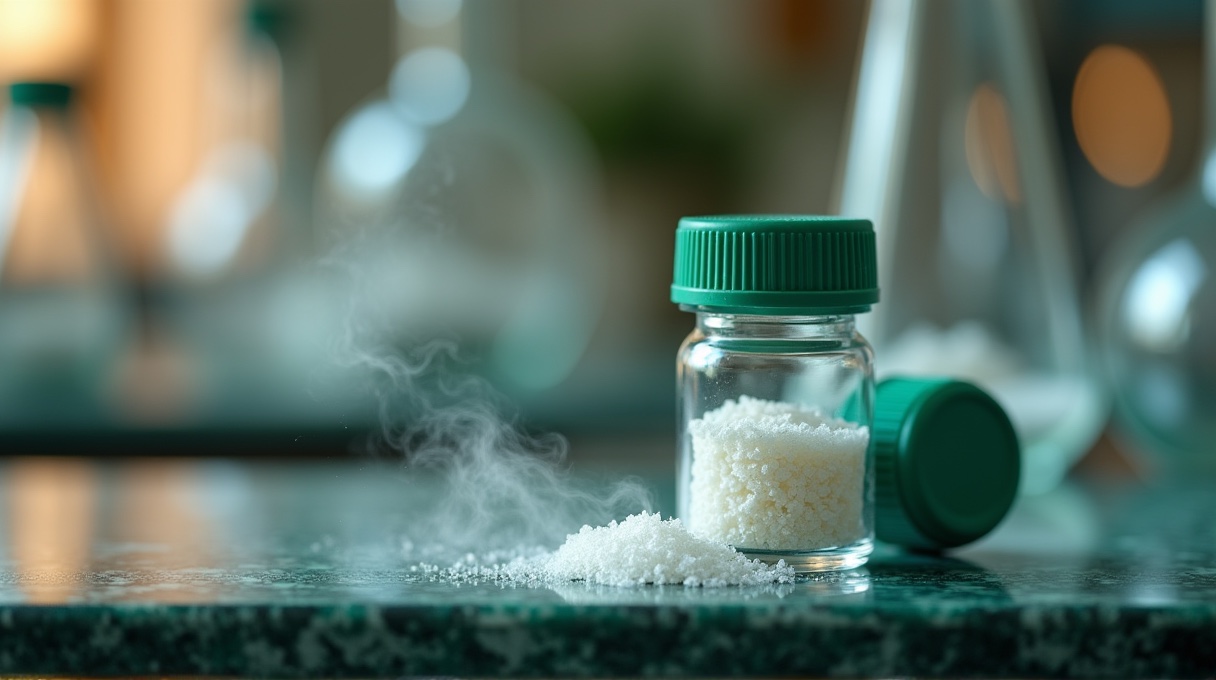
Lyophilization removes water by freezing the solution and then pulling the ice off as vapor under vacuum. What is left is an amorphous solid, usually called the cake, with only a few percent residual moisture. Nearly every route by which a peptide falls apart needs mobile water. Hydrolysis of the backbone, deamidation of asparagine and glutamine, and aggregation in solution all slow down by orders of magnitude when the water phase is gone and the molecules are locked in a glassy matrix. Our explainer on what lyophilization is covers the process itself.
The practical consequence is simple. A sealed vial of powder at warm ambient temperature is in a different situation from the same peptide dissolved at the same temperature. The first tolerates days. The second is measured in hours to weeks depending on the compound.
What the stability literature says about excursions
Published work on lyophilized protein and peptide formulations is consistent on three points. First, degradation in the solid state follows temperature the way most chemistry does, so the damage from an excursion scales with both how hot it got and how long it stayed there. A brief peak matters much less than a sustained one. Second, residual moisture is the dominant variable. A cake dried to low moisture is far more forgiving of heat than one that retained water during drying. Third, the cake behaves as a glass below its glass transition temperature, and mobility rises sharply above it. Well-formulated lyophilized peptides have glass transitions comfortably above the temperatures a parcel encounters, which is the physical reason ambient shipping is defensible at all.
None of that makes heat free. It means the realistic failure mode in transit is a small, cumulative loss of the main peak rather than a vial arriving useless.
The summer problem is the vehicle, not the weather
Outside air temperature is a poor proxy for what a parcel experiences. A closed trailer, a delivery van, a metal parcel locker or a porch in direct sun all run well above ambient, and they hold that heat for hours after the outside air cools. The peak a box sees in July is usually set by the last leg of the trip and by how long it sat after delivery. That is the part a lab can influence, by having someone receive the package rather than letting it wait.
What the packaging is meant to do
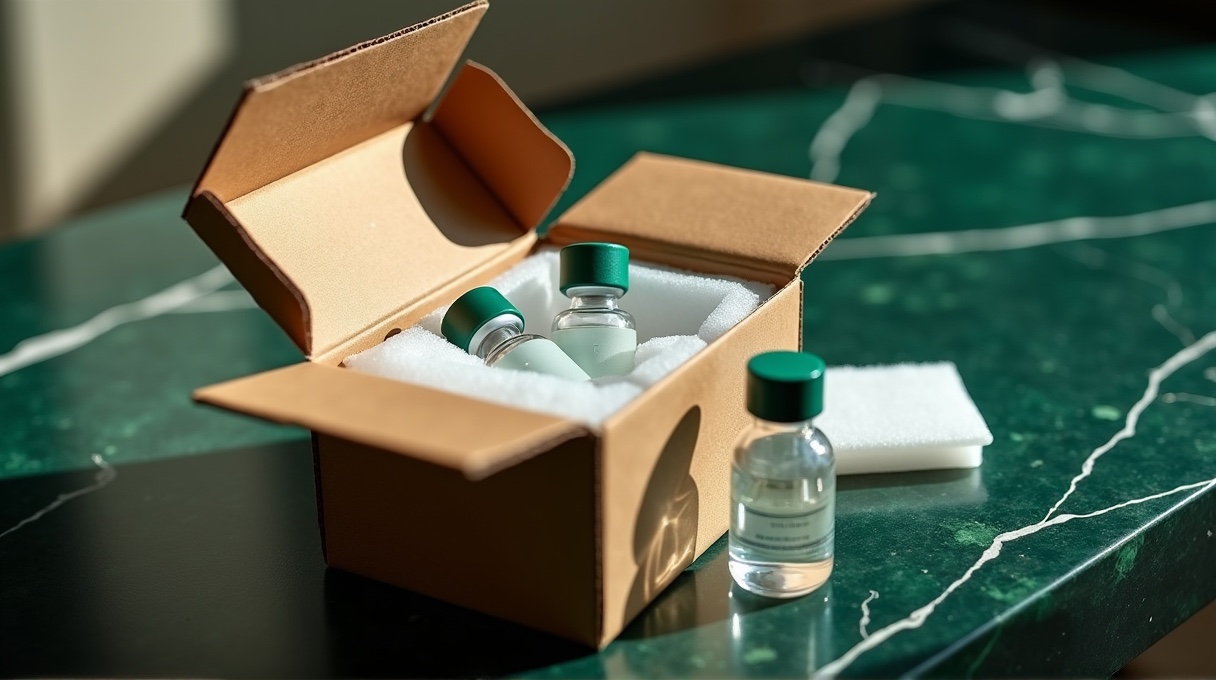
Insulated liners and gel packs are not there to refrigerate the contents. They buffer. The mass of a frozen or chilled pack absorbs heat for the first part of the trip and the foam slows the rate at which the rest arrives. The goal for a lyophilized peptide is to clip the peak, not to hold two to eight degrees the whole way. Trying to hold a hard refrigerated range on a multi-day ground shipment usually means a pack that thaws on day two and then does nothing, which is why validated cold chain for genuinely temperature-sensitive material uses phase-change materials and a data logger rather than a bag of ice.
One thing worth avoiding is direct contact between a hard frozen pack and a glass vial. Thermal shock cracks glass, and a hairline crack in a stopper seal is worse than a warm parcel.
What to check when the box opens
- The cake. It should be a white to off-white solid disc or a light puck at the bottom of the vial. A cake that has slumped into a glassy film, browned, or collapsed to a fraction of its original volume is a reason to stop and photograph the vial.
- Loose powder. Some cakes break into fragments in transit. Fragmentation alone is cosmetic. Melting is not.
- The stopper and seal. The crimp should be tight and the stopper flush. A lifted or tilted stopper means the vacuum seal is suspect and moisture has probably entered.
- Moisture. Condensation inside the vial, or a cake that looks wet or sticky at the edges, points to a breached seal.
- Glass. Check the neck and base for cracks, especially where a vial sat against a gel pack.
- The label. Confirm the compound, the nominal mass and the lot number, then match that lot to the certificate before anything goes in the notebook. Our guide to reading a certificate of analysis covers the match.
When refrigerated shipping actually matters
| What is shipping | Ambient is fine | Why |
|---|---|---|
| Short lyophilized peptides such as BPC-157 | Yes | Glassy solid, low moisture, no mobile water phase |
| Lipidated incretin peptides such as semaglutide and retatrutide | Yes | Same solid-state argument; the fatty acid chain does not change it |
| Co-lyophilized blends | Yes | Both components are in the same dried matrix |
| Anything already in solution | No | Solution-phase degradation is the fast pathway; this is real cold chain |
| Diluents and consumables | Yes | Room temperature storage is the labeled condition |
The pattern is that cold chain follows the water. Powder ships. Liquid needs a validated chain and a logger. The full storage picture once a vial is in the building is in our storage and stability guide, and the whole GLP-1 research collection ships as lyophilized powder for this reason.
Logging receipt properly
Receiving is a record, not an errand. Five fields close the loop and take a minute. The date and time the parcel was received. The condition of the outer carton and whether the gel pack was still cold. The compound, nominal mass and lot number from each vial. The condition of the cake. And where the vial went, which shelf or freezer, at what temperature. If a result later looks odd, that entry is the only evidence that separates a transit problem from a bench problem. Anything that arrived questionable should be quarantined and photographed before it is opened, because a photograph of an intact seal is far more useful than a memory of one.
Frequently asked questions
The gel pack arrived fully thawed. Is the vial ruined?
Almost certainly not. A thawed pack means the buffer was consumed, which is the expected end state on a multi-day ground shipment. The evidence that matters is the cake and the seal, not the pack.
Should a shipment be refrigerated immediately on arrival?
Most lyophilized peptides are stable at room temperature for extended periods, and refrigeration or freezing is the long-term condition rather than an emergency measure. Move the vials to their labeled storage condition the same day and allow them to reach room temperature again before the stopper is punctured, so condensation does not form on cold powder.
Does a hot shipment show up on a certificate of analysis?
No. A certificate describes the lot at the test date, before shipping. It is a baseline, not a record of what happened in transit, which is why arrival inspection is a separate check.
References
- Carpenter JF, et al. 1997. Rational design of stable lyophilized protein formulations: some practical advice. Pharmaceutical Research.
- Wang W. 2000. Lyophilization and development of solid protein pharmaceuticals. International Journal of Pharmaceutics.
- Manning MC, et al. 2010. Stability of protein pharmaceuticals: an update. Pharmaceutical Research.
- Pikal MJ. 1990. Freeze-drying of proteins: process, formulation and stability. BioPharm.
- United States Pharmacopeia. General Chapter <1079> Good Storage and Distribution Practices for Drug Products.
Research use only. This article describes laboratory handling of research reagents. Homegrown Peptides products are not for human or animal use, are not drugs, and are not intended to diagnose, treat, cure or prevent any disease. Nothing here is medical advice.