The same peptide sequence can be supplied in more than one physical format, and the format is not a packaging decision. It changes the formulation chemistry, the stability profile, the analytical work needed to characterise it, and the class of research question the preparation can support. This article describes three formats as laboratory preparations: the lyophilised vial, the nasal spray solution, and the dissolving film. It covers what the published transport literature says about mucosal routes, and where each format is fragile.
The lyophilised vial as the reference format
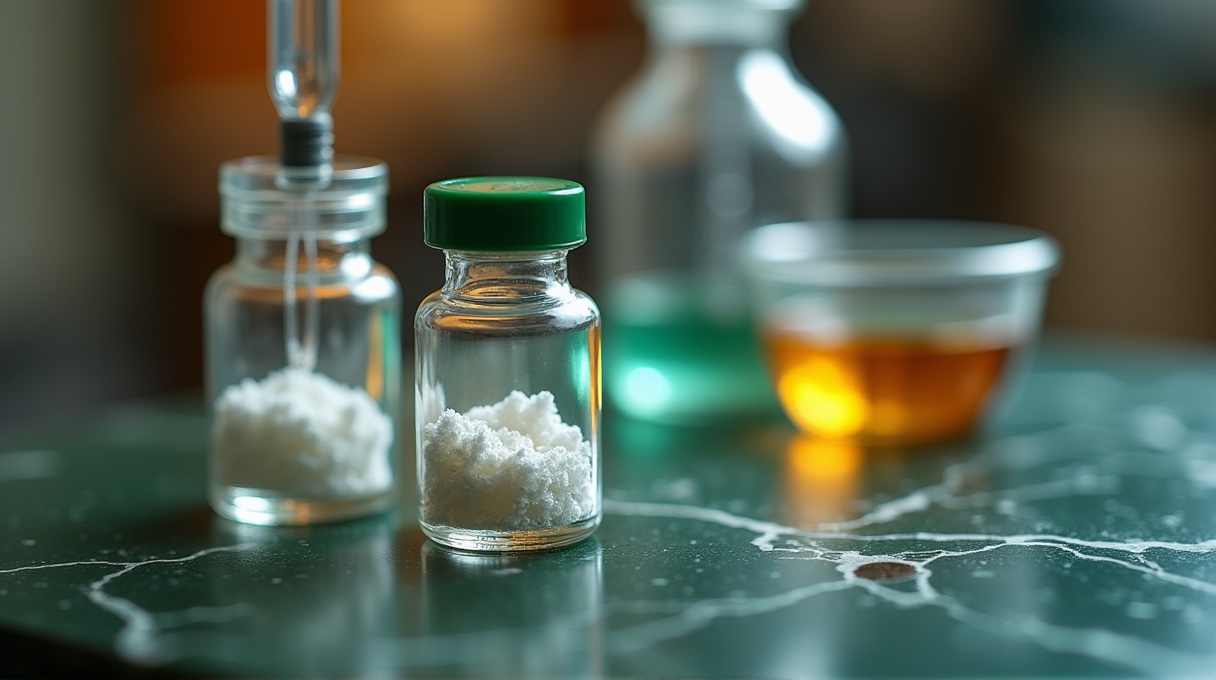
Freeze-dried powder in a sealed vial is the default for good reason. Removing water suppresses hydrolysis, deamidation and most aggregation pathways, which is why a sealed vial holds for months to years under refrigeration while a solution holds for days to weeks. The format is also analytically clean. There is no excipient matrix to interfere with chromatography, the mass on the label is the mass in the vial, and the researcher chooses the diluent, the concentration and the buffer.
That flexibility is the real argument for it. A vial can become a cell-culture stock, an analytical standard, or the starting material for another preparation. The cost is a reconstitution step with its own arithmetic and its own contamination risk, covered in reconstituting lyophilized peptides, and a shorter clock once the stopper is punctured, covered in storage and stability.
Nasal spray preparations
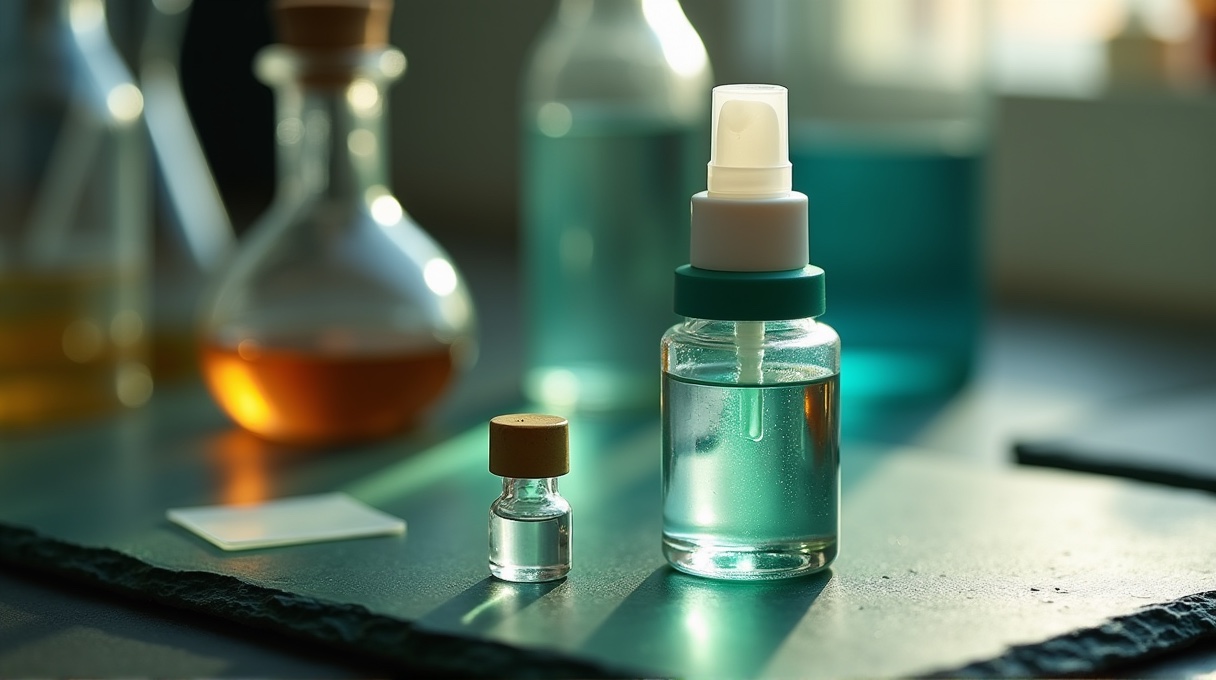
A nasal spray preparation is a peptide in an aqueous vehicle, filled into a metered pump that produces a defined spray volume and droplet distribution. The format exists in research because the nasal cavity has been studied for decades as a transport route for molecules that survive poorly in the gastrointestinal tract.
The relevant science is specific. The respiratory epithelium is thin, densely vascularised, and drains directly to systemic circulation without a first pass through the liver. The olfactory region at the roof of the cavity is more interesting still: work by Thorne and colleagues in rodent models traced labelled peptide along olfactory and trigeminal nerve pathways into central nervous tissue, and a body of literature reviewed by Illum has examined how far that route extends and what limits it. The limits are real. The absorptive area is small, mucociliary clearance moves material toward the throat within minutes, and enzymes in the mucosa degrade peptides on contact. Larger peptides cross poorly without a permeation enhancer, and those enhancers carry their own toxicity questions.
Formulation therefore does more work here than in any other format. Tonicity and pH must sit in a range that does not damage the epithelium in the model. Viscosity modifiers extend residence time against clearance. A preservative is usually required because a pump is repeatedly actuated. Droplet size governs where in the cavity the spray deposits, and a finer aerosol tends to reach the lung rather than the target region, which is the wrong answer for a nasal study. A combination preparation such as Selank and Semax nasal spray adds a further constraint, since two sequences must remain stable in a single vehicle at a single pH. For labs preparing their own spray solutions, nasal reconstitution solution is formulated for the purpose rather than being general-purpose bacteriostatic water, and the distinction between diluents is set out in bacteriostatic water versus sterile water.
Dissolving strips
A dissolving strip is a thin polymer film, typically hydroxypropyl methylcellulose or pullulan, loaded with the active compound and cast to a defined thickness. Placed against a wet mucosal surface it hydrates and disintegrates, releasing its payload into the oral mucosa. The transmucosal literature on this route is well developed, and the attraction is the same as for the nasal route: the buccal and sublingual epithelium is vascularised and drains without hepatic first pass.
The constraints are different. Film loading capacity is limited, so a strip suits low-mass payloads rather than milligram quantities. Content uniformity across a cast sheet is the central manufacturing challenge and the thing to ask a supplier about. The polymer matrix is hygroscopic, so individual moisture-barrier packaging is not optional. Against that, a film is dry, which makes it more stable than an aqueous spray, and it needs no reconstitution, no diluent and no measuring. A preparation such as NAD dissolving strips carries a cofactor rather than a peptide, which sidesteps the peptidase problem in the mucosa entirely and is part of why that molecule appears in this format.
Comparing the three
| Attribute | Lyophilized vial | Nasal spray | Dissolving strip |
|---|---|---|---|
| Physical state | Dry powder, sealed | Aqueous solution in a pump | Dry polymer film |
| Preparation before use | Reconstitution required | Ready as supplied | Ready as supplied |
| Stability driver | Moisture ingress after opening | Hydrolysis, oxidation, microbial growth | Ambient humidity, film integrity |
| Typical storage | Refrigerated or frozen, sealed | Refrigerated, protected from light | Cool, dry, sealed pouch |
| Payload range | Milligram scale, flexible | Constrained by volume and solubility | Low, constrained by film loading |
| Formulation complexity | Minimal, researcher controlled | High: pH, tonicity, viscosity, preservative | High: polymer, plasticiser, uniformity |
| Suits questions about | Concentration response, analytics, cell work | Mucosal transport and clearance | Transmucosal release from a solid matrix |
Choosing a format for a study
Match the format to the question rather than to convenience.
- Characterising the molecule itself, building a concentration series, or running an analytical comparison: the lyophilised vial, because nothing else lets you set the concentration.
- Studying nasal mucosal transport, clearance kinetics or the effect of a viscosity modifier: a spray preparation, because the pump and the vehicle are part of what is being studied.
- Studying release from a solid matrix or the behaviour of a dry transmucosal format: a film.
- Comparing formats head to head: hold the lot constant. Two formats made from different lots confound the format comparison with a material comparison.
The full range of spray preparations is in the sprays collection, and the same certificate and lot-traceability questions apply to every format.
The two heptapeptides that appear most often in the nasal-spray research format, Selank and Semax, are compared structure by structure in Selank vs Semax.
Frequently asked questions
Is a spray preparation less stable than a vial?
Generally yes. It is an aqueous solution, so hydrolysis and oxidation proceed, and the container is opened repeatedly. Lyophilised powder in a sealed vial is the most stable of the three formats by a wide margin.
Why are some compounds offered as strips and others not?
Loading capacity and mucosal stability. Films hold small payloads, and peptides exposed to mucosal peptidases degrade quickly, so the format favours small, robust molecules. Cofactors and short sequences fit it better than large peptides do.
Can a lyophilised vial be made into a spray preparation in the lab?
The powder can be reconstituted in a vehicle formulated for nasal preparations rather than in plain bacteriostatic water. Doing it properly means controlling pH, tonicity and microbial stability, and characterising the resulting solution, which is a formulation exercise rather than a reconstitution step.
References
- Illum L, 2000, European Journal of Pharmaceutical Sciences. Transport of drugs from the nasal cavity to the central nervous system.
- Illum L, 2003, Journal of Controlled Release. Nasal drug delivery: possibilities, problems and solutions.
- Thorne RG, Pronk GJ, Padmanabhan V, Frey WH, 2004, Neuroscience. Delivery of insulin-like growth factor-I to the rat brain and spinal cord along olfactory and trigeminal pathways.
- Born J, Lange T, Kern W, McGregor GP, Bickel U, Fehm HL, 2002, Nature Neuroscience. Sniffing neuropeptides: a transnasal approach to the human brain.
- Lam JKW, Xu Y, Worsley A, Wong ICK, 2014, Advanced Drug Delivery Reviews. Oral transmucosal drug delivery for pediatric use.
Research use only. The formats described here are laboratory preparations studied in published research. Homegrown Peptides products are not for human or animal use, are not drugs, and are not intended to diagnose, treat, cure or prevent any disease. Nothing here is medical advice or a protocol.