The published GHK-Cu literature splits into three real categories, and "serum" is not one of them. Studies either applied GHK-Cu topically to skin or a wound surface (creams, gels, dressing-impregnated formulations, including cosmetic liquid serums), added it directly to a cell or tissue culture medium in vitro, or worked with it in its original, naturally occurring context: human blood serum, where the tripeptide circulates and declines with age. A cosmetic "serum" is a topical formulation category, not a separate validated delivery route with its own clinical dataset. For the compound's general chemistry and mechanism, see what-is-ghk-cu.
Confusingly, the search term covers two unrelated meanings of the same word. Blood serum is where GHK-Cu was first isolated. Cosmetic serum is a thin, water-based leave-on product, a formulation choice within the topical route, not a different delivery mechanism. The sections below separate what was actually tested, in which model, by which route, with its own citation.
| Key fact | Value reported | Source |
|---|---|---|
| Where GHK was first identified | Isolated from human plasma (blood serum), as a fraction that altered liver cell behavior in culture | Pickart and Thaler, 1973 |
| Approximate molecular weight, free GHK tripeptide | 340.4 g/mol | Standard peptide chemistry reference values for Gly-His-Lys |
| Approximate molecular weight, GHK-Cu(II) complex | 403.9 g/mol | Standard peptide-copper complex reference values |
| Routes with published controlled studies | Topical (cream, gel, dressing, cosmetic serum) and in vitro cell or organ culture exposure | Study table below |
| Routes without a located controlled GHK-Cu trial | No dedicated subcutaneous or intravenous injection trial of GHK-Cu itself was located in the peer-reviewed literature reviewed for this article | Literature search for this article |
| Animal models used for topical wound work | Rat (full-thickness wounds) and pig (ischemic open wounds) | Canapp et al., 2003; related rodent wound literature |
Is GHK-Cu ever injected in published research?
Not in a dedicated, controlled GHK-Cu trial located for this article. The compound's foundational pharmacology, including its role in cellular copper transport, was established using cultured cells with GHK or GHK-Cu added directly to the growth medium, which is an in vitro exposure route, not an injection into a living animal or person. The wound-repair literature that follows from that early work is topical: the tripeptide-copper complex is applied to the wound surface itself, in a cream, gel or dressing-impregnated vehicle, not injected beneath it. Readers searching for injection data specifically should read that as an open question in the literature rather than an established route with its own trial record.
What does "GHK-Cu serum" actually mean in a published study?
Two different things, and only one of them is a delivery route. Blood serum is where Pickart and Thaler first identified the tripeptide fraction in 1973, as part of normal human plasma; its concentration there has since been reported to fall with age, which is the original biological observation behind interest in GHK-Cu. Cosmetic serum is a product format: a thin, typically water- or glycerin-based topical liquid, as opposed to a thicker cream or an occlusive ointment. Every human skin study located for this article that used a serum-style vehicle still delivered GHK-Cu by the topical route, through the skin surface, not by any mechanism unique to the word "serum." The formulation changes absorption kinetics somewhat (a thin aqueous vehicle spreads and may penetrate the stratum corneum differently than a heavier cream), but it is a topical-route variant, not a fourth delivery category.
What do the topical wound studies actually show?
The clearest controlled topical data come from animal wound models. Canapp et al. (2003) applied a topical tripeptide-copper complex directly to ischemic open wounds in a pig model and tracked wound closure parameters against a control group over the course of the study. Related rodent full-thickness wound work from the same research lineage applied the complex topically to the wound bed and measured new collagen deposition relative to untreated or vehicle-treated wounds. In both cases, the test article sits on the wound surface in a gel or cream base; nothing in these studies describes injecting the compound into or beneath the wound margin.
What do the human topical studies measure?
Human data are smaller in number and narrower in scope than the animal wound literature. The most frequently cited controlled human trial, Abdulghani et al., compared a topical copper-binding peptide cream against other topical actives on photodamaged facial skin, using clinical grading and skin biopsy as endpoints over a period of topical application. This is cosmetic dermatology, not a systemic or injectable pharmacology trial, and the endpoints (surface roughness, fine lines, biopsy-measured collagen) are specific to skin applied directly with the test cream.
What do the cell-culture and gene-expression studies use instead of a body route?
A separate and mechanistically important branch of the literature does not use a route at all in the clinical sense: GHK or GHK-Cu is added directly to a culture dish. Maquart et al. (1988) added the copper complex to fibroblast cultures and measured stimulated collagen synthesis. A related study measured increased matrix metalloproteinase-2 expression under the same kind of direct culture exposure. The gene-expression work builds on this approach at scale: Lamb et al. (2006) profiled GHK's effect on genome-wide expression across cultured human cell lines as part of the Broad Institute's Connectivity Map, adding the compound to culture medium across a concentration range and recording the resulting expression signature. None of this is "injection" or "topical" in the skin-application sense; it is direct cellular exposure in a dish, which is how the mechanism was characterized before any animal or human skin study was run. For the full gene-expression and collagen picture, see ghk-cu-copper-binding-and-collagen-research.
Route comparison
| Route | What the literature actually used | Typical vehicle | Typical endpoint | Human controlled data |
|---|---|---|---|---|
| Topical, skin | Cream, gel or cosmetic liquid serum applied to intact or photodamaged skin | Water-, glycerin- or oil-based topical base | Clinical grading, biopsy collagen, surface imaging | Yes, small controlled trials located |
| Topical, wound surface | Cream or gel applied directly to an open wound bed | Topical wound-care base, sometimes a dressing-impregnated form | Wound closure rate, histology, collagen deposition | No; data located are animal (rat, pig) |
| In vitro cell or tissue culture | GHK or GHK-Cu added directly to the culture medium | Aqueous culture medium, defined concentration | Collagen synthesis, MMP expression, gene-expression signature | Not applicable; cultured human cells, not living subjects |
| Subcutaneous or intravenous injection | No dedicated controlled GHK-Cu trial located | Not established in the literature reviewed | Not established | No |
| Blood serum (biological, not cosmetic) | Measured as a naturally circulating plasma fraction, not administered | Not applicable; this is the body's own fluid, not a delivery vehicle | Plasma concentration | Yes, as an observational measurement, not an experimental arm |
Study table
| Study | Model and n | Amount and route, as reported | Endpoint | Finding |
|---|---|---|---|---|
| Pickart and Thaler, 1973 (PubMed 4706941) | Human plasma fraction tested on cultured normal and neoplastic rat liver cells | Tripeptide fraction isolated from plasma, added directly to culture medium at defined concentrations, in vitro | Cell survival and growth in culture | Fraction prolonged survival of normal liver cells and stimulated growth of neoplastic liver cells in culture |
| Pickart et al., 1980 (PubMed 6893633) | Cultured cell systems used to test copper transport | Tripeptide added to culture medium at defined concentrations alongside labeled copper, in vitro | Cellular copper uptake | Tripeptide facilitated copper uptake into cells relative to copper alone |
| Maquart et al., 1988 (PubMed 2460283) | Human skin fibroblast cultures | GHK-Cu complex added to culture medium at micromolar concentrations, in vitro | Collagen synthesis (labeled proline incorporation) | Stimulated collagen synthesis versus untreated culture |
| Simeon et al., 2000 (PubMed 11057670) | Human skin fibroblast cultures | GHK-Cu complex added to culture medium, in vitro | Matrix metalloproteinase-2 expression | Increased MMP-2 expression, consistent with extracellular matrix remodeling |
| Canapp et al., 2003 (PubMed 14669421) | Pig model, ischemic open wounds | Topical tripeptide-copper complex applied to the wound surface, repeated application across the study period | Wound closure rate, histology | Favorable wound closure parameters versus control wounds |
| Abdulghani et al. | Human adults with photodamaged facial skin, placebo- and comparator-controlled | Topical copper-binding peptide cream applied to facial skin across a period of weeks | Clinical skin grading, biopsy collagen | Measurable improvement in photodamage parameters versus comparator and placebo arms |
| Pyo et al., 2007 (PubMed 17703054) | Human scalp hair follicles, organ culture (ex vivo) | GHK-Cu added directly to follicle culture medium at defined concentrations | Hair shaft elongation in culture | Increased follicle elongation versus control medium |
| Lamb et al., 2006 (PubMed 17008526) | Multiple cultured human cell lines | GHK added to culture medium across a concentration range, in vitro, for gene-expression profiling | Genome-wide expression signature | GHK produced a distinct expression signature entered into the Connectivity Map reference library |
How this is handled in a research setting
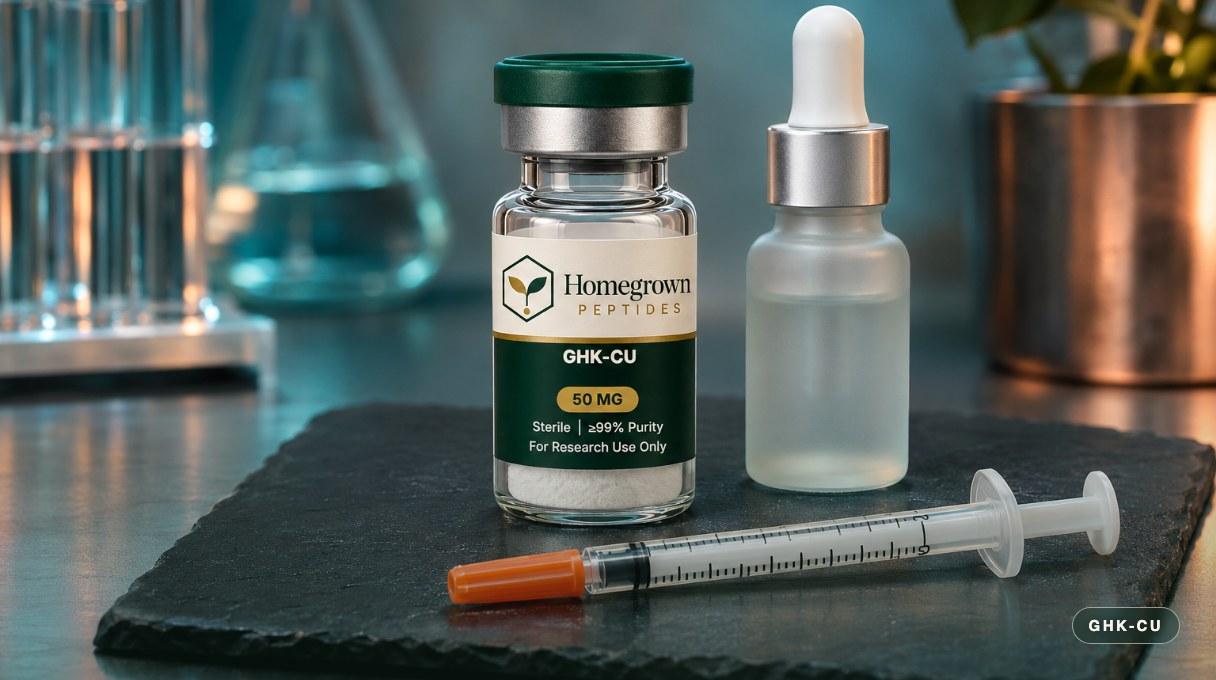
GHK-Cu, including the copper-binding-peptide-ghk-cu vial and the blended glow-mix format, ships as lyophilized powder and is reconstituted before any bench or culture work; the concentration math is covered in reconstituting-lyophilized-peptides. Because the copper ion is part of the active complex, solution color and clarity are a useful bench check in addition to the paperwork; what the certificate of analysis should state about identity and purity is explained in how-to-read-a-peptide-coa. Reconstituted solution is kept cold and used within the stability window the certificate specifies, consistent with the topical, wound-surface and culture-exposure methods described in the studies above.
Why does route matter for interpreting GHK-Cu claims?
Because a finding generated by adding the compound to a culture dish is not evidence about what happens when a cream is applied to intact human skin, and neither is evidence about an injected route that has not been tested. The gene-expression work describes what GHK does to cultured cells at a defined concentration in a dish; it does not describe skin penetration or blood levels. Keeping the three categories, topical, culture and the as-yet-untested injectable route, separate is the only way to read the GHK-Cu literature accurately.
Frequently asked questions
Has anyone injected GHK-Cu in a published animal or human trial?
No dedicated, controlled GHK-Cu injection trial was located in the peer-reviewed literature reviewed for this article. The compound's systemic or parenteral pharmacology, as distinct from its topical and in vitro culture data, is not established the way its topical wound and skin literature is.
Is a cosmetic GHK-Cu serum pharmacologically different from a GHK-Cu cream?
Not in route. Both are topical formulations applied to the skin surface. They differ in vehicle (a thin, often water-based liquid versus a thicker emulsion), which can change spreadability and how the product layers with other topicals, but no controlled study located for this article compared a serum vehicle against a cream vehicle for GHK-Cu head to head.
Why do GHK-Cu levels in blood serum come up in this literature at all?
Because that is where the compound was discovered. Pickart and Thaler's 1973 work started from human plasma, not from a topical or cell-culture experiment, and reported that the naturally circulating tripeptide fraction had identifiable effects on liver cells in culture. Later interest in topical and wound applications grew out of that original plasma observation, not the other way around.
Do the wound-repair animal studies use the same formulation as cosmetic skin creams?
Not necessarily. The pig and rat wound studies used topical vehicles suited to an open wound bed, which can differ from a cosmetic facial cream in base and consistency. Both are topical-route studies, but they are not interchangeable formulations.
What does the Connectivity Map gene-expression finding actually depend on?
It depends on direct exposure of cultured human cells to GHK at a known concentration in the medium, profiled for genome-wide expression changes. It says nothing by itself about what amount reaches a cell after topical application through skin, since the culture exposure bypasses the stratum corneum entirely.
Is there any published data on GHK-Cu absorption through intact human skin?
Human topical trials such as Abdulghani et al. measured clinical and biopsy endpoints after a period of topical use, which demonstrates an effect associated with topical application, but a dedicated skin-penetration or bioavailability study quantifying how much of the applied compound crosses into deeper skin layers was not confidently located for this article; the general penetration rules for peptides by route are covered in peptide-bioavailability-by-route-in-research.
Why is GHK-Cu often studied alongside BPC-157 and TB-500 in a blended vial?
Because the three peptides are examined in overlapping tissue-repair and wound models in the literature, even though each has its own distinct mechanism; the rationale for the combination is covered in glow-blend-ghk-cu-bpc-157-tb-500-research.
References
- Pickart L, Thaler MM. Tripeptide in human serum which prolongs survival of normal liver cells and stimulates growth in neoplastic liver. Nature. 1973;243(5405):85-87. PubMed 4706941.
- Pickart L, Freedman JH, Loker WJ, Peisach J, Perkins CM, Stenkamp RE, Weinstein B. Growth-modulating plasma tripeptide may function by facilitating copper uptake into cells. Nature. 1980;288(5792):715-717. PubMed 6893633.
- Maquart FX, Pickart L, Laurent M, Gillery P, Monboisse JC, Borel JP. Stimulation of collagen synthesis in fibroblast cultures by the tripeptide-copper complex glycyl-L-histidyl-L-lysine-Cu2+. FEBS Lett. 1988;238(2):343-346. PubMed 2460283.
- Simeon A, Emonard H, Hornebeck W, Maquart FX. The tripeptide-copper complex glycyl-L-histidyl-L-lysine-Cu2+ stimulates matrix metalloproteinase-2 expression by fibroblast cultures. Life Sci. 2000;67(18):2257-2265. PubMed 11057670.
- Canapp SO Jr, Farese JP, Schultz GS, Gowda S, Ishak AM, Swaim SF, Vangilder J, Lee-Ambrose L, Martin FG. The effect of topical tripeptide-copper complex on healing of ischemic open wounds. Vet Surg. 2003;32(6):515-523. PubMed 14669421.
- Abdulghani AA, Sherr A, Shirin S, et al. Effects of topical creams containing vitamin C, a copper-binding peptide cream, and alpha-tocopherol on cutaneous photodamage: a placebo-controlled, double-blind study. Dis Mon. 1998;44(1):1009-1013.
- Pyo HK, Yoo HG, Won CH, Lee SH, Kang YJ, Eun HC, Cho KH, Kim KH. The effect of tripeptide-copper complex on human hair growth in vitro. Arch Pharm Res. 2007;30(7):834-839. PubMed 17703054.
- Lamb J, Crawford ED, Peck D, et al. The Connectivity Map: using gene-expression signatures to connect small molecules, genes, and disease. Science. 2006;313(5795):1929-1935. PubMed 17008526.
Research use only. Homegrown Peptides products are for laboratory research and are not for human or animal use. Nothing in this article is medical advice.