GHK-Cu is the smallest compound in most peptide catalogues and one of the oldest in continuous study. It is three amino acids bound to a single copper ion, it was first described in the early 1970s, and it has accumulated more than fifty years of literature spanning biochemistry, dermatology and, more recently, transcriptomics. This article covers the chemistry, the discovery, what the published work reports, and the handling quirks that come with a metal complex.
The chemistry
GHK is glycyl-L-histidyl-L-lysine, three residues in that order. On its own it is a small, water-soluble tripeptide with a mass near 340 daltons. The interesting part is the histidine imidazole nitrogen and the adjacent backbone nitrogens, which together form a binding site with high affinity for copper in its divalent state. The resulting complex, written GHK-Cu, is what the literature almost always means when it discusses activity.
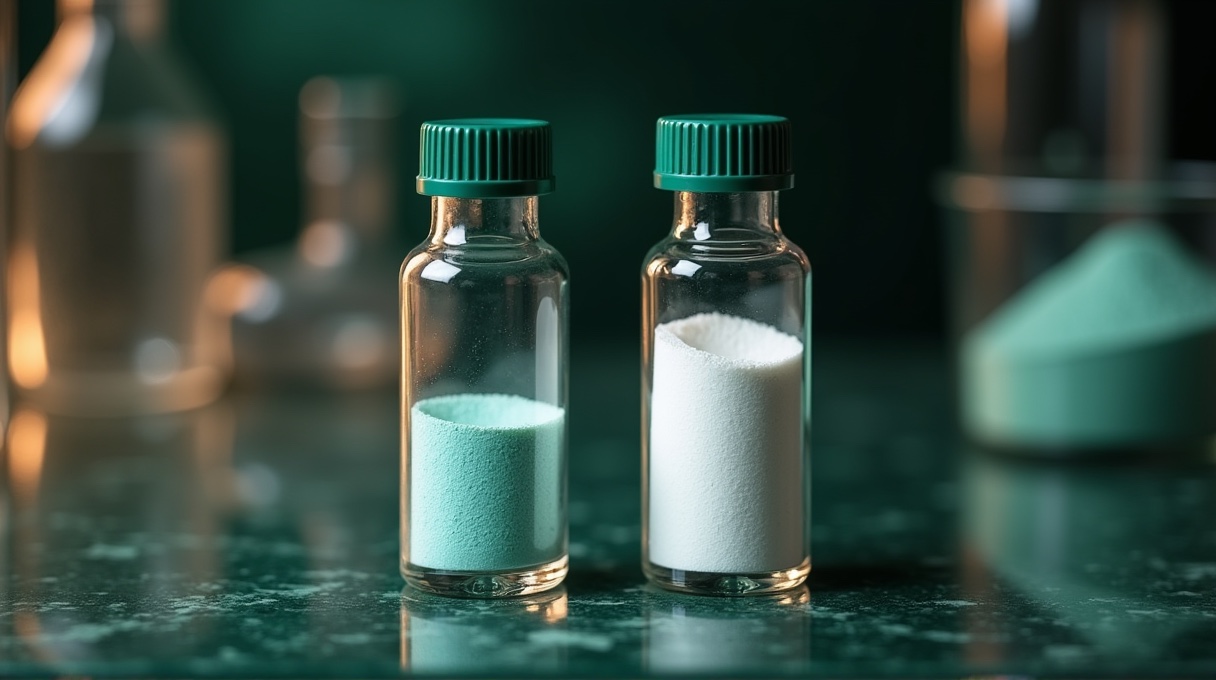
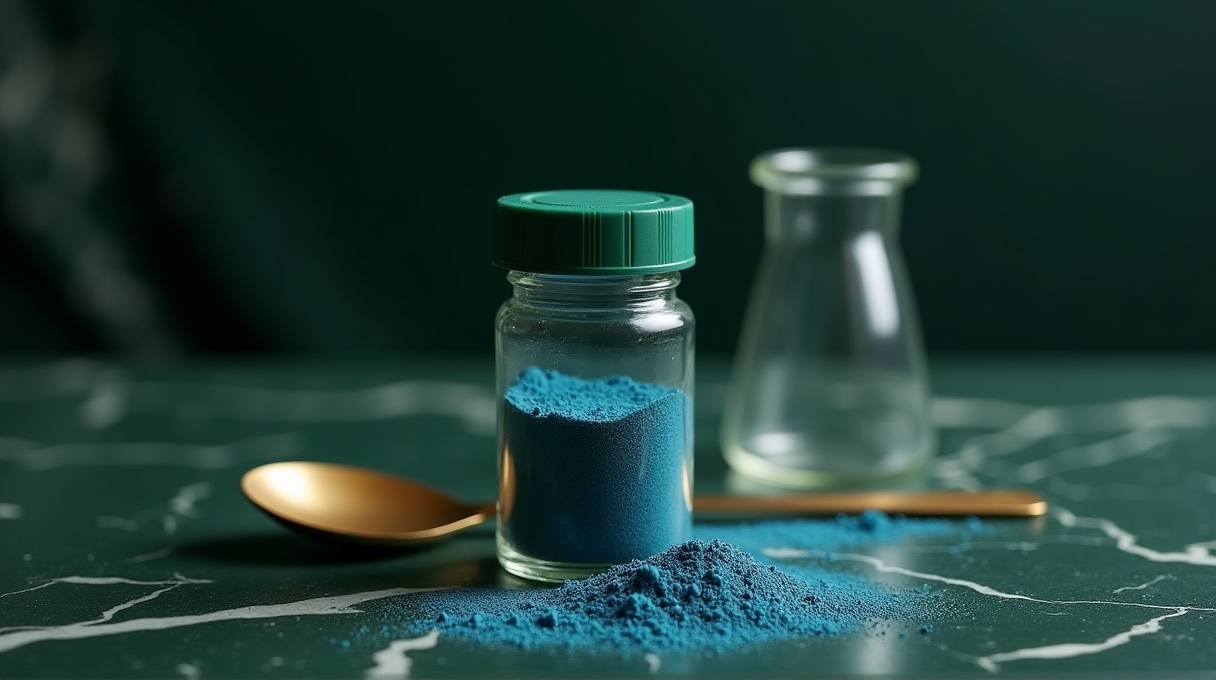
The bound copper is what gives the material its most recognisable property. GHK-Cu is blue. A correctly manufactured lot is a distinctly blue powder and produces a blue solution on reconstitution, which is a useful visual identity check that no other peptide in the catalogue offers. Pale, grey or white material labelled as the copper complex is a reason to stop and read the certificate.
Discovery and the plasma decline observation
The tripeptide was identified by Loren Pickart in the early 1970s while investigating a factor in human plasma that influenced the behaviour of cultured liver cells. The work was published in 1973 and the active fraction was resolved to the three-residue sequence. Pickart has remained the central figure in the field, and a large share of the review literature carries his name.
A frequently cited observation from that body of work is that the concentration of GHK in human plasma is reported to fall with age, with figures given for young adults compared with older adults. It is an association measured in plasma samples. It is not a demonstration that the decline causes anything, and papers that treat it as a mechanism are overreading the source.
Collagen and fibroblast work
The most reproduced result in the field is from fibroblast culture. Groups working in the 1980s and 1990s reported that exposure to the copper complex increased collagen synthesis in cultured fibroblasts, with effects also reported on glycosaminoglycan production and on the expression of matrix metalloproteinases and their tissue inhibitors. The pattern described is not simple stimulation of matrix production. It is described as a shift in the balance between matrix deposition and matrix breakdown, which is why the compound appears in remodelling discussions rather than only in synthesis discussions.
Copper itself is a cofactor for lysyl oxidase, the enzyme that cross-links collagen and elastin, and that connection is part of why a copper-carrying peptide attracted attention in connective tissue research in the first place.
The gene-expression datasets
The newer strand of work uses transcriptome profiling rather than single-endpoint assays. Analyses published from around 2010 onward report that exposure of cultured human cells to GHK is associated with changes in the expression of a large number of genes, with the published figures running into the low thousands when a modest fold-change threshold is applied. The reported pattern is described as broadly restorative, meaning a shift in expression away from profiles associated with aged or damaged tissue.
Two cautions apply when reading these papers. Large-scale expression changes in culture at a chosen concentration are a screening result, not a mechanism, and the reported gene counts depend heavily on the statistical threshold used. The datasets are a starting point for hypothesis generation.
What the literature covers, at a glance
| Area | Model type | Reported observation |
|---|---|---|
| Collagen synthesis | Cultured human fibroblasts | Increased collagen production relative to control |
| Matrix remodelling | Fibroblast culture | Changes in metalloproteinase and inhibitor expression |
| Wound models | Rodent dermal injury | Faster closure, increased vessel density reported |
| Gene expression | Human cell transcriptome profiling | Broad expression shifts at modest fold-change thresholds |
| Copper transport | Biochemistry, plasma studies | High-affinity binding and exchange of divalent copper |
Handling a metal complex
GHK-Cu behaves differently from an ordinary peptide on the bench, and most of the differences trace back to the copper.
- Colour is data. Blue powder, blue solution. Loss of colour suggests the complex has dissociated or the copper has changed state.
- pH matters more than usual. The stability of the copper complex is pH dependent, and strongly acidic conditions favour dissociation.
- Chelators and some buffers compete. Anything in a buffer that binds divalent metals can strip the copper. Check the buffer composition before reconstituting into anything other than water.
- Light and oxidation. Store protected from light, and expect a shorter usable window in solution than for an uncomplexed peptide. See our storage and stability guide.
- Analysis differs. Purity reporting for a metal complex is not identical to a plain peptide, and the certificate should state the method. Our COA guide covers what to look for.
Where it appears in the catalogue
The single compound sits in the peptides collection. It is also a component of two co-lyophilized vials, the three-component GLOW blend and the four-component KLOW blend, both of which state the milligram content of each component on the label. The difference between those two is set out in GLOW versus KLOW.
Frequently asked questions
Why is the powder blue?
The colour comes from the bound copper ion, not from the peptide. A blue powder and a blue solution are expected for the complex. Material that is white or colourless is either the uncomplexed tripeptide or something is wrong with the lot.
Is GHK the same product as GHK-Cu?
Not quite. GHK is the bare tripeptide. GHK-Cu is the tripeptide with copper bound. Most of the published activity work uses the copper complex, so the certificate should make clear which form is in the vial.
Does the reported plasma decline with age mean anything causal?
No. It is a measured association between age and plasma concentration. Causation has not been established by that observation alone, and the literature should be read accordingly.
References
- Pickart L and Thaler MM, 1973. Nature New Biology. Tripeptide in human serum which prolongs survival of normal liver cells and stimulates growth in neoplastic liver.
- Maquart FX and colleagues, 1988. FEBS Letters. Stimulation of collagen synthesis in fibroblast cultures by the tripeptide copper complex glycyl-L-histidyl-L-lysine.
- Simeon A and colleagues, 2000. Life Sciences. The tripeptide copper complex glycyl-L-histidyl-L-lysine stimulates matrix metalloproteinase-2 expression by fibroblast cultures.
- Pickart L, Vasquez-Soltero JM and Margolina A, 2015. BioMed Research International. GHK peptide as a natural modulator of multiple cellular pathways in skin regeneration.
- Pickart L and Margolina A, 2018. International Journal of Molecular Sciences. Regenerative and protective actions of the GHK-Cu peptide.
Research use only. This article summarises published laboratory research. Homegrown Peptides products are not for human or animal use, are not drugs, and are not intended to diagnose, treat, cure or prevent any disease. Nothing here is medical advice.