THYMOSIN ALPHA-1
Lot TA110-0803 · 99.78 %- Lot-matched certificate of analysis, identity and purity by HPLC and mass spec
- Ships within 1 business day from the U.S., tracked, in protective packaging
- Research use only. Not for human or animal use
- Ships within 1 business day, tracked, protective packaging
- 2-Day $12.99, free at $1,000 and over
- Overnight $250
- Certificate of analysis available on request
- ≥99% purity specification, HPLC & mass-spec verified at source
- Ships from a U.S. facility within 1 business day
- Secure card checkout on our payment partner's page, 20% already in the total
Complete your setup
Lyophilized peptides need bacteriostatic water and sterile lab supplies to reconstitute. Add the essentials in one click.
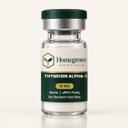 THYMOSIN ALPHA-1In your order
Thymosin Alpha-1 is a 28-amino-acid peptide originally isolated from thymic tissue. It is studied for immune-modulation, particularly T-cell maturation and innate immune signaling.
Common research applications include:
- T-cell maturation research
- Innate immune signaling studies
- Immune-response models
Specifications
- Class: Thymic peptide
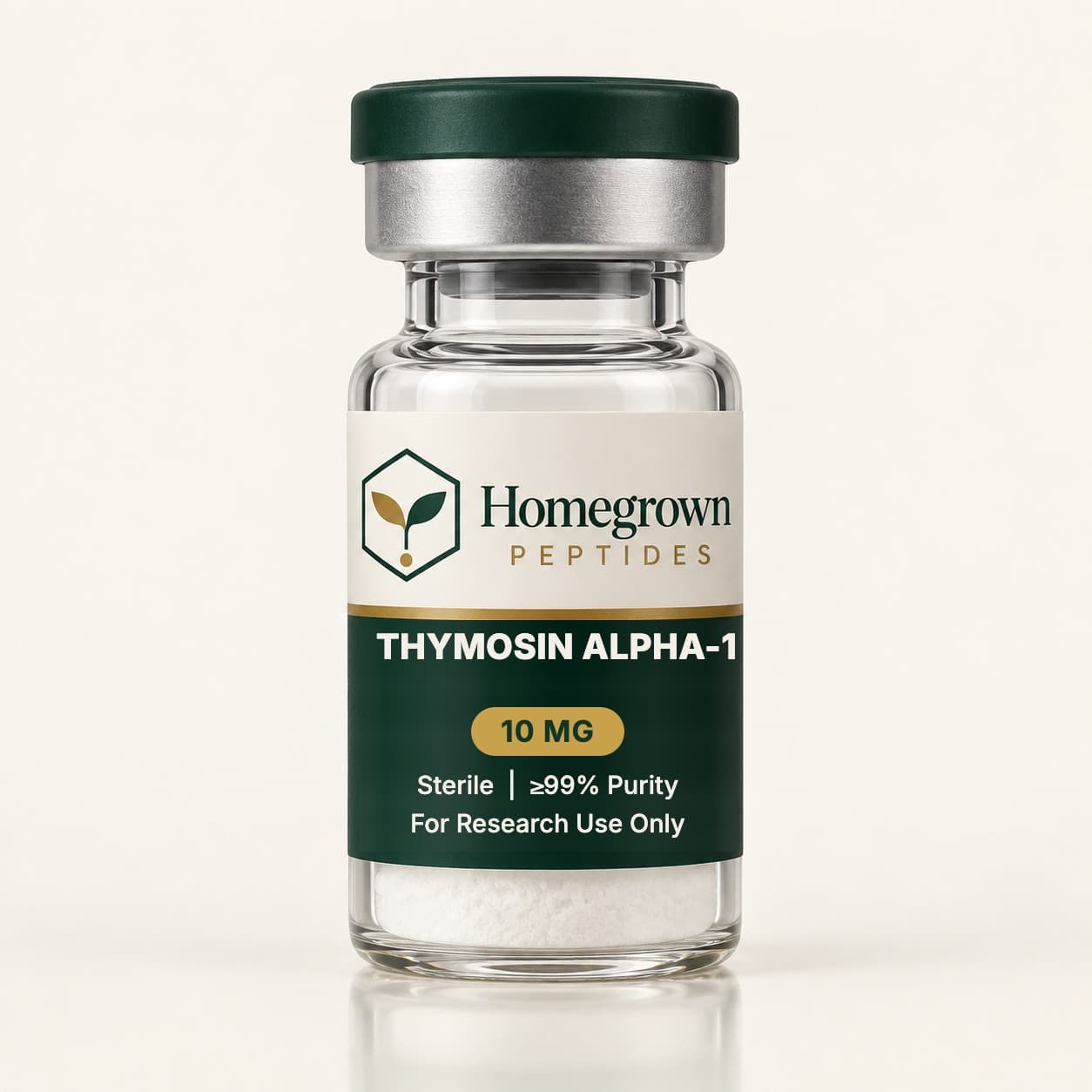
- Form: lyophilized powder in a sealed glass vial
- Available sizes: 10 mg
- Purity: verified at 99% or higher by HPLC, identity confirmed by mass spectrometry
- Testing: every lot is third-party tested, with a lot-matched Certificate of Analysis available on request
- supplied by a U.S. lab
- Storage: keep sealed, cool, dry and away from light; refrigerate after reconstitution
For laboratory research use only. This product is not for human or veterinary use, is not a drug, food or cosmetic, and is not intended to diagnose, treat, cure or prevent any disease.
Lots on file for THYMOSIN ALPHA-1
One row per size. Purity by RP-HPLC, measured content against the stated amount, and the date the independent laboratory issued the certificate. Printed minimum ≥ 99.0 %.
| Size | Lot | Purity (RP-HPLC) | Measured content vs label | Certificate date | Results |
|---|---|---|---|---|---|
| 10 mg | TA110-0803 | 99.78 % | 10.87 mg · stated 10 mg | Aug 17, 2026 | Lot results → |
What the certificate shows
Line by line, with the real numbers from the certificate on file for THYMOSIN ALPHA-1.
Lot TA110-0803 · 10 mg
| Line on the certificate | What this lot reports | How to read it |
|---|---|---|
| Identity | Confirmed against reference (LC-MS/MS) | The laboratory matched the sample's mass against a reference standard. This is the line that says the vial holds this peptide and not a cheaper one with a similar retention time. |
| Overall purity | 99.78 % by RP-HPLC (214 nm) | The share of the chromatogram that is the target peak. Everything else is process residue or related peptide. Read it next to the printed minimum on the label, not on its own. |
| Measured content | 10.87 mg against a stated 10 mg (HPLC quantitation) | What the laboratory actually weighed in the vial, quantified against the peptide standard. A figure at or above the stated amount means the fill is not short. |
| Endotoxin | <0.05EU/mL by USP <85> | Bacterial fragments are biologically active on their own and are invisible to HPLC and mass spectrometry. This is a separate assay, run to the USP chapter named beside it. |
| Heavy metals | <0.01ppm by USP <232> | Lead, arsenic, mercury and cadmium picked up during synthesis. They are inorganic, so only an elemental method finds them. |
| HPLC retention | 9.310 min | Where the target peak came off the column. Repeating this number across lots is how a laboratory shows the same molecule was run each time. |
| Laboratory and dates | Bioviridian · sample received Aug 11, 2026 · issued Aug 17, 2026 | Who ran the assay and when. A certificate with no issuing laboratory and no dates cannot be checked by anyone. |
| Verification code | COA7585 | The laboratory's own reference for this document, so the result can be confirmed with the laboratory rather than taken from this page. |
Full results for lot TA110-0803How certificates work hereLook up a lot number
Research background: thymosin alpha-1
What the published record on this 28-residue thymic peptide actually measured, and where it disagrees with itself.
Thymosin alpha-1 is a 28-residue acetylated peptide first isolated from thymic tissue. The catalog sequence starts Ac-Ser-Asp-Ala-Ala-Val and the stated molecular weight is 3108.30. Published work describes it as an immune signalling peptide rather than a single-receptor agonist. A 2016 review in Vitamins and Hormones reports that it acts through Toll-like receptors on myeloid and plasmacytoid dendritic cells, which then start cytokine production. 1 A 2020 review in World Journal of Virology collects the same mechanism work next to the clinical record. 2
The largest published trial is TESTS, reported in BMJ in 2025. 3 It was a multicentre, double blinded, placebo controlled phase 3 study across 22 centres, running from September 2016 to December 2020. It randomised 1,106 adults in a one-to-one ratio and analysed 1,089. The primary endpoint was 28-day all-cause mortality. The trial reported 23.4 percent in the thymosin arm and 24.1 percent in the placebo arm, with a hazard ratio of 0.99. The authors concluded that there was no clear evidence of a mortality reduction.
An earlier and smaller trial reported the opposite direction. ETASS, published in Critical Care in 2013, randomised 361 participants across six teaching hospitals. 4 It measured the same 28-day endpoint and added SOFA score and monocyte HLA-DR on days 0, 3 and 7. Mortality was 26.0 percent against 35.0 percent in the control arm. The mean difference in monocyte HLA-DR change was 3.9 percent at day 3 and 5.8 percent at day 7. Reading TESTS and ETASS side by side is the honest summary of this literature.
The hepatitis B studies measured virological endpoints instead of survival. A 1998 randomised controlled trial in Hepatology enrolled 98 participants in three arms: 26 weeks, 52 weeks, and an untreated control followed for 18 months. 5 Assessed 18 months after entry, complete virological response was 40.6 percent, 26.5 percent and 9.4 percent. Blinded histology showed the largest change in lobular necroinflammation. A 1999 phase 3 placebo controlled study in Journal of Viral Hepatitis enrolled 97 participants over 12 months. 6 It reported sustained loss of HBV DNA with a negative HBeAg value in 25 percent against 13 percent. The authors stated plainly that the result did not confirm the efficacy reported in earlier studies.
Three further records set the scale of the rest of the work. A 2011 double blinded study in Inflammation randomised 24 participants with severe acute pancreatitis. It tracked monocyte HLA-DR and the CD4 to CD8 ratio on admission, day 8 and day 28. 7 A 2020 report in Clinical Infectious Diseases reviewed 76 severe COVID-19 cases. It measured thymus output by T-cell receptor excision circles, and read PD-1 and Tim-3 on CD8 cells by flow cytometry. 8 A 2021 retrospective study of 275 cases in Frontiers in Immunology reached the opposite conclusion on lymphocyte counts, and its title says so. 9
In vitro work is narrower and mostly answers one question. A 1996 study in International Journal of Immunopharmacology tested whether the peptide promotes cell growth or transformation. 10 Added peptide had no effect on cell growth. NIH-3T3 cells transfected with the prothymosin alpha precursor expressed raised levels of the mature peptide. They showed neither faster proliferation in liquid culture nor loss of contact inhibition in soft agar. The authors concluded that the data argue against a growth-promoting role.
Read against that record, the questions worth asking about a vial are analytical rather than clinical. Which lot is in the box, which method confirmed identity, and how the measured content compares with the amount on the label. Those three answers are on the certificate, and they are the part a supplier can be held to.
Research use only. Nothing above is guidance for use, and none of these studies describe this product. Every reference below was checked against its PubMed record before it was published here.
References
- Immune Modulation with Thymosin Alpha 1 Treatment Vitamins and hormones, 2016. PubMed 27450734
- Thymosin alpha 1: A comprehensive review of the literature World journal of virology, 2020. PubMed 33362999
- The efficacy and safety of thymosin α1 for sepsis (TESTS): multicentre, double blinded, randomised, placebo controlled, phase 3 trial BMJ (Clinical research ed.), 2025. PubMed 39814420
- The efficacy of thymosin alpha 1 for severe sepsis (ETASS): a multicenter, single-blind, randomized and controlled trial Critical care (London, England), 2013. PubMed 23327199
- Efficacy of thymosin alpha1 in patients with chronic hepatitis B: a randomized, controlled trial Hepatology (Baltimore, Md.), 1998. PubMed 9581695
- Thymosin alpha1 treatment of chronic hepatitis B: results of a phase III multicentre, randomized, double-blind and placebo-controlled study Journal of viral hepatitis, 1999. PubMed 10607256
- Thymosin alpha 1 is associated with improved cellular immunity and reduced infection rate in severe acute pancreatitis patients in a double-blind randomized control study Inflammation, 2011. PubMed 20549321
- Thymosin Alpha 1 Reduces the Mortality of Severe Coronavirus Disease 2019 by Restoration of Lymphocytopenia and Reversion of Exhausted T Cells Clinical infectious diseases : an official publication of the Infectious Diseases Society of America, 2020. PubMed 32442287
- Thymosin Alpha-1 Has no Beneficial Effect on Restoring CD4+ and CD8+ T Lymphocyte Counts in COVID-19 Patients Frontiers in immunology, 2021. PubMed 34149679
- Thymosin alpha 1 does not promote growth or oncogenic transformation International journal of immunopharmacology, 1996. PubMed 8933211
How to compare suppliers
Thymosin alpha-1 is sold by a lot of sites. Six checks separate a documented vial from a listing.
- A certificate tied to a lot, not a brochure. Ask which lot is in the box, then ask to see that lot's results. Every vial here is labelled with its lot number, and each public lot has its own results page.
- A named laboratory on the document. A certificate should say who ran the assay. The certificates on file name Bioviridian as the issuing laboratory, with a verification code and a dated release.
- Identity as well as purity. Purity by RP-HPLC answers what share of the sample is the peptide. Identity by LC-MS/MS answers whether it is the right molecule. One figure without the other answers half the question.
- Measured content against the stated amount. A vial sold as 10 mg should come with a measured content figure, so the fill can be read against the label instead of assumed.
- Shipping terms you can plan around. Orders here ship to United States addresses only, within one business day, with tracking sent by email. Standard shipping is a flat 12.99 dollars under 1,000 dollars and free at 1,000 dollars or more.
- A person who replies. Certificate requests, bulk questions and size questions all go to support@homegrownpeptides.com, and a person answers them.
Everything in that list is already on this page or one click from it. The 10 mg size ships with lot TA110-0803 results on file.
Also in the catalog
Frequently Asked Questions
Is thymosin alpha-1 available for purchase as a research peptide?
Yes. The 10 mg lyophilized vial is listed above for laboratory research use only. It is not a drug, supplement or cosmetic, and it is not for human or animal use. Each vial carries a lot number that maps to its own certificate of analysis.
What does the certificate for thymosin alpha-1 report?
Lot TA110-0803 reports 99.78 percent purity by RP-HPLC at 214 nm, identity confirmed against reference by LC-MS/MS, and 10.87 mg measured content against a stated 10 mg. Endotoxin was below 0.05 EU per mL by USP 85 and heavy metals below 0.01 ppm by USP 232. The laboratory was Bioviridian and the certificate was issued on August 17, 2026.
Which published studies measured thymosin alpha-1?
The research background section on this page summarises ten verified PubMed records. They include the 1,106-participant TESTS phase 3 trial in BMJ in 2025 and the 361-participant ETASS trial in Critical Care in 2013. Every reference links to its PubMed record so the endpoints can be checked directly.
How is the thymosin alpha-1 vial shipped and stored?
Orders ship to United States addresses within one business day, with tracking sent by email. Store the lyophilized powder at minus 20 degrees Celsius, protected from light and moisture. Reconstituted solution is held at 2 to 8 degrees Celsius.
Can a certificate for a different lot be requested?
Yes. Email support@homegrownpeptides.com with the lot number printed on the vial and the matching certificate is sent back. Public lots also have their own results page under /lot.
Why does the certificate report 10.87 mg for a 10 mg vial?
Measured content is what the laboratory quantified in the vial against the peptide standard, not a target. A figure at or above the stated amount means the fill is not short. For lot TA110-0803 that figure is 10.87 mg against a stated 10 mg.
How does thymosin alpha-1 differ from thymalin?
Thymosin alpha-1 is a single defined 28-residue sequence with one molecular weight and one certificate line for identity. Thymalin is a peptide complex extracted from thymus tissue, so its composition can vary more between lots. Both are listed separately in this catalog.
Do the published trials on thymosin alpha-1 agree with each other?
No, and the research background section on this page says so rather than selecting one side. The 1,106-participant TESTS trial in BMJ in 2025 reported no difference in 28-day mortality, while the 361-participant ETASS trial in Critical Care in 2013 reported 26.0 percent against 35.0 percent. Two COVID-19 records also reach opposite conclusions on lymphocyte counts.
What does Research Use Only mean?
This product is supplied strictly for laboratory and research use only. It is not a drug, food, supplement or cosmetic, is not approved by the FDA, and is not for human or veterinary consumption.
Learn more about THYMOSIN ALPHA-1
From the research blog
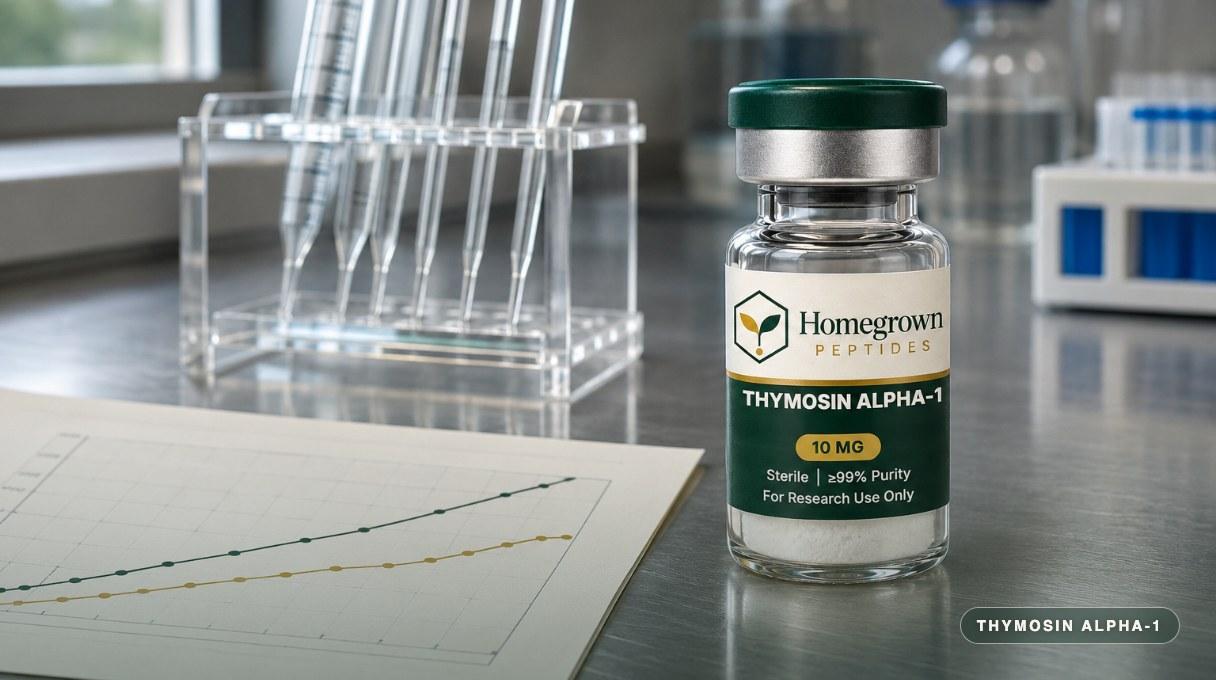
Thymosin Alpha-1 in Clinical Studies: Hepatitis, Sepsis and Immune-Marker Trial Designs and Amounts Reported
What the published hepatitis B, hepatitis C, sepsis and immune-marker trials of thymosin alpha-1 measured, and the amounts and routes they reported.
Read the article →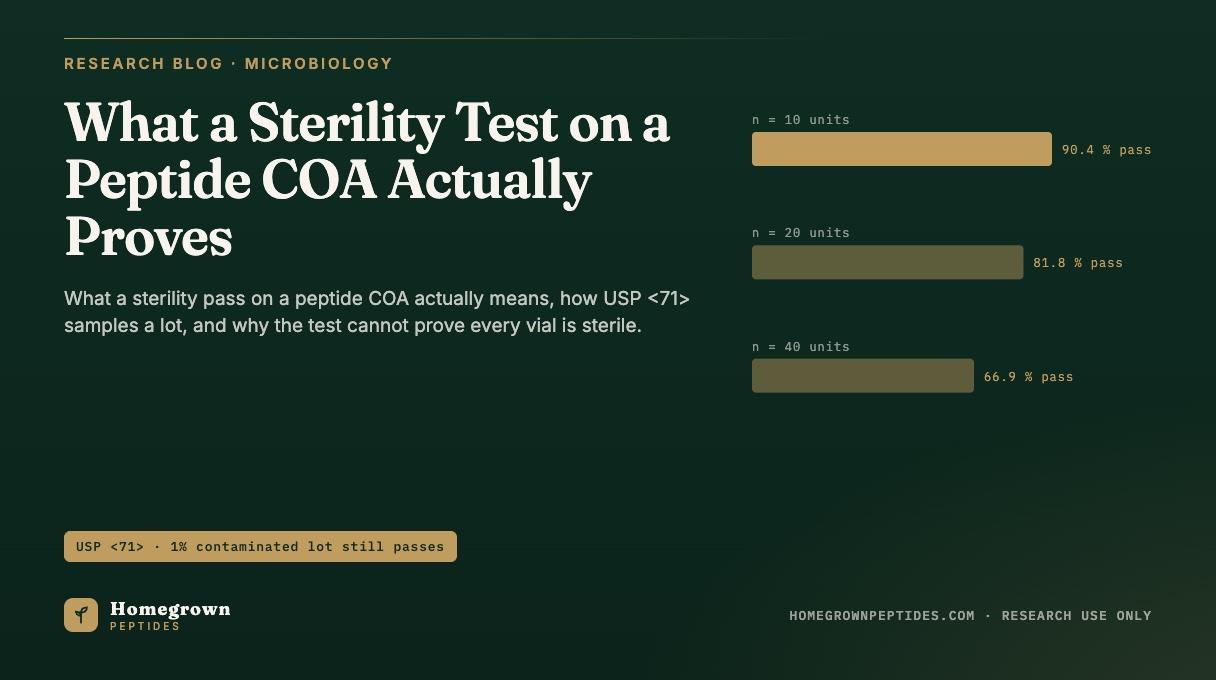
What a Sterility Test on a Peptide COA Actually Proves: USP <71>, Sample Size and the Limits of a "Pass"
What a sterility pass on a peptide COA actually means, how USP <71> samples a lot, and why the test cannot prove every vial is sterile.
Read the article →
What Is Thymosin Alpha-1? The 28-Amino-Acid Thymic Peptide in Immune Research
What thymosin alpha-1 is, where the 28-amino-acid sequence comes from, and what the published literature reports about its immune signaling.
Read the article →