A line on a certificate reading "sterility: pass" means a defined number of units pulled from the lot were incubated for 14 days in two growth media and showed no microbial growth. It is a sample based test with low statistical power: it can catch gross contamination but cannot prove every vial in the lot is sterile. That gap is why sterility assurance in manufacturing rests on process control, not on the test itself.
| Parameter | USP <71> value | Source |
|---|---|---|
| Incubation period | 14 days, observed for turbidity indicating growth | USP General Chapter <71>, Sterility Tests |
| Medium for anaerobes (and aerobes) | Fluid thioglycollate medium, incubated at 30 to 35 degrees C | USP General Chapter <71> |
| Medium for aerobes and fungi | Soybean casein digest medium, incubated at 20 to 25 degrees C | USP General Chapter <71> |
| Permitted methods | Membrane filtration (preferred where feasible) or direct inoculation | USP General Chapter <71> |
| Sample size, batch of 100 to 500 containers | 10 units | USP General Chapter <71>, minimum sample table |
| Sample size, batch over 500 containers | 2 percent of the batch or 20 units, whichever is less | USP General Chapter <71> |
| Method suitability requirement | Bacteriostasis and fungistasis test confirming the product does not inhibit growth of the challenge organisms | USP General Chapter <71> |
What does USP <71> actually require?
USP General Chapter <71> allows two methods. Membrane filtration passes the reconstituted test units through a filter that retains microorganisms, rinses the filter, then places the pieces into growth media; it is preferred whenever feasible because the rinse removes residual antimicrobial activity before incubation. Direct inoculation simply adds the test units straight into the media. The filtration hardware itself is covered in a separate article on aseptic technique and sterile filtration.
Two media run in parallel for 14 days: fluid thioglycollate medium for anaerobic and aerobic bacteria at 30 to 35 degrees C, and soybean casein digest medium for aerobic bacteria and fungi at 20 to 25 degrees C. Units are checked periodically for the cloudiness, color change or visible colonies that indicate growth.
Before any of that, the lab runs a growth promotion test on each media lot and a method suitability test (a bacteriostasis and fungistasis check) on the specific product: spiking it with a known small number of reference organisms to confirm they still grow despite the product's presence. If they do not, the method changes (more rinse volume, a larger filter, dilution) until inhibition is removed. Skipping this is the single most common reason a sterility test produces a false pass.
Sample size scales with batch size rather than staying fixed: roughly 100 to 500 final containers calls for 10 units; over 500, the requirement drops to 2 percent of the batch or 20 units, whichever is less. As batch size grows, the tested fraction shrinks.
Why is the test statistically weak?
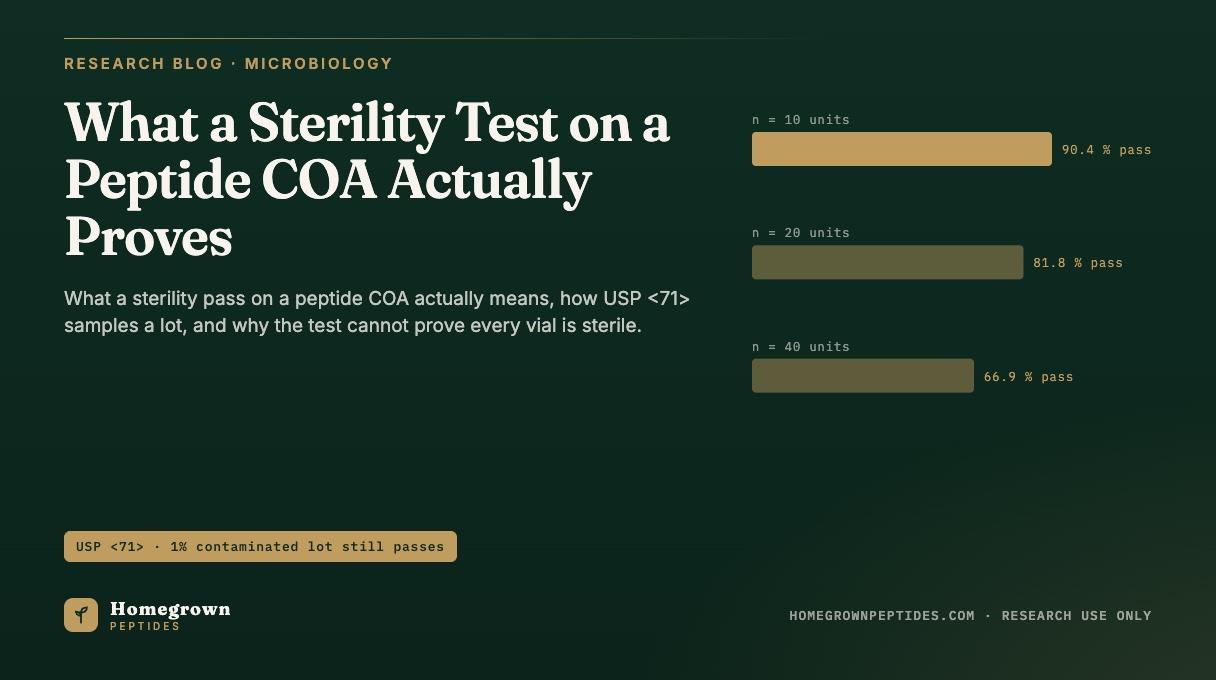
The core problem is simple binomial sampling. If a fraction p of the units in a lot are truly contaminated, and n units are drawn and tested, the probability that none of the n is contaminated, and the lot therefore passes, is (1 minus p) raised to the n. With n equal to 20 and p equal to 1 percent, that works out to about 82 percent: a lot where 1 in 100 units is actually contaminated still passes roughly four times out of five under the standard 20 unit sample. The table below runs the same formula across a few contamination rates and sample sizes; testing every unit would use up the entire batch, so this arithmetic is unavoidable.
| True contamination rate | Probability of passing, n = 10 | Probability of passing, n = 20 | Probability of passing, n = 40 |
|---|---|---|---|
| 0.1 percent | 99.0 percent | 98.0 percent | 96.1 percent |
| 1 percent | 90.4 percent | 81.8 percent | 66.9 percent |
| 5 percent | 59.9 percent | 35.8 percent | 12.9 percent |
| 10 percent | 34.9 percent | 12.2 percent | 1.5 percent |
At a contamination rate as low as 1 unit in 1,000, the test is barely more informative than not testing at all, passing the lot 96 to 99 percent of the time. The test is built to catch gross, systemic contamination events, not to characterize the true rate of an otherwise well controlled process.
What is the difference between "sterile filtered", "aseptically filled" and "sterility tested"?
These three phrases describe different steps in the same process and get used almost interchangeably, which is exactly why they are worth separating.
| Term | What it describes | What it does not prove |
|---|---|---|
| Sterile filtered | Bulk solution passed through a 0.22 micron (or tighter) rated filter before filling, removing bacteria and fungi present at that moment | That containers stayed sterile, or that the filter was intact and integrity tested |
| Aseptically filled | Filling happened under validated conditions (classified cleanroom, qualified operators, environmental monitoring) meant to keep contamination out of an already sterile stream | A lot release result by itself; it is a process claim verified through monitoring and media fill studies |
| Sterility tested | A defined number of finished units were incubated per USP <71> and showed no growth | That every untested unit in the lot is free of contamination, for the statistical reasons above |
A certificate listing "sterility: pass" reports only the third item. It says nothing about whether filtration or fill was adequate; those are separate controls a sterility result cannot retroactively validate.
What does a sterility test on a lyophilized peptide involve?
A lyophilized peptide has to be reconstituted before testing, since the growth media need a liquid to receive. The standard approach reconstitutes the test units in sterile diluent, then passes that solution through a 0.45 micron rated membrane, rinsed with additional sterile fluid in several washes specifically to dilute out any residual antimicrobial activity before the filter pieces go into the two media. This rinse step is where method suitability testing earns its keep: it confirms the rinse volume chosen is enough to stop the product from suppressing growth in the assay.
That concern is not hypothetical. A meaningful share of naturally occurring and synthetic peptides carry intrinsic antimicrobial activity as part of their biological function, not as an added preservative. A 2002 review in Nature on antimicrobial peptides across multicellular organisms laid out how widespread this is in cationic peptides generally (1), and a 2006 structural review of the human cathelicidin LL-37 described the membrane disrupting mechanism behind it (2); related reviews of the broader antimicrobial and host defense peptide literature reach the same conclusion (3, 4, 5). A lab cannot assume a peptide is inert to the test organisms just because it is not labeled as a preservative.
A separate failure mode applies to any formulation containing an actual bacteriostatic preservative, most often benzyl alcohol in a reconstitution diluent rather than the peptide itself: carryover at inhibitory concentration can suppress growth even in a genuinely contaminated sample, producing a false negative. A 1998 study of freezing and freeze drying process conditions and protein recovery, cited below, illustrates why lyophilization formulations are chosen deliberately (6): excipients chosen to protect the peptide are not neutral with respect to a downstream sterility assay.
What are rapid microbiological methods, and are they accepted?
Several alternative methods detect microbial growth or markers faster than 14 days: ATP bioluminescence measures light from a luciferase reaction with adenosine triphosphate from living cells, flagging growth within hours; automated systems adapted from clinical blood culture work monitor carbon dioxide or other metabolic signals continuously, often calling a result in 3 to 5 days; flow cytometry counts stained microbial cells directly from a sample volume; and polymerase chain reaction based methods detect microbial nucleic acid without waiting for visible growth.
None of these replace the compendial method on a lab's say so. USP General Chapter <1223>, Validation of Alternative Microbiological Methods, lays out the comparability studies (detection limit, specificity, accuracy, ruggedness) a lab must complete before a rapid method can stand in for the classic test. The main benefit, once validated, is turnaround time rather than better statistics: a faster method still samples the same number of units from the same lot, so it inherits the same sampling limitations above. It answers "did we find growth sooner," not "did we test more of the batch."
Why does sterility assurance come from the process rather than the test?
For terminally sterilized products, the industry works around the limits of end product testing with sterility assurance level: a probability that a single unit remains non sterile after the cycle, often targeted at one in a million, derived from validated lethality of the process rather than from testing finished units. Parametric release formalizes this: for a well characterized cycle, a lot can be released on confirming the process parameters were met, without an end product sterility test at all.
Lyophilized peptides are different: almost always produced by aseptic processing (sterile filtration, aseptic fill, then freeze drying) rather than terminal sterilization, since heat or radiation would damage the peptide. Parametric release in that sense does not apply cleanly here, since there is no terminal lethality step to measure. The equivalent assurance comes from environmental monitoring of the fill suite, qualified operators, validated media fills, and container closure integrity testing; the sterility test sits on top as a final check, not the primary control. A lot that passed every process control and still failed gets investigated and almost always rejected; a lot with a known fill deviation does not get a free pass because sampled units showed no growth.
How should a lab read "sterility: pass" next to endotoxin and purity lines on the same certificate?
Each line on a certificate answers a different, narrow question; none substitutes for another. Purity and identity, covered in a separate guide on how to read a peptide certificate of analysis, describe chemical composition: how much of the vial is the intended peptide, and whether mass and sequence match what was ordered. Endotoxin testing, covered in endotoxin testing and the LAL assay, measures a bacterial cell wall fragment by a biochemical reaction, a chemistry question rather than a microbiology question. A vial can be endotoxin free and still contain live organisms of a type that does not produce the targeted endotoxin, and a vial can pass sterility testing while still carrying measurable endotoxin from organisms killed earlier in processing, since dead cells can still shed it. A broader comparison of endotoxin, sterility and heavy metal testing is in testing beyond purity. On a certificate for a product such as thymosin alpha 1, the sterility, endotoxin and purity lines are independent evidence, not three readings of one claim.
Frequently asked questions
Does a sterility pass mean every vial in the lot is sterile?
No. It means the units pulled for testing, a sample as small as 10 to 20 units depending on batch size, showed no growth over 14 days. As the probability table above shows, a lot with a real contamination rate of 1 percent can still pass that test most of the time.
How long does a sterility test take to complete?
The incubation runs 14 days under USP <71>, plus the time needed to confirm method suitability for the product and growth promotion for the media lots, both typically done once per product or media lot rather than repeated every batch.
Can a lot that passed sterility testing still contain endotoxin?
Yes. Sterility testing detects live organisms in the sample tested; endotoxin testing detects a cell wall component by a separate biochemical assay. Organisms present earlier and later killed can leave endotoxin behind even in a lot with no live growth. See endotoxin testing for how that assay works.
Is a lyophilized powder sterile by default just because it was freeze dried?
No. Freeze drying is a drying and stabilization step, not a sterilizing step. Sterility of the finished powder depends on whether the solution was sterile filtered and the fill was aseptic before freeze drying began. A freeze dried cake made from a contaminated solution is simply a contaminated freeze dried cake.
What is bioburden, and how does it relate to the sterility test?
Bioburden is the microbial load present in a material before any sterilizing or aseptic step, usually reported as colony forming units. It is a process monitoring measurement taken earlier, separate from the end of lot sterility test, and one input used to judge whether an aseptic process is in control.
Why do some certificates of analysis not list a sterility result at all?
Sterility testing is not run on every category of material. A non sterile, bulk research grade powder not represented as sterile may be characterized on purity, identity and residual solvent without a sterility line, since the claim was never made. A sterility result should only be relied on where the product is represented as sterile and the test was performed on that specific lot.
References
- Zasloff M. Antimicrobial peptides of multicellular organisms. Nature. 2002;415(6870):389-395. PubMed 11807545.
- Dürr UH, Sudheendra US, Ramamoorthy A. LL-37, the only human member of the cathelicidin family of antimicrobial peptides. Biochim Biophys Acta. 2006;1758(9):1408-1425. PubMed 16716248.
- Hancock RE, Sahl HG. Antimicrobial and host defense peptides as new anti infective therapeutic strategies. Nat Biotechnol. 2006;24(12):1551-1557. PubMed 17160061.
- Boman HG. Antibacterial peptides: basic facts and emerging concepts. J Intern Med. 2003;254(3):197-215. PubMed 12930229.
- Hancock RE, Diamond G. The role of cationic antimicrobial peptides in innate host defences. Trends Microbiol. 2000;8(9):402-410. PubMed 10989307.
- Jiang S, Nail SL. Effect of process conditions on recovery of protein activity after freezing and freeze drying. Eur J Pharm Biopharm. 1998;45(3):249-257. PubMed 9653629.
- United States Pharmacopeia. General Chapter <71>, Sterility Tests. USP-NF.
- United States Pharmacopeia. General Chapter <1223>, Validation of Alternative Microbiological Methods. USP-NF.
Research use only. Homegrown Peptides products are for laboratory research and are not for human or animal use. Nothing in this article is medical advice.