
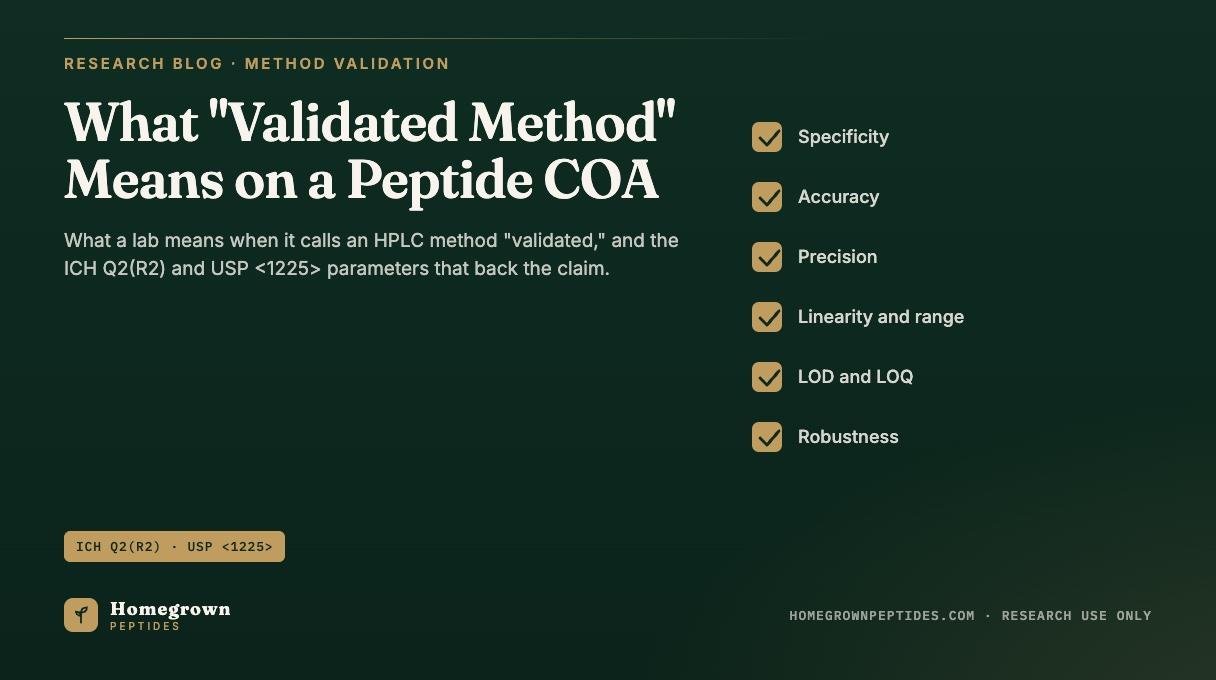
"Validated method" means the laboratory has demonstrated, with documented experiments, that its procedure is fit for its purpose: specific for the analyte, accurate, precise, linear over a stated range, with known detection and quantitation limits and robustness to small changes. ICH Q2(R2) and USP <1225> define those parameters, and without them a purity figure is a reading, not a measurement.
An unvalidated HPLC run can still produce a clean peak and a tidy percentage. It just cannot tell anyone how much to trust that percentage, because no one checked whether the method separates the analyte from what it needs separating from, whether response is proportional to concentration, or whether a different column lot changes the answer. Validation is the paperwork that turns a chromatogram into evidence.
| Parameter | ICH Q2(R2) definition, one line | Typical acceptance for peptide RP-HPLC | Source |
|---|---|---|---|
| Specificity | Ability to assess the analyte unequivocally in the presence of expected interferents (degradants, impurities, matrix) | Baseline resolution from known related substances; peak purity confirmed by diode array or mass spectrometry | ICH Q2(R2) |
| Accuracy | Closeness of agreement between the found value and an accepted reference value | Recovery of about 98 to 102 percent against a qualified reference standard, for assay methods | ICH Q2(R2); USP <1225> |
| Precision, repeatability | Agreement between results under the same operating conditions over a short interval | Relative standard deviation of about 1 to 2 percent for assay; wider at low-level impurities | ICH Q2(R2) |
| Precision, intermediate | Agreement within the same laboratory across days, analysts or instruments | Relative standard deviation typically within 2 to 3 times the repeatability figure | ICH Q2(R2) |
| Linearity | Ability of results to be proportional to analyte concentration over a range | Correlation coefficient at or above 0.995 across five or more concentrations | ICH Q2(R2) |
| Range | Interval between the upper and lower concentrations shown to have suitable precision, accuracy and linearity | About 80 to 120 percent of target for assay; limit of quantitation to 120 percent of specification for impurities | ICH Q2(R2) |
| Detection limit (LOD) | Lowest amount that can be detected, not necessarily quantitated | Signal to noise ratio of about 3 to 1, or a standard-deviation-of-response calculation | ICH Q2(R2) |
| Quantitation limit (LOQ) | Lowest amount that can be quantitated with acceptable precision and accuracy | Signal to noise ratio of about 10 to 1 | ICH Q2(R2) |
| Robustness | Capacity to remain unaffected by small, deliberate variations in method parameters | Flow rate, column temperature, mobile phase pH and column lot varied one at a time without loss of resolution | ICH Q2(R2) |
What is analytical method validation, and who defines it?
Method validation is the documented demonstration that a specific procedure, on specific equipment, in a specific lab, does what it is supposed to do. The current global reference is ICH Q2(R2), adopted in November 2023, which merges and replaces the former Q2(R1) text, defining the validation parameters above without dictating fixed numeric limits.
USP runs a parallel system: general chapter <1225> covers full validation of a compendial-style procedure, and <1226> covers verification, a lighter check that an already-validated method still performs in a new lab. ICH also published Q14, a lifecycle companion describing how a procedure is developed rather than how it is validated; citing Q14 describes development history, not a substitute for Q2(R2) data.
None of these documents certify a method on their own. They describe the experiments a lab must run, and the evidence it must keep, so the reader's job is to ask whether that evidence exists.
Which validation parameters are required for which type of test?
ICH Q2(R2) does not require every parameter for every method; the requirement depends on what the test is asking. A method confirming identity is held to a different standard than one assigning a number to a low-concentration impurity, or one assigning the main assay value.
| Parameter | Identity test | Impurity, quantitative | Impurity, limit only | Assay or content |
|---|---|---|---|---|
| Specificity | Required | Required | Required | Required |
| Accuracy | Not applicable | Required | Not required | Required |
| Precision | Not applicable | Required | Not required | Required |
| Linearity | Not applicable | Required | Not required | Required |
| Range | Not applicable | Required | Not required | Required |
| LOD | Not applicable | Not required | Required | Not required |
| LOQ | Not applicable | Required | Not required | Not required |
| Robustness | Recommended | Recommended | Recommended | Recommended |
This matrix is discussed at length in a widely cited comparison of FDA, USP and ICH validation expectations (Shabir, 2003). A certificate reporting an impurity below the quantitation limit as "not detected" is making an LOD-based claim; one reporting a precise impurity percentage is making a more demanding claim, needing accuracy, precision, linearity and range data behind it.
What does each parameter mean in practice for a peptide RP-HPLC method?
Specificity. Shown by resolving the main peak from known and likely related substances: truncated sequences, oxidized or deamidated forms, aggregates and synthesis byproducts. Labs demonstrate it with forced-degradation samples, material stressed by acid, base, oxidation, heat or light, then injected to confirm degradants elute away from the main peak and that diode-array or mass-spectral peak-purity checks flag no co-elution. Peptide and protein degradation pathways and forced-degradation practice are documented in the pharmaceutical-stability literature (Manning et al., 2010; Hawe et al., 2012).
Accuracy. Checked by spiking a known amount of a qualified reference standard into the matrix and comparing the recovered amount to the known amount, expressed as percent recovery. For an assay method, recoveries clustered around 98 to 102 percent across the working range are typical; recovery that drifts with concentration points to a bias the method has not accounted for.
Precision. Repeatability (same analyst, instrument, day) and intermediate precision (different days, analysts or columns) are both reported as relative standard deviation. Assay precision in the low single digits is routine for a well-behaved peptide method; precision at the quantitation limit for a minor impurity is necessarily wider.
Linearity and range. A linearity study injects five or more concentrations spanning the intended working range, typically about 80 to 120 percent of target for an assay, or from the quantitation limit up to 120 percent of the specification limit for an impurity. The response-versus-concentration plot should fit a straight line with a correlation coefficient at or above 0.995, with no systematic bow in the residuals, which would indicate detector or column saturation.
LOD and LOQ. Usually set from the signal-to-noise ratio of a diluted standard (roughly 3 to 1 for detection, 10 to 1 for quantitation) or from the standard deviation of the response and the calibration slope. Both approaches, and their limitations at very low concentrations, are covered in a frequently cited clinical-chemistry primer on blank, detection and quantitation limits (Armbruster and Pry, 2008).
Robustness. A robustness study varies small, realistic parameters one at a time, flow rate, column temperature, mobile phase pH, gradient slope, column lot, and checks that resolution and quantitation hold up. A method that fails when the column lot changes is not ready for routine use, since every new column shipment becomes a validation event.
What is a reference standard, and why does a validated content method need one?
Accuracy and content assignment are only as good as the material measured against. A primary reference standard is characterized independently, often by more than one orthogonal technique, and assigned a content value with a stated uncertainty. A secondary (working) standard is calibrated against it for routine use, since primary material is expensive and limited.
For peptides, content assignment commonly leans on techniques outside the HPLC method itself. Quantitative amino acid analysis, built on reactions such as the ninhydrin method used to monitor peptide synthesis (Sarin, Kent, Tam and Merrifield, 1981), measures the constituent amino acids directly and is largely independent of chromatographic response factors. Quantitative nuclear magnetic resonance is a second orthogonal route, comparing proton signals against a certified internal standard. A method validated for assay still needs one of these absolute techniques behind its standard, or its accuracy is only accuracy relative to another unchecked number. See net peptide content versus purity for how that value reaches a certificate.
How is area percent purity different from a validated assay?
Area percent purity divides the main peak's area by the total area of all detected peaks. It is fast, needs no reference standard, and assumes every peak, main compound and impurities alike, absorbs light at the detection wavelength with roughly the same efficiency per unit mass. That assumption is frequently wrong for peptides, where a truncated fragment or oxidized variant can have a meaningfully different response factor from the parent sequence.
A validated assay method corrects for that: a characterized reference standard, a real-concentration calibration curve, and accuracy and precision data that tell the lab how much to trust the number in absolute terms, not just relative to other peaks in the run. That is why "99.1 percent purity" (an area-percent read) and "84 percent net peptide content" (a validated, standard-referenced assay) can both appear on the same certificate without contradicting each other. The area-percent mechanics are covered in HPLC purity explained.
What should a certificate disclose so you can judge the method?
A certificate rarely reprints a full validation report. It should disclose enough to tell a reader whether a validated method stands behind the number.
| Disclosure | Why it matters |
|---|---|
| Method or SOP reference | Ties the result to one specific, documented procedure rather than an unspecified "HPLC test" |
| Column type and dimensions | Resolution and retention depend on stationary phase, particle size and column length |
| Mobile phases and gradient | Defines what is actually separating the analyte from related substances |
| Detection wavelength | Different wavelengths give different relative responses for peptide bonds versus aromatic side chains |
| Injection volume | Affects sensitivity and whether the method is operating within its validated linear range |
| System suitability results | Confirms the specific run met resolution, tailing and reproducibility checks before results were accepted |
| Reference standard identity and lot | Shows what the result is actually being compared against |
| Validation status | Distinguishes a fully validated method from one that was only verified or transferred |
Reading the chromatogram trace itself is covered in the sibling article how to read an HPLC chromatogram on a peptide COA; the general walkthrough of every field is in how to read a peptide COA. A certificate for a product such as SS-31 listing a method reference, standard lot and validation statement gives a reader far more to check than a percentage alone.
What is the difference between validation, verification and transfer?
Validation is the original, full demonstration that a method works for its purpose, against every applicable parameter above. Verification, under USP <1226>, is a smaller study confirming an already-validated method performs as expected locally; it does not re-derive the method's core performance. Transfer moves a validated method between labs, with a protocol showing the receiving lab gets equivalent results. "Verified" is not a weaker claim about the number, just a smaller body of evidence behind it.
Frequently asked questions
Does ISO/IEC 17025 accreditation mean the method is validated?
Not by itself. ISO/IEC 17025 accredits a lab's quality management system: competence, equipment traceability, trained staff, document control. It can require validated or verified methods, but accreditation is not a substitute for a method-specific validation package for a given peptide and procedure.
What is forced degradation?
Deliberately stressing a sample with acid, base, heat, light or oxidizing agents to generate degradation products faster than normal storage would. The degraded sample is run on the candidate method to confirm it can detect and resolve those degradants from the main peak, which is the core evidence for specificity.
What is LOQ?
The limit of quantitation is the lowest amount of an analyte a method can measure with acceptable precision and accuracy, not merely detect. It is typically set where the signal-to-noise ratio reaches about 10 to 1, marking the floor below which a reported impurity number is unreliable even if a peak is visible.
Can a purity method be validated without a reference standard?
Specificity and precision can be studied without a characterized reference standard, since those parameters compare the method to itself. Accuracy cannot: without a reference standard carrying an independently assigned content value, there is nothing to recover a known amount against, so accuracy, and any content claim built on it, cannot be established.
What does "method verified" mean?
The lab confirmed that an already-validated method performs as expected on its own equipment and analysts, per USP <1226>. It is a narrower, faster study than full validation and assumes the method's performance characteristics were already established elsewhere.
How often is a method revalidated?
There is no fixed interval in ICH Q2(R2) or USP <1225>; revalidation is triggered by events, not a calendar. A change in synthesis route, column chemistry, instrument platform or specification limit, or an unexplained shift in system suitability, are the typical triggers.
References
- ICH Expert Working Group. Q2(R2) Validation of Analytical Procedures. International Council for Harmonisation. 2023. database.ich.org
- Shabir GA. Validation of high-performance liquid chromatography methods for pharmaceutical analysis: understanding the differences and similarities between validation requirements of the US Food and Drug Administration, the US Pharmacopeia and the International Conference on Harmonization. J Chromatogr A. 2003;987(1-2):57-66. PubMed PMID 12613797
- Hawe A, Wiggenhorn M, van de Weert M, Garbe JH, Mahler HC, Jiskoot W. Forced degradation of therapeutic proteins. J Pharm Sci. 2012;101(3):895-913. PubMed PMID 22083792
- Manning MC, Chou DK, Murphy BM, Payne RW, Katayama DS. Stability of protein pharmaceuticals: an update. Pharm Res. 2010;27(4):544-575. PubMed PMID 20143256
- Sarin VK, Kent SB, Tam JP, Merrifield RB. Quantitative monitoring of solid-phase peptide synthesis by the ninhydrin reaction. Anal Biochem. 1981;117(1):147-157. PubMed PMID 7316187
- Armbruster DA, Pry T. Limit of blank, limit of detection and limit of quantitation. Clin Biochem Rev. 2008;29(Suppl 1):S49-S52. PubMed PMID 18852857
- Bansal S, DeStefano A. Key elements of bioanalytical method validation for small molecules. AAPS J. 2007;9(1):E109-E114. PubMed PMID 17408234
Research use only. Homegrown Peptides products are for laboratory research and are not for human or animal use. Nothing in this article is medical advice.