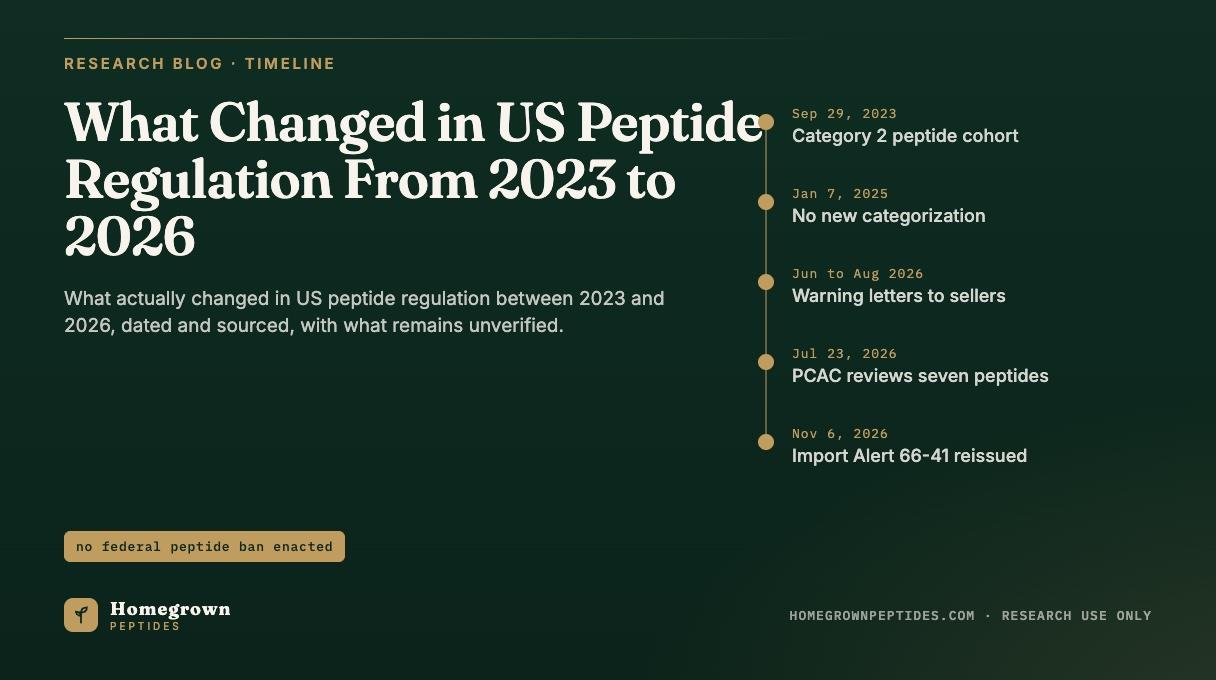
No federal "peptide ban" has been enacted. What changed between 2023 and 2026 is how FDA applies existing law: a September 2023 wave of Category 2 compounding listings, a January 2025 policy change that stopped new nominations from being categorized, 2026 warning letters applying the intended use rule to "research" sellers, a July 2026 advisory committee review of seven peptides, and an updated import alert.
As of November 7, 2026. This article describes United States federal law and published agency actions as of that date. It is general information, not legal advice; the rules differ by state and change over time, and anyone with a specific question should consult a lawyer licensed in their jurisdiction.
Key facts
| Rule or action | What it establishes | Source |
|---|---|---|
| 21 U.S.C. 355(a) | No new drug may enter interstate commerce without an effective FDA approval | law.cornell.edu |
| 21 U.S.C. 812(a) and (b)(1) | Five drug schedules exist; Schedule I requires high abuse potential, no accepted medical use, and no accepted safety under supervision | law.cornell.edu |
| DEA alphabetical controlled substances list | No entry for BPC-157, TB-500, ipamorelin, CJC-1295, sermorelin, melanotan, kisspeptin, selank, semax, NAD, glutathione, or "peptide" | deadiversion.usdoj.gov |
| 21 CFR 201.128 | Intended use may be shown by labeling, advertising, or a product's design, not only by what the label says | law.cornell.edu |
| Category 2 additions, Sept 29, 2023 | GHRP-2, GHRP-6, ipamorelin acetate, kisspeptin-10, and ibutamoren mesylate added over safety risk concerns | fda.gov |
| Revised interim policy, Jan 7, 2025 | FDA stopped categorizing substances nominated on or after that date | fda.gov |
The dated timeline, 2022 to 2026
Dates below are the agency's own published or "content current as of" dates, not the date a change took practical effect.
| Date | Event | What it changed | Source |
|---|---|---|---|
| November 2013 | FDA RUO/IUO labeling guidance (background, predates this window) | Defined "Research Use Only" for diagnostics only, not chemicals; the baseline for every later research label | FDA RUO/IUO guidance |
| Dec 29, 2022 | Ibutamoren mesylate added to 503B Category 2 | Flagged ibutamoren before the larger 2023 cohort | FDA Category 2 page |
| Sept 29, 2023 | Category 2 additions: GHRP-2, GHRP-6, ipamorelin acetate (503B); kisspeptin-10, ibutamoren mesylate (503A); tranilast (503B) | Six substances added over safety risk concerns; the same cohort included BPC-157, CJC-1295, AOD-9604, a TB-500 fragment, thymosin alpha-1, GHK-Cu, KPV, MOTS-c, selank, semax, DSIP, epitalon, melanotan II, dihexa, LL-37, and PEG-MGF, all later withdrawn | FDA Category 2 page |
| Jan 7, 2025 | Revised interim 503A/503B policy | FDA stopped categorizing newly nominated substances; existing listings were not reversed | FDA interim policy PDF |
| Aug 8, 2025 | Current date, shortage compounding page | Restates when a shortage drug is not "commercially available" for compounding | FDA shortage page |
| Aug 18, 2025 | Current date, Personal Importation page | Restates the narrow conditions for import enforcement discretion | FDA import page |
| Apr 22, 2026 | Current date, Category 2 page | Shows which 2023 nominations were later withdrawn; not a safety finding either way | FDA Category 2 page |
| May 14, 2026 | Current date, 503A bulk page | Reaffirms 503A's three conditions and three categories | FDA 503A bulk page |
| June 17, 2026 | Warning letter, Wholesale Peptide | Applied intended use doctrine to Prostamax and a gonadorelin product | FDA warning letter |
| July 23-24, 2026 | Pharmacy Compounding Advisory Committee meeting | Reviewed seven peptides for compounding uses; no votes or recommendations posted | FDA PCAC meeting page |
| Aug 24, 2026 | Warning letter, Peptide Partners LLC | Applied intended use doctrine to a GLP-1 class line, SS-31, a TH9507 product, PT-141, and a reconstitution solution | FDA warning letter |
| Oct 1, 2026 | FDA page on unapproved GLP-1 drugs | Reported adverse event counts through May 31, 2026, and salt form concerns | FDA GLP-1 page |
| Nov 6, 2026 | Import Alert 66-41 published date (revision May 19, 2026) | Confirms the current detention list for unapproved new drugs | FDA import alert page |
What hasn't changed in federal peptide law since 2023?
The core statutes have not moved. A "drug" is still defined by 21 U.S.C. 321(g) as an article "intended for use in the diagnosis, cure, mitigation, treatment, or prevention of disease in man or other animals" or "intended to affect the structure or any function of the body of man or other animals." A "new drug" still cannot enter interstate commerce without an approved application under 21 U.S.C. 355(a). Scheduling under 21 U.S.C. 812 still requires high abuse potential, no accepted medical use, and no accepted safety under supervision, none of which names a peptide specifically.
No agency has scheduled any research peptide as a controlled substance. The DEA's alphabetical list has no entry for BPC-157, TB-500, ipamorelin, CJC-1295, sermorelin, melanotan, kisspeptin, selank, semax, glutathione, somatropin, or "peptide." That is separate from whether a peptide may lawfully be sold for a given use, which turns on intended use and compounding rules, not scheduling. See what "research use only" actually means on a label.
One statute sits in a gray zone: 21 U.S.C. 333(e) sets separate criminal penalties for distributing "human growth hormone" for unauthorized human use, defined as "somatrem, somatropin, or an analogue of either of them." Whether a GHRH analog or ghrelin receptor agonist counts as an "analogue" of somatropin is not resolved by the text, and this article takes no position on it.
What changed in FDA compounding rules for peptides?
A 503A or 503B compounded drug can use a bulk drug substance if it meets a USP or NF monograph, is a component of an FDA-approved drug, or appears on FDA's 503A bulks list. Substances judged to carry significant safety risks, pending further evaluation, go into what FDA calls Category 2, apart from Category 1 (still under evaluation) and Category 3 (insufficient nomination information).
On September 29, 2023, FDA added GHRP-2, GHRP-6, ipamorelin acetate, kisspeptin-10, and ibutamoren mesylate to Category 2, alongside tranilast. Its reasons centered on immunogenicity risk from aggregation or impurities, except ibutamoren mesylate, linked to "potential for congestive heart failure in certain patients." Kisspeptin-10 is the one Category 2 peptide also sold as a research product; see the kisspeptin-10 certificate for how that listing differs from a research-use sale.
The same cohort initially listed BPC-157, CJC-1295, AOD-9604, a TB-500 fragment, thymosin alpha-1, GHK-Cu, KPV, MOTS-c, selank, semax, DSIP, epitalon, melanotan II, dihexa, LL-37, and PEG-MGF. Every one of those nominations was later withdrawn, which is not a safety finding either way. See what FDA's 503A bulk drug substances lists mean for research peptides for how the categories interact. Several compounds on that list are still catalogued here for laboratory research only, among them Thymosin Alpha-1.
On January 7, 2025, FDA revised its policy so substances nominated after that date are no longer categorized at all. Existing listings were not reversed; no new peptide nomination has since gone through that process.
The most recent compounding action is a meeting, not a rule. On July 23 and 24, 2026, the Pharmacy Compounding Advisory Committee reviewed BPC-157, KPV, TB-500, and MOTS-c, then emideltide (DSIP), semax, and epitalon, each for specific potential uses. The page lists briefing materials only; no vote or recommendation is posted, and advisory advice is non-binding. Adding a substance to the bulks list would require separate rulemaking that has not been published.
What changed in enforcement against "research use" sellers?
The tool itself has not changed: 21 CFR 201.128 lets FDA look past a disclaimer to the "objective intent" shown by a website or product design. What changed in 2026 is FDA applying it, in public warning letters, to research-labeled sellers.
On June 17, 2026, a warning letter to Wholesale Peptide over Prostamax and a gonadorelin product quoted website claims about prostate inflammation, bladder control, testosterone production, and testes function as intended-use evidence, citing 21 U.S.C. 201(g)(1), 201(p), 505(a), and 301(d): "Despite statements on your product labeling marketing your products for, 'RESEARCH USE ONLY' and 'not for human consumption,' evidence obtained from your product labeling, including your website establishes that your products are intended to be drugs for human use."
On August 24, 2026, a similar letter to Peptide Partners LLC named a GLP-1 class line, SS-31, a TH9507 product, PT-141, and a reconstitution solution, quoting claims about bone health, brain cells, blood sugar and lipids, appetite and metabolism, retina protection, liver health, and sexual function: "Despite statements on your product labeling marketing your products 'for research use only' and 'not for human or veterinary use,' evidence obtained from your website establishes that your products are intended to be drugs for human use." Both letters gave fifteen business days to respond.
In both cases FDA is not calling the disclaimer false on its face, only arguing other site evidence contradicts it. See what "research use only" means and whether research peptides are legal in the United States.
What changed for the GLP-1 drug class?
FDA's October 1, 2026 page on unapproved GLP-1 drugs used for weight loss covers compounds by development code, including NN9535, LY3298176, and LY3437943, describing companies that sold versions falsely labeled "for research purposes" with dosing instructions. It reports 990 adverse event reports for compounded NN9535 and over 730 for LY3298176, both through May 31, 2026. On NN9535 salt forms, FDA says it lacks data on whether a salt shares the approved drug's properties, and knows of no lawful basis for them in compounding. See the regulatory status of GLP-1 class research compounds.
What changed at the US border?
Import rules have not changed in structure. Under 21 U.S.C. 381(a), FDA can refuse admission to an article that appears "adulterated, misbranded, or in violation of section 355"; refused articles are destroyed unless exported within ninety days. What's current is the list: Import Alert 66-41 shows a published date of November 6, 2026, revised May 19, 2026, authorizing FDA divisions to detain, without physical examination, products from firms on its "Red List" that appear to be unapproved new drugs.
FDA's Personal Importation page, current as of August 18, 2025: "In most circumstances, it is illegal for individuals to import drugs or devices into the U.S. for personal use because these products purchased from other countries often have not been approved by the FDA." Enforcement discretion applies only in narrow circumstances. CBP confirms FDA, not CBP, decides admissibility.
What this timeline does not include
This article covers only the dated, published actions documented above. It does not verify or assert: public statements by agency leadership about peptides as a class; how the committee voted on July 23 or 24, 2026, or whether any rule followed; state actions scheduling a research peptide under their own statutes; exact dates FDA considers the NN9535 or LY3298176 shortages resolved; any FTC action naming a peptide seller; or S2 examples on the 2026 World Anti-Doping Agency Prohibited List. Where a question depends on one of these, it has not been verified here.
What to watch next?
Three threads will decide how much of this still holds. First, whether FDA posts any outcome from the July 2026 committee review, and whether that leads to a rule changing the bulks list. Second, whether further warning letters apply the same analysis to other sellers. Third, whether any state schedules a research peptide on its own, something several state statutes allow by rule.
Frequently asked questions
Is there a federal peptide ban in 2026?
No. No statute or rule bans peptides as a class. There is a drug approval requirement under 21 U.S.C. 355(a), compounding limits under 503A and 503B for specific categorized substances, and intended use enforcement under 21 CFR 201.128.
Did FDA ban BPC-157?
No. BPC-157 was nominated for Category 2 in September 2023, and that nomination was later withdrawn, which is not a safety finding either way. It was also one of four substances the July 23, 2026 committee reviewed for a possible use in ulcerative colitis, but no vote is posted. See BPC-157's legal status and FDA's position.
What happened at the July 2026 committee meeting?
The committee reviewed BPC-157, KPV, TB-500, and MOTS-c on July 23, 2026, and emideltide (DSIP), semax, and epitalon on July 24, 2026, each for a specific potential use. The page lists briefing documents only; no vote tally or recommendation is posted.
Did the January 2025 policy change make peptides illegal?
No. It stopped FDA from sorting newly nominated substances into Category 1, 2, or 3. It did not change what was already categorized or alter the statutes governing new drugs, misbranding, or compounding.
What is the difference between a Category 2 listing and a withdrawn nomination?
A Category 2 listing means FDA holds the substance "may present significant safety risks" in compounding. A withdrawn nomination means the nominator pulled the request first. FDA's page states a withdrawal "is not a safety finding in either direction."
Where can I check for updates on peptide regulation?
Recheck the pages cited here: FDA's 503A bulk substances page, its Category 2 page, its warning letters database, its Personal Importation page, and the Import Alert 66-41 page, each carrying its own current or published date.
References
- Cornell LII. 21 U.S.C. 355, new drugs. law.cornell.edu
- Cornell LII. 21 U.S.C. 812, schedules of controlled substances. law.cornell.edu
- Cornell LII. 21 CFR 201.128, meaning of intended uses. law.cornell.edu
- FDA. Bulk Drug Substances Used in Compounding Under Section 503A of the FD&C Act. Current as of May 14, 2026. fda.gov
- FDA. Certain Bulk Drug Substances for Use in Compounding That May Present Significant Safety Risks. Current as of April 22, 2026. fda.gov
- FDA. July 23-24, 2026 Meeting of the Pharmacy Compounding Advisory Committee. Current as of August 6, 2026. fda.gov
- FDA. FDA's Concerns With Unapproved GLP-1 Drugs Used for Weight Loss. Current as of October 1, 2026. fda.gov
- FDA. Warning Letter, Peptide Partners LLC. August 24, 2026. fda.gov
- FDA. Warning Letter, Wholesale Peptide. June 17, 2026. fda.gov
- FDA. Import Alert 66-41, Detention Without Physical Examination of Unapproved New Drugs Promoted In The U.S. Published November 6, 2026 (revised May 19, 2026). accessdata.fda.gov
Research use only. Homegrown Peptides products are for laboratory research and are not for human or animal use. Nothing in this article is medical advice.