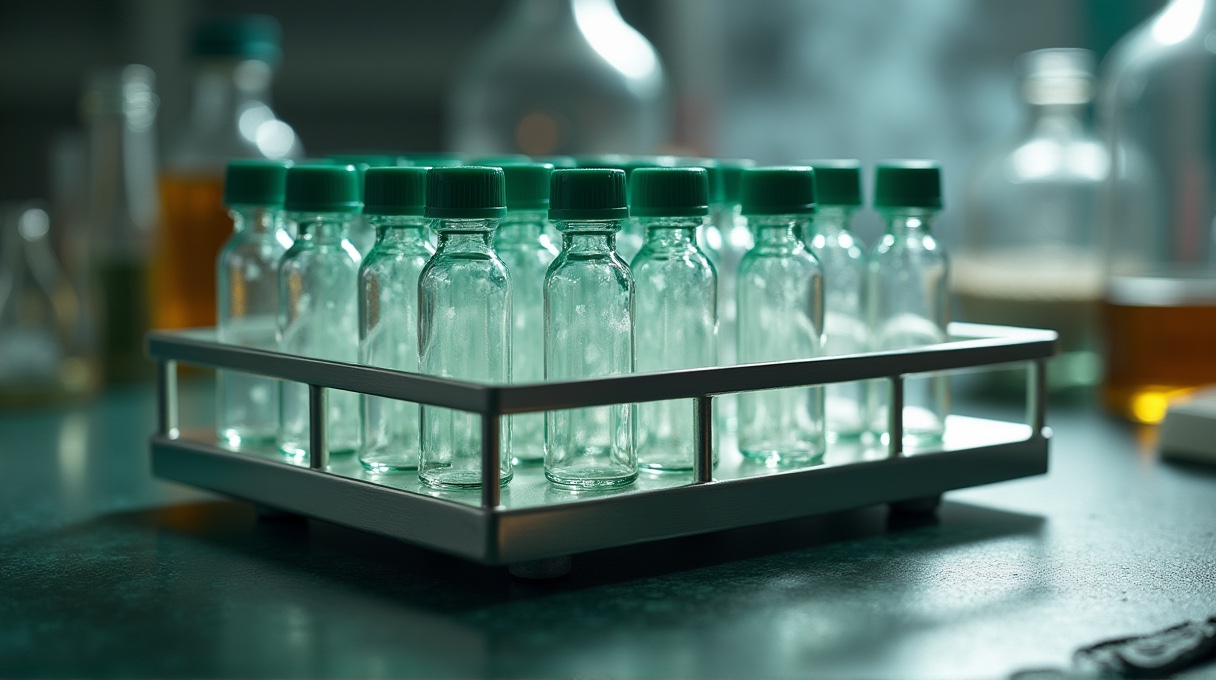
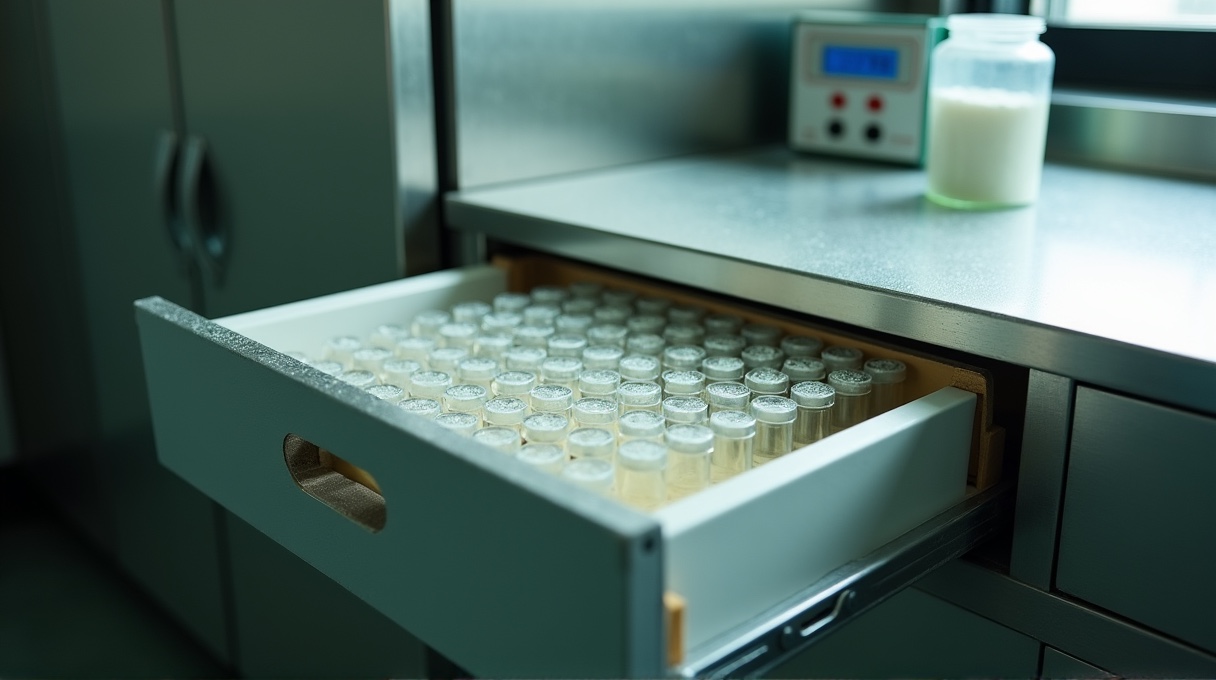
A peptide storage station is a set of designated temperature zones, moisture and light controls, and a labeling system that a lab uses to keep research peptides in the condition they arrived in. It is not one piece of equipment but a small workflow: a freezer for long-term lyophilized stock, a refrigerator for short-term holds and reconstituted solutions, desiccant to keep opened vials dry, and a label and log that tie every vial back to its lot and certificate of analysis. Labs that skip any one of these pieces tend to lose track of which vial is which, not because the peptide degraded but because the paperwork did. This guide covers the equipment, controls and records side of that workflow; for the underlying temperature, light and freeze-thaw science behind the zones described here, see our companion article on peptide storage and stability.
What temperature zones does a storage station need?
A working station separates storage by physical state and by how long the material will sit before use. Published handling recommendations for research peptides describe long-term lyophilized storage at -20 C to -80 C, short-term holds at 2-8 C, and frozen reconstituted stock solutions kept at -70 C or below in sealed tubes, with working dilutions treated as short-term only (Hoofnagle et al., 2016). The table below summarizes the zones in practical terms.
| Zone | Typical range | What belongs here | Notes |
|---|---|---|---|
| Long-term freezer | -20 C to -80 C | Unopened lyophilized vials, concentrated frozen stock solutions | Manual-defrost unit, not frost-free |
| Refrigerator | 2-8 C | Vials in active short-term use, working (dilute) solutions | Limited holding time, not indefinite |
| Bench (brief) | Room temperature | Vial during weighing, reconstitution or aliquoting only | Minutes, not storage |
| Desiccator | Room temperature, low humidity | Opened lyophilized vials between uses | Silica gel or molecular sieve, replace when spent |
Why are frost-free freezers a problem for lyophilized peptides?
A standard household or "frost-free" freezer prevents ice buildup by periodically warming its interior enough to melt condensation, then cooling back down. That cycle is convenient for food but not for a lyophilized cake. FDA-approved storage instructions for at least one other lyophilized biological product state explicitly that frost-free and auto-defrost freezers must not be used because they cycle to warmer temperatures several times a day, and specify a non-cycling freezer instead (FDA, IMLYGIC prescribing information). The underlying issue is general to freeze-dried material: even below its glass transition temperature a lyophilized cake retains some residual moisture and molecular mobility, and repeated warming toward that transition point speeds up the slow degradation pathways that low, stable temperature is meant to suppress (Zäh et al., 2025, on water activity and glass transition in lyophilized formulations). A manual-defrost chest or upright freezer, checked periodically before frost buildup forces a defrost, avoids the problem entirely.
How should desiccant and moisture control work for opened vials?
Lyophilized peptide is hygroscopic. The freeze-drying process removes most of the water that would otherwise drive hydrolysis, but an opened vial exposed to room air starts reabsorbing moisture immediately, and residual moisture above the level needed to stabilize the dried cake increases the rate of degradation (Zäh et al., 2025). The standard fix is a desiccator: recommendations for handling research and clinical peptides call for bringing a lyophilized vial to room temperature inside a desiccator before opening it, so that condensation forms on the desiccant rather than on the peptide, and for storing opened vials in an airtight container with a fresh desiccant pack between uses (Hoofnagle et al., 2016). Silica gel with a color-change indicator is the simplest option for a small lab: swap it out once the indicator beads show the container is no longer holding humidity down. Moisture content in dried protein and peptide preparations is a recognized, independently measurable driver of storage stability, which is why it gets its own control step rather than being lumped in with "keep it cold" (Towns, 1995).
Why does light protection matter for peptide vials?
Peptides that contain aromatic residues such as tryptophan, tyrosine or phenylalanine, along with several other side chains, can absorb light and undergo photo-oxidation. A controlled photostability study of a therapeutic protein exposed to standardized ICH-guideline light dosing found measurable changes to structure, stability and aggregation state that were not present in dark controls held under otherwise identical conditions (Shah et al., 2018). FDA's Q1B guidance defines that standardized light-exposure test (1.2 million lux hours plus a defined near-UV dose) as the benchmark for whether a drug substance needs light-protective packaging (FDA, Q1B Photostability Testing guidance). For a bench storage station, the practical version of that finding is simple: keep vials in amber glass or opaque secondary containers, and store the desiccator or freezer box away from direct light rather than on an open shelf. Handling guidance for research peptides specifically recommends amber or dark storage tubes for photochemically sensitive sequences (Hoofnagle et al., 2016).
What should a labeling scheme include?
Every vial in the station should carry, at minimum: compound name, lot number, date received, date reconstituted (if applicable), concentration once reconstituted, and the initials of whoever performed the reconstitution. This is chain-of-custody information: it lets a lab reconcile any vial against its certificate of analysis rather than relying on memory. Our guide on how to read a peptide certificate of analysis covers what fields a COA reports and how lot numbers tie back to it; the storage label is the bridge between the physical vial and that document. For a compound like the one on our TB-500 lot page, the label on the bench vial and the lot number on the COA should match exactly before anything is logged as in use. A dated log entry at reconstitution, noting diluent volume and resulting concentration, keeps that math auditable later instead of reconstructed from memory.
How should freeze-thaw and aliquoting be handled for reconstituted solutions?
A reconstituted peptide solution is aqueous chemistry: hydrolysis, oxidation and (without a preservative) microbial growth are all live possibilities once powder meets liquid. Handling guidance for research peptides recommends dividing a reconstituted stock into single-use aliquots and storing the concentrated stock frozen (at or below -70 C) rather than repeatedly freezing and thawing one working vial, because multiple freeze-thaw cycles are a recognized route to oxidation of methionine and cysteine residues in peptide sequences that contain them (Hoofnagle et al., 2016). Aliquoting is a bench technique: dividing a reconstituted solution, prepared with our bacteriostatic water or another appropriate diluent, into single-draw volumes that are pulled once and never returned to the freezer. A published stability study of a different reconstituted peptide-excipient product illustrates why a validated window matters: under refrigeration at 2-8 C, that product's biochemical activity and pH remained stable through the full 14-day assessment period, with no bacterial growth detected across five challenge organisms out to 36 days (Ellis et al., 2023). Such figures come from the specific product studied; a lab should treat its vendor's stated shelf life, not a general assumption, as the actual limit.
What temperature log and thermometer setup makes sense?
A simple min/max thermometer, placed in each freezer and refrigerator zone and read and reset on a regular schedule, catches the two failure modes that matter: a unit that drifted warm overnight, and a door left open long enough to matter. The reading, date and initials go in a log next to the unit, clipboard or spreadsheet. This is the same principle behind the FDA's general requirement that drug storage occur "under appropriate conditions of temperature, humidity, and light" with the facility able to show that those conditions were maintained (21 CFR 211.142). A small lab does not need a full GMP monitoring system to benefit from the same habit: a log that shows, after the fact, whether a freezer held its range for the life of a lot.
What should happen when a shipment arrives?
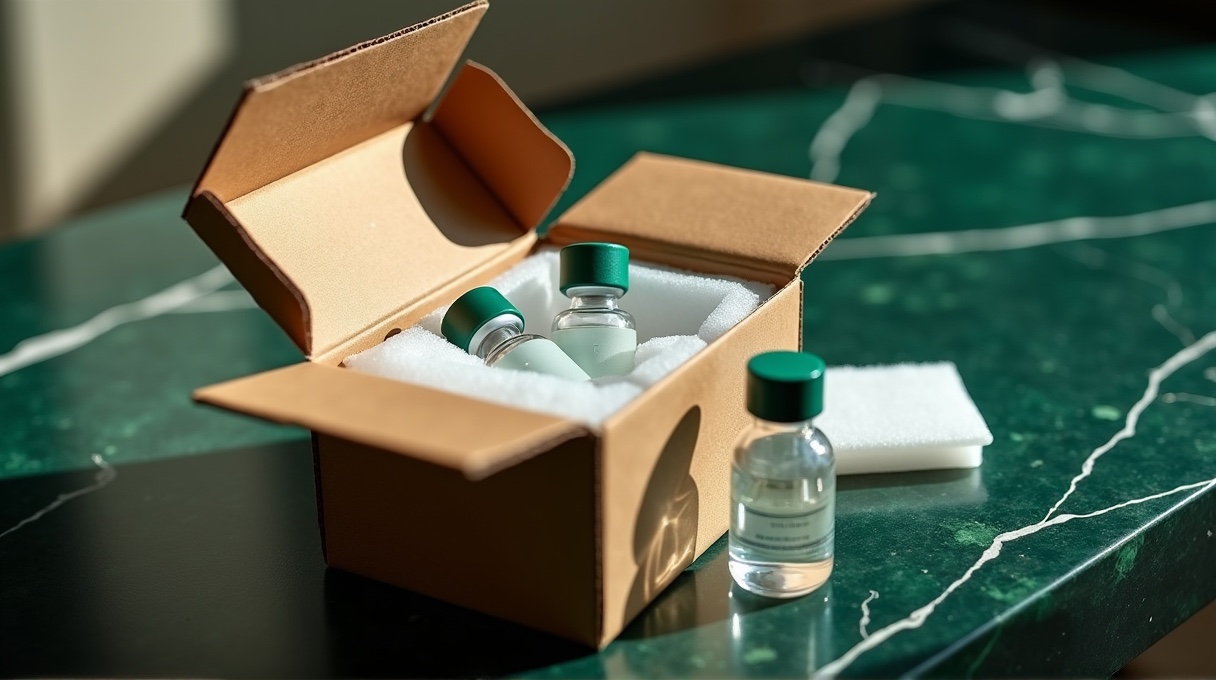
The storage station starts at the door. Inspect the shipment immediately: check that any cold packs or gel packs are still cold (not fully melted), confirm the packing slip and lot numbers match what was ordered, and move lyophilized vials to the freezer zone and any accompanying diluent to the refrigerator without letting them sit at room temperature. Log the date received on each vial's label at this point, before anything else happens to it. Our guide to cold chain and transit for lyophilized peptides covers what a compliant shipment should look like in transit; the storage station is where that cold chain either continues unbroken or breaks on arrival.
Storage conditions by physical state
| State | Recommended storage | Typical holding period | Source |
|---|---|---|---|
| Lyophilized powder, unopened | -20 C to -80 C, manual-defrost freezer | Long-term (months) | Hoofnagle et al., 2016 |
| Lyophilized powder, brief transitional hold | 2-8 C refrigerator | Short-term only | Hoofnagle et al., 2016 |
| Reconstituted concentrated stock | -70 C or below, sealed tube, single-use aliquots | Long-term, one freeze-thaw per aliquot | Hoofnagle et al., 2016 |
| Reconstituted working solution | 2-8 C refrigerator | Per validated study window (example: 14 days for one studied product) | Ellis et al., 2023 |
Frequently asked questions
Can lyophilized peptides go in a regular kitchen-style freezer?
A frost-free or auto-defrost freezer periodically warms itself to clear ice buildup, and FDA-approved storage instructions for other lyophilized biological products explicitly prohibit that type of unit for exactly this reason. A manual-defrost freezer that holds a constant set point is the safer choice for a storage station.
Why is a desiccator necessary if the peptide is already going back in the freezer?
The risk window is not freezer storage, it is the moment a cold vial is opened at room temperature. Bringing the vial to room temperature inside a desiccator first prevents ambient humidity from condensing directly onto the lyophilized cake when the cap comes off.
Does an amber vial replace the need for cold storage?
No. Light exposure and temperature exposure are separate degradation pathways with separate controls. Amber glass or an opaque secondary container addresses photo-oxidation; it does not substitute for keeping the material at the correct temperature.
How long can a reconstituted solution stay refrigerated?
This depends on the specific compound, diluent and concentration, and should be treated as a property of the certificate of analysis or vendor documentation for that lot rather than a fixed rule. Published stability data on reconstituted products in the literature illustrate the kind of validated window a lab should look for rather than a number that applies universally.
What is the minimum information a storage label needs?
Compound name, lot number, date received, date reconstituted if applicable, resulting concentration, and the initials of the person who performed the reconstitution. This is what lets a vial be reconciled against its COA later.
Is a min/max thermometer enough, or does a lab need continuous data logging?
For a small research lab, a min/max thermometer read and logged on a fixed schedule is a reasonable baseline. It will not catch a brief excursion the way continuous logging does, but it does catch sustained drift, which is the failure mode most likely to affect stored material.
References
- Hoofnagle, A.N. et al., "Recommendations for the Generation, Quantification, Storage, and Handling of Peptides Used for Mass Spectrometry-Based Assays," Clinical Chemistry, 2016, PMC
- Zäh, M. et al., "Water Activity as an Indicator for Antibody Storage Stability in Lyophilized Formulations," Molecular Pharmaceutics, 2025, PMC
- Ellis, K. et al., "Biochemical Stability and Microbial Control of Reconstituted DaxibotulinumtoxinA-lanm for Injection," Toxins, 2023, PMC
- FDA, IMLYGIC (talimogene laherparepvec) Prescribing Information (storage and handling section)
- FDA, "Q1B Photostability Testing of New Drug Substances and Products" guidance
- Shah, D. et al., "Effect of photo-degradation on the structure, stability, aggregation, and function of an IgG1 monoclonal antibody," International Journal of Pharmaceutics, University of Colorado Anschutz
- 21 CFR 211.142, Warehousing Procedures, eCFR
- Towns JK. Moisture content in proteins: its effects and measurement. J Chromatogr A. 1995. PubMed 7620565.
Research use only. Homegrown Peptides products are for laboratory research and are not for human or animal use. Nothing in this article is medical advice.