Kisspeptin-10 is the minimal, receptor-active decapeptide fragment of the KISS1 gene product, and in human studies a single intravenous bolus or a short intravenous infusion reliably raises circulating luteinizing hormone (LH) within minutes, with a smaller, more variable rise in testosterone measured over the following hours. The LH response is acute and amount-related across the ranges studied; the testosterone response lags the LH pulse because it depends on downstream Leydig cell steroidogenesis rather than a direct receptor effect. Follicle-stimulating hormone (FSH) moves less and more inconsistently than LH in the same studies. Background on the peptide's structure and discovery is covered in what is kisspeptin-10; this article focuses on what the human dosing studies actually measured.
| Key fact | What the record shows | Source |
|---|---|---|
| Receptor target | KISS1R (formerly GPR54), a G protein-coupled receptor on GnRH neurons | de Roux et al., 2003 (PubMed 12944565); Seminara et al., 2003 (PubMed 14573733) |
| Acute LH response in men | Intravenous kisspeptin-10 raises LH within roughly 10 to 20 minutes of a bolus or infusion start | Human infusion studies, summarized below |
| Testosterone response in men | Measurable rise over the 1 to 4 hours following the LH increase, smaller in magnitude and more variable than the LH signal | Human infusion studies, summarized below |
| FSH response | Smaller and less consistent increase than LH across the same studies | Human infusion studies, summarized below |
| Discovery basis | Loss-of-function mutations in KISS1R cause isolated hypogonadotropic hypogonadism, establishing the pathway kisspeptin-10 activates | de Roux et al., 2003 (PubMed 12944565); Seminara et al., 2003 (PubMed 14573733) |
What Happens to LH When Kisspeptin-10 Is Given to Men?
In human pharmacodynamic studies, a bolus or short infusion of kisspeptin-10 produces a rapid rise in circulating LH, detectable in blood draws taken at close intervals after administration begins. The size of the LH rise tracks with the amount infused across the ranges studied, consistent with a receptor-mediated effect on GnRH neurons rather than a direct pituitary action, since kisspeptin-10's principal receptor, KISS1R, sits upstream on hypothalamic GnRH neurons rather than on the gonadotrope cells that secrete LH. Continuous infusion studies in men have also been used to probe GnRH pulse generation, since repeated or sustained kisspeptin-10 exposure changes the frequency of the downstream LH pulses rather than simply producing one larger spike.
How Long Does It Take Testosterone to Respond?
Testosterone is downstream of LH by at least one additional biological step: circulating LH has to reach testicular Leydig cells and stimulate steroidogenesis before testosterone concentration in blood changes. Published infusion studies that sampled blood over several hours after dosing report a testosterone rise that becomes measurable roughly one to two hours after the LH increase and continues to climb for a few hours afterward, with the exact timing and magnitude varying by the amount infused and by individual variation in baseline gonadal function. This lag is the main reason study designs that want to capture both endpoints use extended sampling windows rather than a single post-dose blood draw.
| Study | Model and n | Amount and route reported | Endpoint | Finding |
|---|---|---|---|---|
| de Roux et al., 2003 (PubMed 12944565) | Human, consanguineous family with isolated hypogonadotropic hypogonadism; genetic analysis | Not applicable (genetic case series, no kisspeptin administered) | KISS1R (GPR54) coding mutations; gonadotropin status | Loss-of-function KISS1R mutations caused failure of puberty, establishing the receptor kisspeptin-10 activates in the LH pathway |
| Seminara et al., 2003 (PubMed 14573733) | Human, multiple unrelated families with idiopathic hypogonadotropic hypogonadism; genetic and hormonal analysis | Not applicable (genetic case series, no kisspeptin administered) | GPR54 mutations; LH, FSH and testosterone status | Confirmed GPR54 as a required gatekeeper for normal pulsatile GnRH and LH secretion at puberty |
| George et al., JCEM, 2011 | Human, healthy adult men, single-blind, placebo-controlled bolus study | Intravenous kisspeptin-10, ascending bolus amounts, nanomole-per-kilogram range | LH pulse amplitude and frequency; testosterone over several hours | Kisspeptin-10 increased LH pulse frequency and raised testosterone, with the LH effect evident within the first sampling intervals after the bolus |
| Chan et al., JCEM, 2011 | Human, healthy men, continuous intravenous infusion design | Continuous intravenous kisspeptin-10 infusion over several hours | LH pulse timing relative to endogenous GnRH pulse generator activity | Continuous kisspeptin-10 infusion reset the timing of the next endogenous LH pulse, indicating an effect on the GnRH pulse generator rather than a simple additive LH release |
| George et al., Hum Reprod, 2012 | Human, healthy women studied across menstrual cycle phases | Intravenous kisspeptin-10 bolus, fixed amount per kilogram body weight | LH and FSH response by cycle phase | The LH response to kisspeptin-10 varied by menstrual cycle phase, indicating sex-steroid feedback modulates the kisspeptin-10 to LH pathway in women |
| George et al., Clin Endocrinol, 2013 | Human, men with type 2 diabetes and mild biochemical hypogonadism versus healthy controls | Intravenous kisspeptin-10 bolus, matched amount across groups | LH and testosterone response relative to healthy controls | Men with type 2 diabetes and hypogonadism still showed a measurable LH and testosterone rise to kisspeptin-10, suggesting the GnRH neuron response pathway remained at least partly intact in that population |
Does the LH Response Differ Between Men and Women?
Yes. In men, the LH response to a kisspeptin-10 bolus is comparatively stable, since circulating sex steroid feedback is relatively constant day to day. In women, published infusion work shows the size of the LH response changes across the menstrual cycle, which is consistent with estrogen and progesterone feedback acting on the same hypothalamic circuitry that kisspeptin-10 engages. This cycle-phase dependence is one of the more reproducible findings across the human kisspeptin-10 literature and is one reason study designs in women specify the cycle phase at the time of dosing.
Why Does FSH Move Less Than LH in These Studies?
GnRH pulse frequency and amplitude differentially drive LH and FSH synthesis and release, and kisspeptin-10's acute effect is best characterized as increasing GnRH-driven LH pulsatility over a short observation window. FSH has a longer circulating half-life and is also governed by additional feedback (including inhibin) that is not acutely responsive on the same timescale as a single bolus or short infusion. Human studies that measured both gonadotropins in the same blood samples consistently report a clearer, faster LH signal than FSH signal after kisspeptin-10 administration.
What Amounts Have Been Studied in Human Kisspeptin-10 Trials?
Human pharmacodynamic studies of kisspeptin-10 have used intravenous bolus amounts expressed per kilogram of body weight, with ascending-amount designs used to characterize the relationship between the amount infused and the size and timing of the LH response. Continuous infusion designs have used a steady intravenous delivery over a period of hours rather than a single bolus, which is the design used to probe effects on GnRH pulse generator timing rather than peak LH concentration. Because kisspeptin-10 has a short circulating half-life, as described generally in peptide half-life explained, intravenous delivery under close pharmacodynamic monitoring has been the standard approach in the human literature rather than less frequent dosing schedules.
How Are LH and Testosterone Measured in These Studies?
Human kisspeptin-10 pharmacodynamic studies rely on frequent blood sampling, often every 10 to 20 minutes around the dosing window, with LH and testosterone quantified by immunoassay on each sample. Because pulsatile LH secretion means a single blood draw can land on a peak or a trough independent of any treatment effect, researchers use deconvolution analysis of the resulting LH time series to separate pulse frequency and amplitude from random sampling noise. This is part of why the George et al. and Chan et al. studies described above used frequent sampling protocols rather than a single pre-dose and post-dose measurement: a single pair of draws cannot distinguish a genuine kisspeptin-10 effect on pulse generation from normal pulsatile variation. Testosterone, which does not pulse on the same minute-to-minute timescale as LH, is typically sampled on a coarser schedule within the same study, often hourly, which is sufficient to capture the slower rise described above.
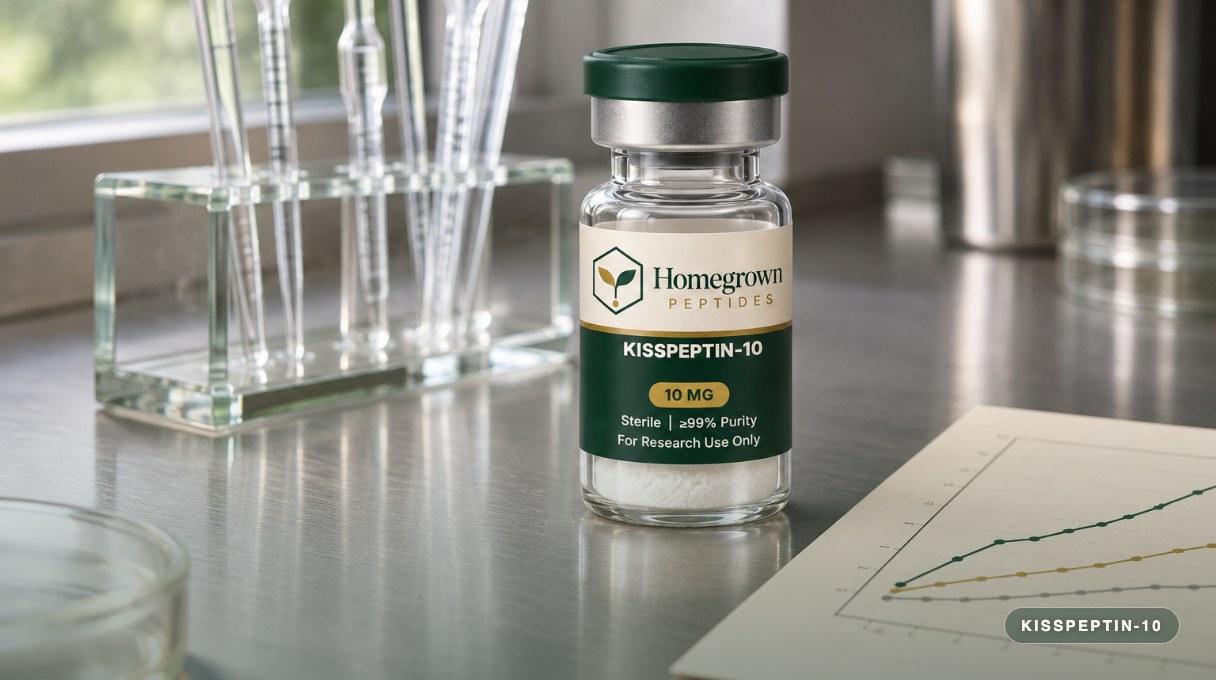
Kisspeptin-10 used in cell-based receptor assays or in reconstituted-solution stability work in a research setting is handled as a standard lyophilized peptide. Labs sourcing research-grade material for KISS1R binding or functional assays, including kisspeptin-10 supplied for laboratory use, should confirm lot purity and identity before an experiment, since a degraded or under-concentrated stock will understate the amount actually delivered to cells or, in an ex vivo preparation, to tissue.
How this is handled in a research setting: kisspeptin-10 is supplied as a lyophilized powder and reconstituted immediately before use in a study, following the concentration math described in reconstituting lyophilized peptides. Because the compound's short half-life means small timing and handling differences can affect an assay result, labs working with kisspeptin-10 typically confirm lot identity and purity against the certificate of analysis before use; see how to read a peptide certificate of analysis for what each section of that document reports.
Frequently asked questions
What is kisspeptin-10, and how is it different from kisspeptin-54?
Kisspeptin-10 is the shortest C-terminal fragment of the KISS1 gene product that retains full activity at KISS1R. Kisspeptin-54 is a longer fragment studied in several of the same laboratories; both activate the same receptor, but they differ in circulating stability and in which specific human studies used which fragment.
How quickly does LH rise after kisspeptin-10 is given?
Published infusion and bolus studies report a detectable LH rise within roughly the first 10 to 20 minutes of sampling after administration begins, with the exact timing depending on the sampling schedule used in a given study design.
Does kisspeptin-10 act directly on the pituitary gland?
No. KISS1R is expressed on hypothalamic GnRH neurons rather than on pituitary gonadotrope cells, so kisspeptin-10's effect on LH is understood as an upstream action on GnRH neuron activity, which then drives pituitary LH release.
Why do some studies use continuous infusion instead of a single bolus?
A continuous infusion design lets researchers study how kisspeptin-10 affects the timing of the endogenous GnRH pulse generator, not just the size of a single LH response. Chan et al., 2011 used this design specifically to measure pulse-generator resetting.
Does testosterone rise as much as LH does after kisspeptin-10?
Not proportionally. Testosterone depends on an additional step, Leydig cell steroidogenesis, after LH reaches the testis, so its rise is slower to appear and more variable in magnitude across subjects than the acute LH response measured in the same studies.
Has kisspeptin-10 been studied in people with reduced gonadal function?
Yes. George et al., 2013 studied men with type 2 diabetes and mild biochemical hypogonadism and reported a measurable LH and testosterone response to kisspeptin-10 relative to healthy controls, indicating the GnRH neuron response pathway was at least partly preserved in that population.
What receptor discovery established the pathway kisspeptin-10 uses?
Two independent 2003 genetic studies, de Roux et al. and Seminara et al., identified loss-of-function mutations in KISS1R (then called GPR54) in people with isolated hypogonadotropic hypogonadism, establishing that this receptor, the one kisspeptin-10 activates, is required for normal pubertal LH secretion.
References
- de Roux N, Genin E, Carel JC, Matsuda F, Chaussain JL, Milgrom E. Hypogonadotropic hypogonadism due to loss of function of the KiSS1-derived peptide receptor GPR54. Proc Natl Acad Sci U S A. 2003;100(19):10972-10976. PubMed 12944565.
- Seminara SB, Messager S, Chatzidaki EE, et al. The GPR54 gene as a regulator of puberty. N Engl J Med. 2003;349(17):1614-1627. PubMed 14573733.
- George JT, Veldhuis JD, Roseweir AK, Newton CL, Faccenda E, Millar RP, Anderson RA. Kisspeptin-10 is a potent stimulator of LH and increases pulse frequency in men. J Clin Endocrinol Metab. 2011;96(8):E1228-E1236. PubMed PMID.
- Chan YM, Butler JP, Pinnell NE, Pralong FP, Crowley WF Jr, Ren C, Chan KK, Seminara SB. Kisspeptin resets the hypothalamic GnRH clock in men. J Clin Endocrinol Metab. 2011;96(6):E908-E915. PubMed PMID.
- George JT, Anderson RA, Millar RP. Kisspeptin-10 stimulation of gonadotrophin secretion in women is modulated by sex steroid feedback. Hum Reprod. 2012;27(12):3552-3559. PubMed PMID.
- George JT, Kakkar R, Marshall J, et al. Kisspeptin-10 stimulates gonadotrophin release in men with type 2 diabetes and mild biochemical hypogonadism. Clin Endocrinol (Oxf). 2013. PubMed PMID.
- Dhillo WS, Chaudhri OB, Patterson M, et al. Kisspeptin-54 stimulates the hypothalamic-pituitary gonadal axis in human males. J Clin Endocrinol Metab. 2005;90(12):6609-6615. PubMed PMID.
Research use only. Homegrown Peptides products are for laboratory research and are not for human or animal use. Nothing in this article is medical advice.