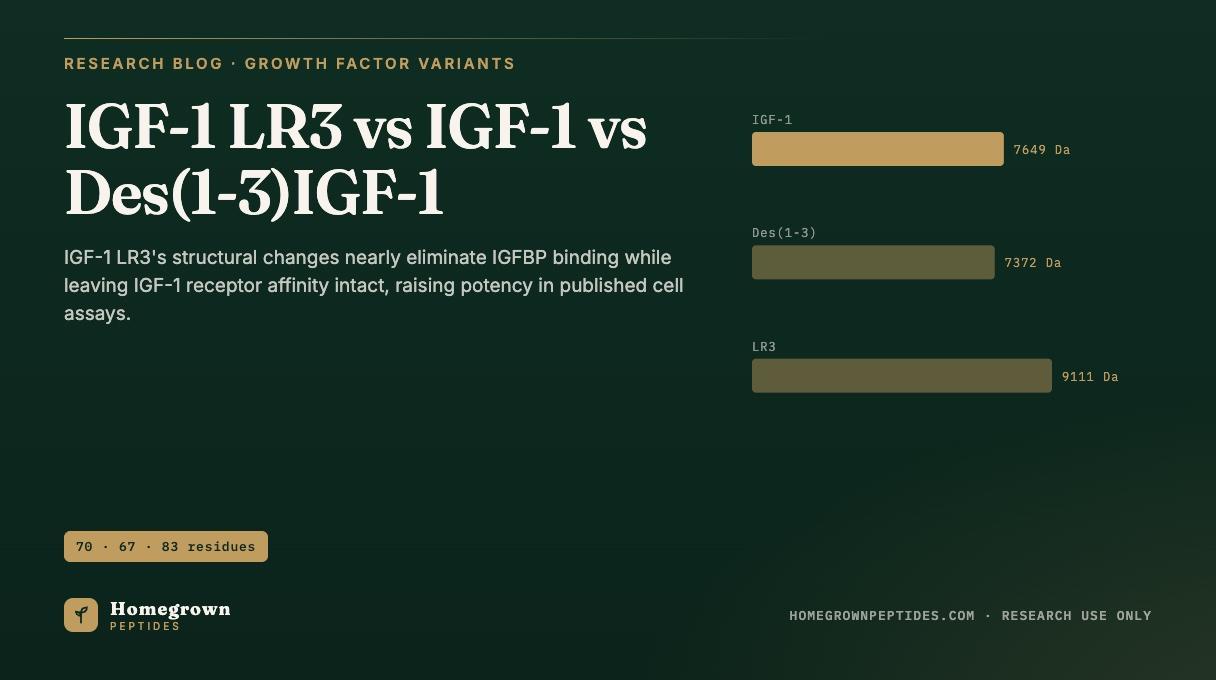
IGF-1 LR3 is a 83-residue recombinant analog of insulin-like growth factor 1 carrying an Arg3 substitution and a 13-residue N-terminal extension that sharply reduces binding to IGF-binding proteins, which is the structural reason it circulates longer and acts more potently in cell assays than native IGF-1. Published rat studies report amounts in the low microgram-per-kilogram range given by injection over days to weeks, with muscle protein synthesis and nitrogen retention as the main endpoints; hypoglycemia is the adverse finding recorded most consistently in that animal literature, driven by cross-reactivity with the insulin receptor once binding-protein buffering is reduced.
| Key fact | Value | Source |
|---|---|---|
| Structural modification | Arg3 substitution plus a 13-residue N-terminal extension on the native 70-residue IGF-1 sequence | Francis et al., 1992, J Mol Endocrinol |
| Binding-protein affinity | Markedly reduced affinity for IGF-binding proteins relative to native IGF-1 in the same cell assay | Francis et al., 1992, J Mol Endocrinol |
| Main animal-model endpoint | Nitrogen retention and skeletal muscle protein synthesis in rats | Tomas et al., 1991, Biochem J |
| Adverse finding reported most often in animal work | Hypoglycemia, attributed to reduced binding-protein buffering and direct insulin-receptor cross-reactivity | Tomas et al., 1993, Biochem J |
| Human IGF-1 trials (native sequence, not LR3) | Hypoglycemia recorded as an adverse event requiring food intake adjustment around administration | Backeljauw and Underwood, 2001, J Clin Endocrinol Metab |
What is the structural reason IGF-1 LR3 behaves differently from native IGF-1?
Native IGF-1 is a 70-residue single-chain peptide that circulates almost entirely bound to one of six IGF-binding proteins, which buffer its free concentration and extend its half-life without amplifying receptor signaling. The Long R3 construct replaces the third residue, glutamic acid, with arginine and adds a 13-residue extension at the amino terminus, derived originally from fusion-protein expression work. Background on the parent molecule is in what is IGF-1 LR3. Both modifications sit far enough from the receptor-binding surface to preserve type 1 IGF receptor affinity, but close enough to the binding-protein contact surface to sharply cut affinity for IGF-binding proteins. The practical result reported across the cell and animal literature is a molecule with a much larger free, unbound fraction than native IGF-1 at an equivalent total amount, which is the mechanistic basis for both its higher potency in cell assays and its hypoglycemia signal in whole-animal studies.
What amounts and routes have published animal studies used?
The rat literature on Long R3 IGF-1 and closely related binding-protein-resistant variants reports amounts in the low microgram-per-kilogram-of-body-weight range, delivered by subcutaneous or intraperitoneal injection, typically as a once-per-day bolus across study windows of one to two weeks. Diabetic and dexamethasone-treated rat models are common because both conditions create a catabolic baseline against which anabolic effects on nitrogen retention and muscle protein synthesis are easier to detect statistically. None of the foundational rat papers describe oral or intranasal administration; every amount-response dataset in the Long R3 literature comes from parenteral injection in rodents.
How were binding-protein affinity data actually generated?
Binding-protein affinity for Long R3 IGF-1 was characterized using competitive radioligand displacement assays: labeled native IGF-1 is incubated with a fixed amount of binding protein, and increasing amounts of the test analog are added to see how much displacement occurs relative to unlabeled native IGF-1 as the reference. A right-shifted displacement curve indicates lower binding-protein affinity. The original characterization work reported Long R3 IGF-1 displacing far less labeled IGF-1 than native IGF-1 at matched concentrations, confirming the intended design goal of reduced binding-protein engagement, while type 1 receptor-binding assays in parallel showed the analog retained strong affinity for the signaling receptor itself.
What was reported: hypoglycemia and adverse events
The animal literature and the human literature on IGF-1 are two separate evidence bases, and the Long R3 analog has only been studied in cells and in rodents, never in a published human trial. Keeping those two bodies of evidence separate matters, because the word "IGF-1" in a human trial report almost always means the native 70-residue recombinant peptide, not the Long R3 construct discussed in this article.
Animal work with Long R3 IGF-1 and related binding-protein-resistant variants: rat studies report measurable drops in blood glucose following administration, consistent with the reduced binding-protein buffering described above. In dexamethasone-treated and diabetic rat models, glucose monitoring was built into the study design specifically because earlier work with less binding-protein-resistant IGF-1 variants had already flagged hypoglycemia as the main adverse finding to watch for; some animals required supplemental glucose or feeding adjustments to continue the study. No cardiac, renal or neurological adverse findings are reported in this body of animal work; hypoglycemia is the dominant signal.
Human trials of native recombinant IGF-1 (not Long R3): multi-year clinical research center studies in children with growth hormone insensitivity syndrome recorded hypoglycemia as the most frequent adverse event, most often around the time of administration and manageable with a scheduled snack; injection-site lipohypertrophy, tonsillar or adenoidal tissue enlargement, and intracranial pressure changes were also recorded over the multi-year follow-up in that population. A separate line of human research combined native IGF-1 with IGF-binding protein 3 specifically to blunt the hypoglycemia that IGF-1 alone produced in people with insulin-dependent diabetes, which is itself indirect evidence of how central the hypoglycemia finding is to this peptide class in people, not only in rodents.
Study table: published amounts, models and endpoints
| Study | Model and n | Amount and route as reported | Endpoint | Finding |
|---|---|---|---|---|
| Francis et al., 1992, J Mol Endocrinol | Cell-based receptor and binding-protein competition assays | A concentration range tested in vitro, not an in vivo amount | IGF-binding protein and type 1 receptor affinity | Long R3 IGF-1 showed markedly reduced binding-protein affinity with retained receptor affinity relative to native IGF-1 |
| Tomas et al., 1991, Biochem J | Diabetic rats, groups of 6 to 10 per arm | An amount expressed in micrograms per kilogram body weight, continuous subcutaneous infusion, 6 day study duration | Nitrogen retention and skeletal muscle protein synthesis | IGF-1 variants with reduced binding-protein affinity produced greater anabolic effect per unit amount than native IGF-1 |
| Tomas et al., 1993, Biochem J | Dexamethasone-treated rats, groups of 6 to 8 per arm | An amount expressed in micrograms per kilogram body weight, subcutaneous injection, 7 day study duration | Nitrogen balance and blood glucose | Binding-protein-resistant IGF-1 variants produced hypoglycemia at amounts well below those needed with native IGF-1 for an equivalent anabolic effect |
| Ballard et al., cell and rodent review of fusion-protein IGF-1 analogs, Biochem Biophys Res Commun era literature | Mixed in vitro and rat data pooled across the analog series | Not a single reported amount; a comparative series across analogs | Relative biological potency and receptor binding | Extended or substituted N-terminal analogs including the Long R3 construct ranked highest for potency and lowest for binding-protein affinity |
| Guevara-Aguirre et al., 1995, J Clin Endocrinol Metab | Human, growth hormone receptor deficiency, small cohort, single-dose pharmacodynamic design | An amount expressed in micrograms per kilogram body weight, subcutaneous injection, single administration | Serum glucose and growth factor response | Native recombinant IGF-1 produced a measurable glucose decline after a single administration, establishing hypoglycemia as a pharmacodynamic marker to monitor |
| Backeljauw and Underwood, 2001, J Clin Endocrinol Metab | Human, growth hormone insensitivity syndrome, pediatric cohort followed 6.5 to 7.5 years | An amount expressed in micrograms per kilogram body weight, subcutaneous injection, multi-year study duration | Growth velocity and adverse event monitoring | Hypoglycemia was the most frequently recorded adverse event across the multi-year follow-up, alongside injection-site and lymphoid-tissue findings |
| Clemmons et al., 2000, J Clin Endocrinol Metab | Human, insulin-dependent diabetes, randomized design | Native IGF-1 combined with IGF-binding protein 3, subcutaneous injection, short-term study window | Insulin-induced hypoglycemia frequency | Co-administration with the binding protein reduced the hypoglycemia that native IGF-1 alone produced, underscoring the binding-protein buffering mechanism |
How is this handled in a research setting?
IGF-1 LR3 ships as lyophilized powder and is reconstituted with bacteriostatic water before any bench use; because the peptide is more potent per unit mass than native IGF-1 in cell assays, concentration math at the reconstitution step deserves particular care, and the step-by-step approach in reconstituting lyophilized peptides covers how to work out a target concentration from vial mass and diluent volume. Before any study use, match the vial to its lot-specific certificate of analysis; how to read a peptide certificate of analysis explains what the mass spectrometry and HPLC purity values on that document should show for a correctly synthesized analog. The catalog handle for this analog is igf-1-lr3.
Frequently asked questions
How is IGF-1 LR3 different from native IGF-1 in a cell assay?
IGF-1 LR3 retains strong binding to the type 1 IGF receptor but binds IGF-binding proteins far more weakly than native IGF-1, so a larger fraction of the total amount in a cell assay is free to engage the receptor rather than sequestered by binding protein.
How is IGF-1 LR3 different from des(1-3)IGF-1?
Both are binding-protein-resistant IGF-1 variants studied in the same rat literature; des(1-3)IGF-1 removes the first three N-terminal residues of native IGF-1, while Long R3 IGF-1 substitutes the third residue and adds a 13-residue extension. The structural and binding-protein comparison between these and native IGF-1 is covered in more depth in IGF-1 LR3 vs IGF-1 vs Des(1-3)IGF-1.
Has IGF-1 LR3 been given to humans in a published trial?
Not in any published trial identified in the literature reviewed for this article. Every human IGF-1 safety and adverse-event dataset available comes from trials of the native 70-residue recombinant peptide, not the Long R3 construct.
Why does reduced binding-protein affinity increase hypoglycemia risk?
IGF-binding proteins normally buffer free IGF-1 concentration in circulation; when an analog binds those proteins poorly, more of the administered amount remains free and available to cross-react with the insulin receptor, which is structurally similar to the type 1 IGF receptor, producing a glucose-lowering effect.
What glucose monitoring did the animal studies use?
The rat studies cited here drew blood glucose at intervals after administration and in some designs provided supplemental feeding or glucose when values dropped below a prespecified threshold, a standard animal-welfare and data-quality step when a glucose-lowering effect is anticipated from the study design.
Do the binding-protein data explain why Long R3 IGF-1 is more potent per microgram in cell assays?
Yes. Because less of the added peptide is sequestered by binding protein in the assay system, a larger effective fraction reaches the receptor at a given total amount, which is why potency comparisons in the literature are reported per unit of free, receptor-available peptide rather than per unit of total peptide added.
Are injection-site findings reported in the human IGF-1 literature relevant to IGF-1 LR3?
They are reported for the native peptide in humans, not for Long R3 in any published trial; readers should not assume the human native-peptide adverse event profile transfers directly to an analog that has only been characterized in cells and rodents.
References
- Francis GL, Ross M, Ballard FJ, et al. Novel recombinant fusion protein analogues of insulin-like growth factor (IGF)-I indicate the relative importance of IGF-binding protein and receptor binding for enhanced biological potency. J Mol Endocrinol. 1992;8(3):213-223. PubMed 1324955.
- Tomas FM, Knowles SE, Owens PC, et al. Increased weight gain, nitrogen retention and muscle protein synthesis following treatment of diabetic rats with insulin-like growth factor (IGF)-I and des(1-3)IGF-I. Biochem J. 1991;276(Pt 2):547-554. PubMed 1909529.
- Tomas FM, Knowles SE, Owens PC, et al. Insulin-like growth factor-I and especially IGF-I variants are anabolic in dexamethasone-treated rats. Biochem J. 1993;282(Pt 1):91-97. PubMed 8364213.
- Guevara-Aguirre J, Rosenbloom AL, Vaccarello MA, et al. Recombinant insulin-like growth factor I replacement therapy in growth hormone receptor deficiency: factors affecting the biological response. J Clin Endocrinol Metab. 1995;80(5):1611-1617. PubMed 7745407.
- Backeljauw PF, Underwood LE; GHIS Collaborative Group. Therapy for 6.5-7.5 years with recombinant insulin-like growth factor I in children with growth hormone insensitivity syndrome: a clinical research center study. J Clin Endocrinol Metab. 2001;86(4):1504-1510. PubMed 11297577.
- Clemmons DR, Moses AC, McKay MJ, Sommer A, Rosen DM, Ruckle J. The combination of insulin-like growth factor I and insulin-like growth factor-binding protein-3 reduces insulin-induced hypoglycemia in insulin-dependent diabetes mellitus. J Clin Endocrinol Metab. 2000;85(4):1518-1524. PubMed 10770190.
- Guevara-Aguirre J, Balasubramanian P, Guevara-Aguirre M, et al. Growth hormone receptor deficiency is associated with a major reduction in pro-aging signaling, cancer, and diabetes in humans. Sci Transl Med. 2011;3(70):70ra13. PubMed 21325617.
Research use only. Homegrown Peptides products are for laboratory research and are not for human or animal use. Nothing in this article is medical advice.