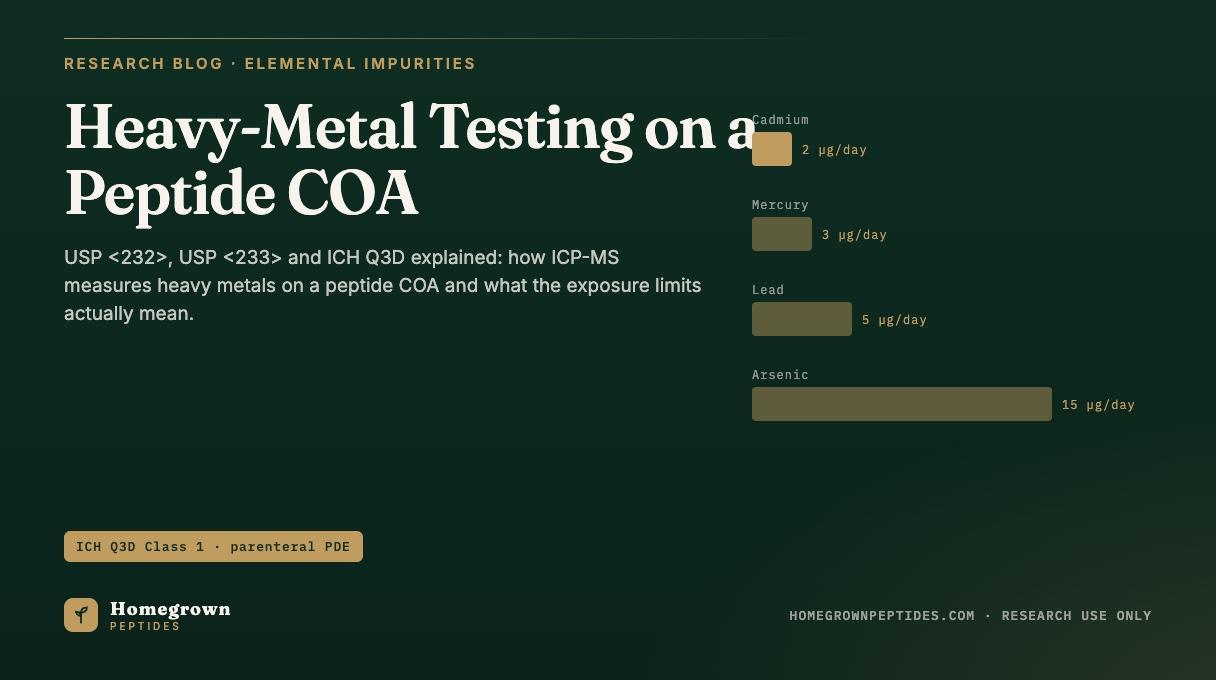
"Heavy metals" on a modern certificate means elemental impurities measured by ICP-MS or ICP-OES under USP <233>, judged against the permitted daily exposures in USP <232> and ICH Q3D. The limits are set per element and per route, with the four Class 1 elements (cadmium, lead, arsenic, mercury) carrying the tightest parenteral PDEs, and a result is reported either per element in ppm (µg/g) or as "below the control threshold."
| Element | ICH class | Parenteral PDE (µg/day) | Typical analytical technique | Source |
|---|---|---|---|---|
| Cadmium | Class 1 | 2 | ICP-MS | ICH Q3D(R2), Table A.2.1 |
| Lead | Class 1 | 5 | ICP-MS | ICH Q3D(R2), Table A.2.1 |
| Arsenic | Class 1 | 15 | ICP-MS | ICH Q3D(R2), Table A.2.1 |
| Mercury | Class 1 | 3 | ICP-MS (cold-vapor or standard nebulization) | ICH Q3D(R2), Table A.2.1 |
| Cobalt | Class 2A | 5 | ICP-MS or ICP-OES | ICH Q3D(R2), Table A.2.1 |
| Vanadium | Class 2A | 10 | ICP-MS or ICP-OES | ICH Q3D(R2), Table A.2.1 |
| Nickel | Class 2A | 20 | ICP-MS or ICP-OES | ICH Q3D(R2), Table A.2.1 |
Why did USP <231> get replaced?
USP General Chapter <231> "Heavy Metals" was a colorimetric sulfide precipitation test: a sample was treated to precipitate a handful of metals as dark sulfides, and the resulting color was compared visually against a lead standard. It returned one combined number, did not identify which element was present, and was blind to several elements regulators actually care about, including mercury in some matrices, with poor recovery and false negatives when organic material interfered with precipitation. USP <232> (limits) and <233> (procedures) replaced it with element-specific, instrument-based measurement, becoming the official compendial requirement for USP-NF articles in December 2018, with ICH Q3D providing the parallel international framework. A certificate that still reports a single "heavy metals" number rather than a per-element panel is reporting against the retired method.
How does ICH Q3D classify elements?
ICH Q3D sorts elemental impurities into four classes based on toxicity and likelihood of occurrence in a drug substance, excipient, or drug product, and that class drives how much testing effort a manufacturer has to justify.
| Class | Elements | Risk basis |
|---|---|---|
| Class 1 | Cadmium (Cd), Lead (Pb), Arsenic (As), Mercury (Hg) | Human toxins with limited or no use in manufacturing; evaluated for every route of exposure regardless of likely source |
| Class 2A | Cobalt (Co), Vanadium (V), Nickel (Ni) | Significant toxicity and relatively high probability of occurrence; a risk assessment is expected unless their absence can be justified |
| Class 2B | Thallium (Tl), Gold (Au), Palladium (Pd), Iridium (Ir), Osmium (Os), Rhodium (Rh), Ruthenium (Ru), Selenium (Se), Silver (Ag), Platinum (Pt) | Significant toxicity but lower probability of occurrence unless intentionally used, for example as a catalyst |
| Class 3 | Lithium (Li), Antimony (Sb), Barium (Ba), Molybdenum (Mo), Copper (Cu), Tin (Sn), Chromium (Cr) | Relatively low toxicity by the oral route but still assessed for parenteral and inhalation products |
Every Class 1 element is evaluated regardless of the synthetic route, because the toxicological concern applies whether or not the element has an obvious reason to be present. Published toxicology reviews on cadmium, lead, arsenic and mercury describe overlapping mechanisms, including oxidative stress and disruption of protein and nucleic acid repair, which is part of why these four carry the tightest limits of any class (Tchounwou PB, et al., 2012; Flora SJ, et al., 2008).
How does a PDE become a concentration limit?
A PDE is expressed in micrograms per day, but a certificate reports a concentration, in micrograms per gram of peptide. ICH Q3D gives three ways to bridge that gap. Option 1 applies one concentration limit to every component of a product by assuming a conservative default maximum daily dose, which the pharmacopeial convention sets at 10 grams per day when the finished product's actual dose is not specified; the limit is simply the PDE divided by that default dose. Option 2 uses the same division but substitutes the product's actual known maximum daily dose, tightening or loosening the ppm limit accordingly; a 2a variant applies one limit to every component, while a 2b variant sets a limit for a single named component, such as the drug substance alone, on the assumption the impurity is confined there. Option 3 skips the concentration step and sums the elemental content contributed by each component, comparing total intake directly against the PDE.
As a calculation only, and strictly as pharmacopeial convention rather than any statement about use, cadmium's parenteral PDE of 2 micrograms per day divided by the Option 1 default of 10 grams per day gives a concentration limit of 0.2 micrograms per gram, or 0.2 ppm. ICH Q3D also defines a control threshold at 30 percent of that calculated limit; a result below it is treated as low enough risk that no further investigation is warranted for that element. USP <233> uses a related summation value, the J value, when screening a panel of elements rather than confirming one: a factor applied so the combined contribution of several elements near their individual thresholds does not collectively exceed the intent of the limits, rather than relying on each element passing its own threshold in isolation.
What does USP <233> require of the method?
USP <233> describes two default procedures, an ICP-OES (inductively coupled plasma optical emission spectrometry) procedure and an ICP-MS (inductively coupled plasma mass spectrometry) procedure, and it permits an alternative validated procedure such as atomic absorption spectroscopy if a laboratory demonstrates equivalence. Before either instrument sees the sample, the peptide is typically digested in a closed-vessel microwave system using nitric acid, sometimes with hydrogen peroxide or a small amount of hydrochloric acid, under elevated temperature and pressure. A closed vessel matters for two reasons: it prevents loss of volatile elements such as mercury and arsenic as the acid heats, and it fully breaks down the organic peptide matrix so the instrument sees free elemental ions rather than metals still bound inside intact peptide bonds.
Validation requirements differ by whether the method is a limit test or a quantitative test. A limit test, reporting only pass or fail against a threshold, must show detectability (a response at the target concentration distinguishable from the response at half that concentration) and precision (repeatability near the target concentration). A quantitative test, reporting an actual numeric concentration, additionally needs accuracy (generally 70 to 150 percent recovery depending on range), specificity (freedom from spectral or matrix interference), and ruggedness across analysts, instruments, and days. ICP-MS generally reaches lower detection limits, often parts-per-trillion, favoring it for Class 1 elements with the smallest PDEs, while parts-per-billion ICP-OES is routinely adequate for higher-PDE elements such as nickel or copper.
Where would metals come from in a synthetic peptide?
A peptide made by solid-phase synthesis does not contain heavy metals by design, but several points in the process can introduce trace amounts. The resin itself, a cross-linked polystyrene or polyethylene glycol support, is manufactured with catalysts and can carry trace metal residues. Coupling and deprotection reagents, including the bases and trifluoroacetic acid cocktails used for chain assembly and final cleavage, are produced at industrial scale and can carry their own trace contamination (Kaiser E, et al., 1970; Isidro-Llobet A, et al., 2009). Some chemistries use a transition-metal catalyst directly: palladium-catalyzed hydrogenolysis is a standard way to remove certain protecting groups, and any residual palladium has to be scavenged and tested for, since Pd is a Class 2B element under ICH Q3D. Stainless-steel processing equipment can leach trace iron, chromium, or nickel on long contact, process water is a route for a broad low-level background, and the ion-exchange resins used to swap a peptide's counterion, for example converting a trifluoroacetate salt to an acetate salt, are themselves a potential source if not adequately cleaned.
Copper deserves a separate note because one widely used research compound, GHK-Cu, contains copper as part of its defined chemical structure rather than as a contaminant. The tripeptide glycyl-histidyl-lysine forms a specific coordination complex with a copper ion, and that bound copper is confirmed as part of the molecule's identity testing, not flagged as an elemental impurity (Pickart L, Margolina A, 2018). A certificate for copper-binding peptide GHK-Cu therefore reports copper content as an identity and content attribute, separately from the Class 3 copper limit that would apply to any unbound, non-complexed copper contamination in the lot. The distinction between an intended structural metal and a metal impurity is exactly why the per-element reporting format matters: a single combined "heavy metals" number could not make that distinction, but a labeled copper-content value and a labeled copper-impurity value can sit side by side on the same certificate without contradicting each other. The GHK-Cu compound overview covers the copper-binding chemistry itself in more depth.
How is the result written on a certificate and how to read it?
An existing overview of endotoxin, sterility and heavy-metal testing on a peptide certificate touches on ICP-MS briefly; the table below is for reading the specific wording a lab uses once that number is on the page.
| Wording on the certificate | What it actually means | Question to ask the lab |
|---|---|---|
| "< 10 ppm total heavy metals" (legacy wording) | A result from the retired USP <231> colorimetric test, reported as one combined figure, not tied to any specific element or route of exposure | Has the panel been updated to element-specific testing under <232>/<233>, and if so, what are the individual element results |
| Per-element result in µg/g, for example "Pb: 0.3 µg/g" | A quantitative ICP-MS or ICP-OES value for one named element, directly comparable to that element's PDE-based concentration limit | Which elements were included in the panel, and was it the Class 1 set only or a broader set |
| "Below the control threshold" | The measured value, or the method's limit of quantitation, falls under 30 percent of the calculated concentration limit for that element, the point at which ICH Q3D says no further risk evaluation is warranted | What is the actual numeric result and the method's detection limit, not only the pass/fail statement |
| "Complies with USP <232>" | A summary statement that every element tested falls under its respective limit | Ask for the underlying per-element data table, since a summary line alone does not show which elements were actually tested |
Reading a certificate line by line, not just the pass or fail summary, is the same habit covered in the general guide to reading a peptide certificate of analysis; heavy-metal reporting is simply the section where that habit matters most, because the summary statement and the underlying data can both be technically true while telling a very different story about what was actually tested.
Frequently asked questions
What is the difference between USP <232> and USP <233>?
USP <232> sets the limits: the permitted daily exposures and the resulting concentration limits per element and per route. USP <233> sets the procedures: the ICP-OES and ICP-MS methods, sample preparation, and validation criteria used to generate the number that gets compared against those limits. They are companion chapters, not alternatives.
Is ICP-MS better than ICP-OES?
Neither is universally better; USP <233> allows either when properly validated. ICP-MS reaches lower detection limits and is generally preferred for the Class 1 elements with the smallest PDEs, since it can detect them well below the concentration limit with margin to spare. ICP-OES has higher throughput for some matrices and is routinely sufficient for elements with larger PDEs.
Does a 99% purity result say anything about metals?
No. HPLC purity is an area-percent measurement of organic related substances, truncated peptides, and other closely related impurities; it has no bearing on inorganic elemental content, which requires a separate ICP-based test. The purity figure is explained in more depth in the article on what 99% purity means.
Why do some certificates still say "heavy metals <231>"?
USP <231> was officially replaced by <232>/<233> in the compendium, with the change taking effect in December 2018. A certificate that still cites <231> wording either comes from a laboratory that has not updated its reported panel, or is a reprinted older document that was never regenerated against the current chapters.
Is copper in GHK-Cu an impurity?
No. Copper is a defined structural part of the GHK-Cu complex, verified during identity testing, and reported as content rather than as a Class 3 elemental impurity. Any additional unbound copper beyond the complex would be assessed separately against the Class 3 limit.
What is a PDE?
Permitted Daily Exposure, the figure ICH Q3D sets for each element and route of exposure. It is derived from toxicological reference points, such as no-observed-effect levels from the published literature, adjusted downward by safety factors, and expressed in micrograms per day.
Why does the route of exposure change the limit for the same element?
ICH Q3D sets separate PDEs for oral, parenteral, and inhalation exposure because absorption and distribution differ by route; parenteral exposure generally bypasses first-pass metabolism, which is a major reason parenteral PDEs for several elements are tighter than the corresponding oral PDEs.
References
- Isidro-Llobet A, Alvarez M, Albericio F. Amino acid-protecting groups. Chem Rev. 2009;109(6):2455-504. PubMed PMID 19364121.
- Kaiser E, Colescott RL, Bossinger CD, Cook PI. Color test for detection of free terminal amino groups in the solid-phase synthesis of peptides. Anal Biochem. 1970;34(2):595-8. PubMed PMID 5443684.
- Pickart L, Margolina A. Regenerative and Protective Actions of the GHK-Cu Peptide in the Light of the New Gene Data. Int J Mol Sci. 2018;19(7):1987. PubMed PMID 29986520.
- Tchounwou PB, Yedjou CG, Patlolla AK, Sutton DJ. Heavy metal toxicity and the environment. Exp Suppl. 2012;101:133-64. PubMed PMID 22945569.
- Flora SJ, Mittal M, Mehta A. Heavy metal induced oxidative stress & its possible reversal by chelation therapy. Indian J Med Res. 2008;128(4):501-23. PubMed PMID 19106443.
- International Council for Harmonisation. ICH Q3D(R2): Guideline for Elemental Impurities. Step 4 version, March 8, 2022. database.ich.org.
- Jin C. Clean Chemistry for Elemental Impurities Analysis of Pharmaceuticals in Compliance with USP 232. AAPS PharmSciTech. 2016;17(5):1141-1149. PubMed 26586536.
- Chahrour O, Malone J, Collins M, et al. Development and validation of an ICP-MS method for the determination of elemental impurities in TP-6076 active pharmaceutical ingredient (API) according to USP <232>/<233>. J Pharm Biomed Anal. 2017;145:84-90. PubMed 28654780.
Research use only. Homegrown Peptides products are for laboratory research and are not for human or animal use. Nothing in this article is medical advice.