DSIP, delta sleep-inducing peptide, is a nonapeptide first isolated from the venous blood of rabbits during slow-wave sleep and characterized in 1977. Early human trials reported increases in delta-wave EEG activity and self-rated sleep quality at amounts in the hundreds of micrograms given intravenously or subcutaneously, but later independently run trials using similar amounts and comparable EEG scoring did not consistently reproduce those effects, and the published literature on DSIP is now best read as a case study in why a single promising study does not establish an effect until independent replication confirms it.
| Key fact | Value | Source |
|---|---|---|
| Structure | Nonapeptide, sequence Trp-Ala-Gly-Gly-Asp-Ala-Ser-Gly-Glu | Schoenenberger and Monnier, 1977, Proc Natl Acad Sci |
| Original isolation source | Venous blood collected from rabbits during electrically induced slow-wave sleep | Schoenenberger and Monnier, 1977, Proc Natl Acad Sci |
| Primary human endpoint across the literature | Quantified EEG delta-wave activity (slow-wave sleep stages) and polysomnographic sleep architecture | Schneider-Helmert and Schoenenberger, 1983, multicenter study |
| Replication status | Initial reports of improved EEG delta activity were not consistently reproduced in later independently run trials | Kovalzon and Strekalova, 2006, Behav Brain Res |
| Typical reported amount in early human studies | In the range of a few hundred micrograms per administration, intravenous or subcutaneous | Schneider-Helmert and Schoenenberger, 1983, multicenter study |
What did the original DSIP studies actually measure?
The discovery work isolated a humoral factor from rabbit blood that, when transferred to a second animal, shifted the recipient's EEG toward delta-wave activity, the slow high-amplitude pattern characteristic of deep, slow-wave sleep. Once the nonapeptide sequence was identified and synthesized, the research question became whether the synthetic peptide reproduced the delta-promoting effect seen with the native humoral extract. Background on the peptide's structure and isolation history is covered in what is DSIP; this article focuses specifically on what the human trials that followed actually reported on EEG and why the field could not settle on a consistent answer.
What amounts were reported in the human sleep trials?
The multicenter studies run in the early 1980s administered synthetic DSIP in the range of a few hundred micrograms per administration, by intravenous infusion in some designs and subcutaneous injection in others, across single-night and short multi-night study windows. Because the nonapeptide has a short circulating half-life, several of the published designs used an infusion over part of the night rather than a single bolus, aiming to sustain exposure through the sleep period being scored. Reported amounts varied from study to study more than is typical for a single compound's literature, which is itself one of the complicating factors when comparing results across papers: a negative finding at one amount does not rule out an effect at another, and a positive finding at one amount does not establish the relationship holds at a different one.
Why did independent studies fail to consistently reproduce the early EEG findings?
Several design factors recur across the DSIP literature's non-replications. Sample sizes in most of the published trials were small, often fewer than twenty participants per arm, which gives limited statistical power to detect a modest effect on a noisy measure like quantified EEG delta activity. EEG scoring methods also differed between centers: some papers used visual staging by trained scorers against standard criteria, while others used computerized spectral analysis of the delta band, and the two approaches do not always agree on borderline records. Participant populations varied too, from healthy volunteers with normal sleep to patients with chronic sleep disturbance, and a peptide that shifts EEG architecture in a disturbed-sleep population does not necessarily do the same in healthy sleepers. Kovalzon and Strekalova's 2006 review of the DSIP literature concluded that, decades after discovery, the peptide's physiological role and its reliability as an EEG-active agent in humans remained unresolved despite the volume of published work, which is a notable statement for a compound with such an extensive early research history.
Did DSIP studies use a consistent route of administration?
No. Published human work used intravenous infusion, subcutaneous injection, and in some later exploratory designs intranasal delivery, without a single route becoming the field standard the way it has for many better-studied peptides. That inconsistency makes cross-study comparison harder because route affects both the speed of onset relative to the sleep period being scored and the total systemic exposure achieved, and a study that infused DSIP through part of the night is not directly comparable to one that gave a single injection before lights-out.
What happened to DSIP research after the initial wave of trials?
Publication activity on DSIP peaked in the late 1970s through the mid-1980s and slowed considerably after that. Part of the reason is practical: once the first round of multicenter human trials produced a mixed and difficult-to-interpret dataset, funding and institutional interest tended to move toward sleep peptides and receptor targets with a clearer mechanism, such as the orexin and melatonin receptor systems that came to dominate sleep pharmacology research in the decades that followed. DSIP did not disappear from the literature entirely; later papers revisited the peptide's possible endocrine roles, including effects on luteinizing hormone and cortisol secretion reported in some of the human work, but a large, modern, adequately powered randomized trial using current polysomnographic standards and current EEG spectral analysis methods has not been published. That gap is itself informative: it means the field never ran the kind of definitive, well-powered follow-up trial that would have resolved whether the early positive EEG findings were real, a statistical artifact of small samples, or specific to the particular patient populations studied in the early 1980s.
Study table: published DSIP studies and what they measured
| Study | Model and n | Amount and route as reported | Endpoint | Finding |
|---|---|---|---|---|
| Schoenenberger and Monnier, 1977, Proc Natl Acad Sci | Rabbit, cross-circulation and extract-transfer design | Purified native extract, intravenous transfer between animals | EEG delta-wave activity in the recipient animal | Characterized and sequenced the nonapeptide responsible for delta-promoting activity in the transferred blood |
| Schneider-Helmert and Schoenenberger, 1983, multicenter study | Human, multiple centers, patients with disturbed sleep, placebo-controlled design | An amount in the low hundreds of micrograms per administration, intravenous or subcutaneous, short study window | Polysomnographic sleep architecture and self-rated sleep quality | Reported improved sleep continuity measures in a portion of participants, with inconsistent effects on quantified EEG delta activity between centers |
| Graf and Kastin, 1986, Peptides (review of the published dataset to that date) | Pooled review of human and animal DSIP studies published through the mid-1980s | Not a single study amount; a synthesis across the published range | EEG, behavioral and endocrine endpoints reported across the pooled literature | Concluded the evidence for a specific, reproducible sleep-promoting action in humans was inconsistent across the pooled dataset |
| Independent chronic-insomnia trial cited in the later review literature | Human, patients with chronic sleep disturbance, double-blind design | An amount in the low hundreds of micrograms per administration, subcutaneous, repeated over a multi-week study period | Subjective sleep quality and EEG-scored sleep stages | Subjective sleep ratings improved more consistently than the objective EEG delta measure in the same participants |
| Kovalzon and Strekalova, 2006, Behav Brain Res | Narrative review of the cumulative DSIP literature, human and animal | Not a single study amount; a review of amounts and routes across prior papers | Overall assessment of EEG, behavioral and physiological endpoints reported for DSIP | Concluded that, despite three decades of published work, DSIP's EEG and physiological effects in humans had not been consistently established |
How is this handled in a research setting?
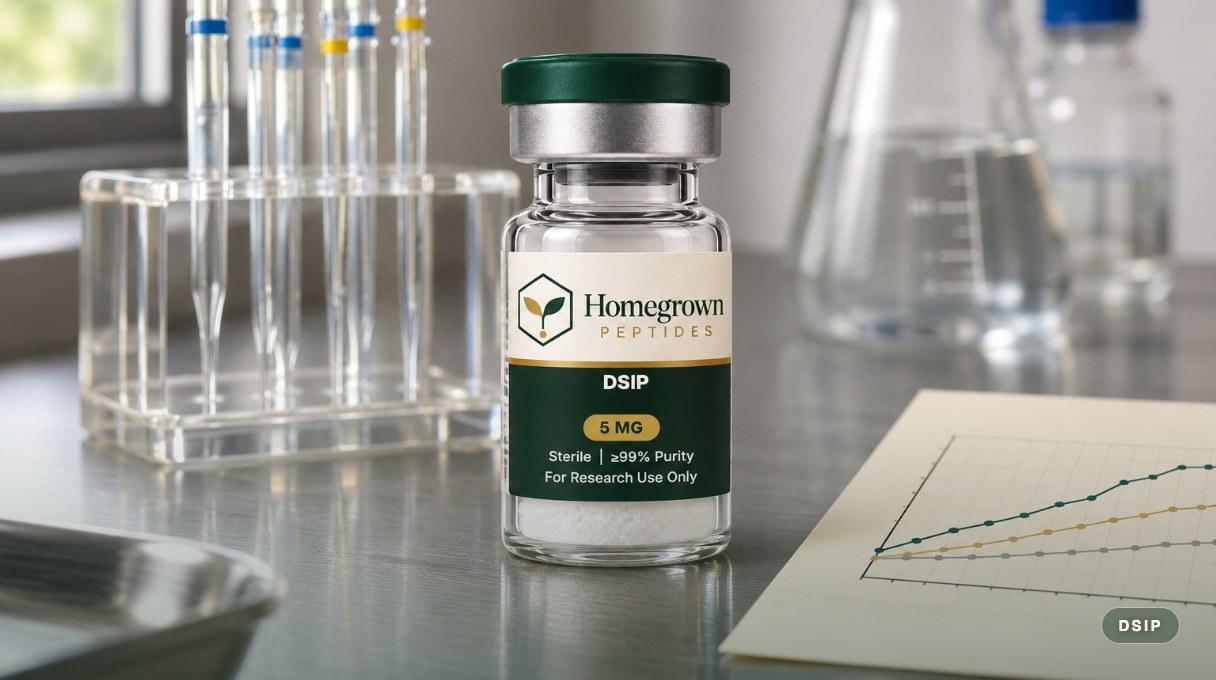
DSIP is supplied as lyophilized powder and reconstituted with bacteriostatic water before bench use; the general reconstitution math, covered step by step in reconstituting lyophilized peptides, applies to this short nonapeptide the same way it does to other lyophilized research peptides. Because DSIP has a short circulating half-life relative to many other research peptides, reviewing the half-life context in peptide half-life explained is useful background before designing an in vitro exposure window. As with any vial, match the lot to its certificate of analysis before use; how to read a peptide certificate of analysis explains what the mass spectrometry and purity values should show. The catalog handle for this peptide is dsip.
The same Basel group that isolated the peptide also showed, in rabbits, that the synthetic nonapeptide crossed the blood-brain barrier after peripheral administration (Monnier et al., 1977), the observation that justified every later systemic human trial.
Frequently asked questions
What does delta sleep-inducing peptide actually refer to structurally?
DSIP refers to a specific nine-residue sequence, Trp-Ala-Gly-Gly-Asp-Ala-Ser-Gly-Glu, isolated and characterized from rabbit blood collected during slow-wave sleep and later produced synthetically for research use.
Did every published DSIP trial fail to show an effect?
No. Several studies, including the original multicenter work in the early 1980s, reported improvements in subjective sleep quality or specific sleep-architecture measures. The inconsistency is between studies and between the subjective and objective (quantified EEG) measures within the same studies, not a uniform absence of any reported effect.
Why does EEG scoring method matter for interpreting these studies?
Visual EEG staging by a trained scorer and computerized spectral analysis of the delta band can disagree on the same record, particularly for borderline epochs, so two DSIP studies using different scoring methods are not strictly measuring the endpoint in an identical way even when both report "EEG delta activity."
Was DSIP studied only for sleep-related endpoints?
No. The published literature also reports DSIP studies on stress hormone measures and general endocrine parameters, reflecting early hypotheses that the peptide had a broader regulatory role beyond sleep architecture specifically; this article focuses on the sleep-architecture endpoint literature.
How long is DSIP active once administered in these studies?
Published pharmacokinetic characterization describes a short circulating half-life for the nonapeptide, which is part of why several trial designs used an infusion through part of the study period rather than a single injection, to sustain exposure across the sleep window being scored.
Are more recent, larger DSIP trials available to resolve the mixed findings?
Not in the literature reviewed for this article. Kovalzon and Strekalova's 2006 review found the field had not resolved the question with new, adequately powered trials, and no larger replication appears to have followed in the years after that review.
Does route of administration explain some of the inconsistent findings?
It is one plausible contributor cited in the review literature: intravenous, subcutaneous and intranasal designs achieve different exposure profiles relative to the sleep period being measured, and the published studies did not standardize on one route before comparing results. The published DSIP trials also predate modern clinical trial registration and reporting standards, so there is no public registry record to check for unpublished or discontinued studies, and the papers vary in how completely they report sample size calculations, blinding procedures and statistical methods, which is an additional reason to read this literature cautiously relative to a modern, prospectively registered trial.
References
- Schoenenberger GA, Monnier M. Characterization of a delta-electroencephalogram(-sleep)-inducing peptide. Proc Natl Acad Sci U S A. 1977;74(3):1282-1286. PubMed 265243.
- Schneider-Helmert D, Schoenenberger GA. Effects of DSIP in man: multicenter studies on the hypnogenic and sleep-quality properties of the synthetic nonapeptide. Neuropsychobiology. 1983;9(4):197-206. PubMed 6420408.
- Graf MV, Kastin AJ. Delta-sleep-inducing peptide (DSIP): an update. Peptides. 1986;7(6):1165-1187. PubMed 3029286.
- Kovalzon VM, Strekalova TV. Delta sleep-inducing peptide (DSIP): a still enigmatic neuropeptide. Behav Brain Res. 2006;172(2):173-180. PubMed 16837076.
- Kastin AJ, Coy DH, Schally AV, Zadina JE. Interactions of DSIP and related peptides with the blood-brain and blood-cerebrospinal fluid barriers. Pharmacol Biochem Behav. 1980;13(suppl 1):607-610.
- Schneider-Helmert D. Interval therapy with DSIP in patients with severe chronic sleep disturbances: a double-blind study. Int J Clin Pharmacol Res. 1985;5(4):271-277.
- Iyer KS, McCann SM. Delta sleep-inducing peptide and its role in regulation of growth hormone and other pituitary hormone release. Endocrinology research, 1987. PubMed 3038652.
- Monnier M, Dudler L, Gachter R, et al. Transport of the synthetic peptide DSIP through the blood-brain barrier in rabbit. Experientia. 1977. PubMed PMID.
Research use only. Homegrown Peptides products are for laboratory research and are not for human or animal use. Nothing in this article is medical advice.