In the published BPC-157 literature, the oral (intragastric) route is used almost exclusively in gastrointestinal models, where the premise of the research is that the peptide is stable in gastric juice and acts locally in the gut. Tendon, muscle and ligament studies are almost all injectable, using intraperitoneal or subcutaneous administration. No paper in the reviewed record runs the same tendon or muscle model through both an oral and an injectable arm to compare them directly.
| Key fact | Detail | Source |
|---|---|---|
| Oral route papers | Concentrated in gastric ulcer, mucosal integrity and gut-injury models | Sikiric P, et al. Eur J Pharmacol. 1997 |
| Injectable route papers | Concentrated in tendon, ligament and muscle models | Staresinic M, et al. J Orthop Res. 2003; 2006 |
| Why oral is used in gut models | Stated premise that the peptide is stable in gastric juice and can act where it is delivered | Sikiric P, et al. Curr Pharm Des. 2010 |
| Direct route comparison studies | None identified in this review for the same tendon or muscle model | Reference list below |
| Systemic absorption data after oral administration | Not established as a separate pharmacokinetic endpoint in the papers reviewed here | Reference list below |
Why are oral BPC-157 studies almost all gut models?
The compound's name in nearly every paper from the Zagreb group includes the phrase "stable gastric pentadecapeptide." That phrase states the authors' founding premise directly: the peptide is proposed to resist breakdown in gastric juice, which is why the intragastric route was chosen for the earliest work on stomach mucosa protection. An intragastric dose delivered to a rat by gavage reaches the stomach and upper gut directly, so a local gut-protection effect does not require much systemic absorption at all. That is a convenient match between route and model: the tissue of interest is exactly where the oral dose lands first.
This also means the oral-route gut papers are not good evidence for what happens after oral administration reaches tissue outside the gastrointestinal tract. None of the gut papers in this review set out to measure blood levels, distribution to muscle or tendon, or any other systemic pharmacokinetic endpoint after intragastric dosing. The oral evidence base answers "does this reach and protect the gut lining," not "does an oral dose reach a tendon or a muscle." The claim of gastric stability itself is reported as a premise in these papers' introductions rather than as a separately cited analytical finding with its own stability-testing methodology; a reader looking for a dedicated gastric-stability assay (for example, incubation in simulated gastric fluid with time-point sampling and mass-spectrometry confirmation of intact peptide) will not find one cited inside the gut-model papers themselves. The stability claim and the gut-protection result are two different kinds of evidence, and only the second is directly measured in the papers in this table.
A second complication is that "oral" and "intragastric" are not identical in every reader's mind. In these rat studies, intragastric delivery means the solution is placed directly into the stomach by gavage tube, bypassing the mouth and esophagus entirely. That is different from how a human would take an oral dose, and none of the papers reviewed here attempt to model swallowing, chewing, or esophageal transit. Readers translating "intragastric" to "oral" should understand that the rat model already skips several steps that would apply to a human oral route.
Does the amount unit change meaning between the two routes?
The per-kilogram amount reported for an intragastric dose and the per-kilogram amount reported for an intraperitoneal dose both describe what left the syringe or gavage tube relative to the animal's body weight. Neither figure accounts for how much of the peptide actually reaches the bloodstream or the target tissue afterward, a quantity pharmacologists call bioavailability. None of the papers in this review report a bioavailability figure for either route. That gap matters because it means the two per-kilogram numbers in the study table below are not directly comparable measures of exposure, even when they share the same nominal figure.
Why are tendon and muscle studies almost all injectable?
Orthopedic models ask a different question: whether a systemically or locally delivered peptide changes repair at a site distant from the gut, such as a transected Achilles tendon or a crushed quadriceps muscle. Every tendon and muscle paper identified in this review used intraperitoneal or subcutaneous administration rather than the intragastric route. That choice is consistent with the orthopedic researchers' goal of getting a reasonably predictable systemic exposure rather than relying on gut absorption, which is harder to control and was never characterized for this peptide in the first place. A smaller number of tendon papers add a local application arm, placing the peptide solution directly at the surgical site in addition to a systemic route, which is a third route distinct from either oral or systemic injection.
What would it take to compare the two routes directly?
A genuine oral-versus-injectable comparison would need the same model, the same amount expressed in comparable per-kilogram terms, and both routes run as arms of one experiment with a shared control group. That study does not appear in the literature reviewed for this article. Readers who see the oral and injectable literatures described as interchangeable should treat that framing with suspicion: it is built by combining two separate bodies of work that were never tested against each other, not by reading a single comparative study.
Study table: route by model, study by study
| Study | Model and n | Amount and route (as reported) | Endpoint | Finding |
|---|---|---|---|---|
| Sikiric et al., 1997 (PubMed) | Rat, stomach mucosa integrity model | 10 micrograms per kilogram and 10 nanograms per kilogram, intraperitoneal and intragastric arms compared within the same gut model | Mucosal integrity, blood pressure response | Both routes protected mucosal integrity in the gut model at comparable amounts |
| Sikiric et al., 2010 (PubMed) | Rat, multiple gastrointestinal injury models reviewed together | Microgram and nanogram per kilogram range, intraperitoneal and intragastric depending on sub-study | Lesion scoring, mucosal protection | Protective pattern reported with both the oral and the injectable route within gut models |
| Staresinic et al., 2003 (PubMed) | Rat, transected Achilles tendon | 10 micrograms per kilogram, intraperitoneal, every 24 hours; no oral arm | Tendon tensile strength, fibroblast outgrowth | Tensile strength and fibroblast outgrowth measures were higher versus untreated controls; route was injectable only |
| Krivic et al., 2008 (PubMed) | Rat, Achilles tendon-to-bone detachment | 10 micrograms per kilogram, intraperitoneal, every 24 hours; no oral arm | Functional recovery of the tendon-to-bone unit | Recovery proceeded on the injectable route even with corticosteroid or NSAID co-administration |
| Staresinic et al., 2006 (PubMed) | Rat, transected quadriceps muscle | 10 micrograms and 10 nanograms per kilogram, intraperitoneal, every 24 hours; no oral arm | Muscle tensile strength, histology | Both amounts on the injectable route were associated with faster early functional recovery |
| Novinscak et al., 2008 (PubMed) | Rat, muscle crush injury | 10 micrograms per kilogram, intraperitoneal, every 24 hours; no oral arm | Muscle structure and function | Structural and functional recovery measures favored the injectable arm versus untreated crush controls |
| Cerovecki et al., 2010 (PubMed) | Rat, ligament injury model | 10 micrograms per kilogram, intraperitoneal and local application arms; no oral arm | Ligament repair measures, functional testing | Both the systemic and the local injectable arms showed repair measures ahead of untreated controls |
How is this handled in a research setting?
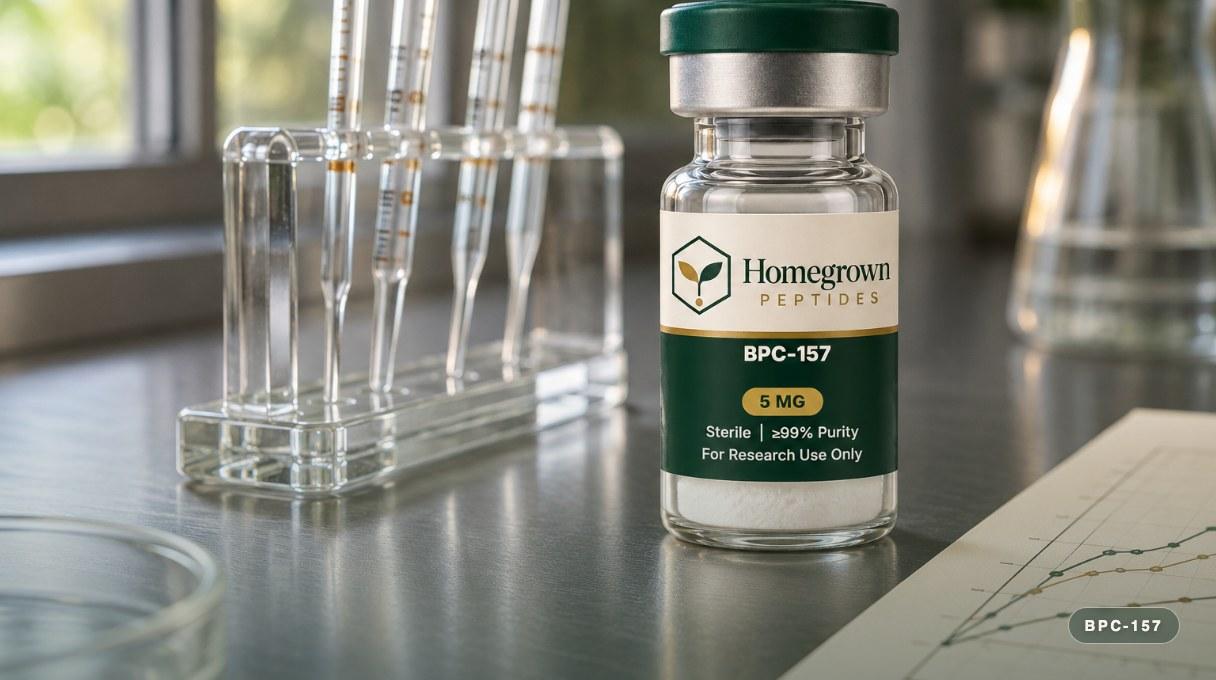
Because the oral and injectable literatures were generated for different models and never run head to head, a research protocol that substitutes one route for the other is substituting one body of evidence for an unrelated one, not interpolating between two points on the same curve. Reconstitution and handling also differ in practice by intended route; our guide to reconstituting lyophilized peptides covers the concentration math for a vial of lyophilized BPC-157 regardless of how the solution is subsequently used in a protocol, and how to read a peptide certificate of analysis explains the purity and identity values that should match the paper's reported peptide before any amount is calculated. Homegrown's BPC-157 research vials are supplied as lyophilized powder with a lot-specific certificate of analysis, the same starting point used across the studies in both tables on this page, regardless of which route a given protocol specifies.
Frequently asked questions
Has anyone compared oral and injectable BPC-157 in the same tendon or muscle model?
Not that this review identified. The injectable tendon and muscle studies have no oral arm, and the oral studies are gut models rather than tendon or muscle models.
Why does the gut literature use the oral route at all?
Because the premise of that research is a peptide proposed to be stable in gastric juice, delivered directly into the stomach where the injury model is located.
Does an oral gut-protection result tell you anything about tendon repair models?
No. The gut papers measure mucosal and intestinal endpoints after intragastric delivery; they do not measure tendon or muscle endpoints and do not establish that an oral dose reaches those tissues.
Is local application the same thing as the oral route?
No. Local or topical application means the peptide solution is placed directly at a wound or surgical site. It is a third route, distinct from both intragastric (oral) and systemic injectable administration, and appears in a subset of the tendon and ligament papers.
Do any of these papers report blood levels after oral administration?
Not in the papers reviewed for this article. None of the gut studies here measured systemic blood levels as a distinct pharmacokinetic endpoint after intragastric dosing.
Are the amounts used on the oral route the same as on the injectable route?
In the one paper that ran both routes within the same gut model, the amounts tested were the same nominal per-kilogram figures. Across the broader literature, amounts are not standardized between routes.
Where does BPC-157 combined with TB-500 fit into the route picture?
Labs that study the two peptides together generally use the same injectable routes reported for each peptide individually rather than an oral arm; see our explainer on why labs pair BPC-157 and TB-500 for how that combined study design is typically built.
References
- Sikiric P, Seiwerth S, Grabarevic Z, et al. The influence of a novel pentadecapeptide, BPC 157, on NG-nitro-L-arginine methylester and L-arginine effects on stomach mucosa integrity and blood pressure. Eur J Pharmacol. 1997;332(1):23-33. PubMed PMID.
- Sikiric P, Seiwerth S, Brcic L, et al. Revised Robert's cytoprotection and adaptive cytoprotection. Curr Pharm Des. 2010;16(10):1226-1238. PubMed PMID.
- Staresinic M, Sebecic B, Patrlj L, et al. Gastric pentadecapeptide BPC 157 accelerates healing of transected rat Achilles tendon and in vitro stimulates outgrowth of fibroblasts from tendon explants. J Orthop Res. 2003;21(6):976-983. PubMed PMID.
- Krivic A, Majerovic M, Jelic I, Seiwerth S, Sikiric P. Modulation of early functional recovery of Achilles tendon to bone unit after transection by BPC 157 and anti-inflammatory agents. Inflamm Res. 2008;57(10):485-492. PubMed PMID.
- Staresinic M, Petrovic I, Novinscak T, et al. Effective therapy of transected quadriceps muscle in rat: gastric pentadecapeptide BPC 157. J Orthop Res. 2006;24(5):1109-1117. PubMed PMID.
- Novinscak T, Brcic L, Staresinic M, et al. Gastric pentadecapeptide BPC 157 as an effective therapy for muscle crush injury in the rat. Surg Today. 2008;38(8):716-725. PubMed PMID.
- Cerovecki T, Bojanic I, Brcic L, et al. Pentadecapeptide BPC 157 (PL 14736) and ligament repair in the rat. J Orthop Res. 2010;28(9):1155-1161. PubMed PMID.
Research use only. Homegrown Peptides products are for laboratory research and are not for human or animal use. Nothing in this article is medical advice.