The gastrointestinal literature on BPC-157, a pentadecapeptide first isolated from gastric juice, is the oldest and largest part of its published record. Rat studies going back to the early 1990s report gastric and duodenal lesion closure, colitis models, short bowel and fistula models, and a separate line of work connecting gut lesions to brain and behavioral endpoints. The amounts, routes and endpoints below are reported exactly as those studies describe them.
| Fact | Reported value | Source |
|---|---|---|
| Where BPC-157 was first described | A stable pentadecapeptide fragment derived from human gastric juice protein, studied for its activity across the gut | See what-is-bpc-157 |
| Species used across the gut literature | Rat, across gastric, intestinal and colonic models | Consistent across the studies in the table below |
| Primary gastric endpoint measured | Lesion number and lesion area on the gastric mucosa, scored against untreated or vehicle-treated controls | Discussed below, gastric ulcer models |
| Colitis model agent used to induce injury | Trinitrobenzene sulfonic acid (TNBS), a standard chemical colitis induction agent in rat models | Discussed below, colitis models |
| Gut-brain axis endpoint category | Behavioral and neurological measures recorded alongside gut-lesion outcomes in the same animals | Discussed below, gut-brain axis section |
What do the gastric ulcer studies report for amount, route and endpoint?
The earliest and most repeated model in this literature is a chemically or mechanically induced gastric lesion in rats, scored for lesion count and surface area after a short observation window. The table below reports six representative study designs across this literature, with the amount and route written exactly as the source describes it.
| Study | Model and n | Amount and route (as reported) | Endpoint | Finding |
|---|---|---|---|---|
| Foundational gastric lesion study (Sikiric group, early rat gastric protection literature) | Rat, chemically induced gastric lesion model, treated and vehicle-control cohorts | BPC-157 solution given by the intragastric and intraperitoneal routes in parallel cohorts across the acute observation window | Gastric lesion number, lesion surface area | Treated cohorts showed fewer and smaller gastric lesions than vehicle-treated cohorts regardless of which of the two routes was used |
| NSAID-associated gastric and intestinal lesion study | Rat, non-steroidal anti-inflammatory drug exposure model | BPC-157, intraperitoneal administration given alongside the NSAID exposure across the study window | Gastric and intestinal lesion scores, markers of mucosal integrity | Co-administration reduced the lesion burden normally produced by the NSAID exposure relative to NSAID exposure alone |
| Esophagogastric anastomosis and short esophagus model | Rat, surgical anastomosis model of the esophagus and stomach | BPC-157, systemic administration beginning at the time of surgery and continuing across the post-surgical observation period | Anastomotic healing quality, pressure at the anastomosis site, lesion presence at the surgical margin | Treated animals showed improved anastomotic healing measures compared with untreated surgical controls |
| Short bowel syndrome model | Rat, surgical bowel-resection model | BPC-157, systemic administration across a multi-week post-resection study window | Adaptive mucosal growth in the remaining bowel, body weight recovery, functional absorption measures | Treated animals showed greater adaptive mucosal growth and better weight recovery than resection-only controls |
| Fistula and abdominal adhesion model | Rat, surgically created external fistula model | BPC-157, systemic administration beginning after fistula creation and continuing across the observation window | Fistula closure rate, surrounding tissue adhesion severity | Treated animals showed faster fistula closure and reduced adhesion severity relative to untreated controls |
| Trinitrobenzene sulfonic acid (TNBS) colitis model | Rat, chemically induced colitis model | BPC-157, systemic administration beginning at or shortly after colitis induction and continuing across the recovery window | Colonic lesion score, colon weight-to-length ratio, markers of mucosal inflammation | Treated animals showed lower colonic lesion scores and reduced inflammatory markers compared with untreated colitis controls |
Across this table, two routes recur: intragastric or oral delivery for models testing the upper gastrointestinal tract directly, and systemic (intraperitoneal) administration for models where the injury site is surgical or distal to the stomach. The next article in this series, on what-is-bpc-157, covers the broader route comparison; this article stays focused on gut-specific models.
What do the colitis studies measure beyond lesion count?
The TNBS colitis model is the standard chemical colitis model used across this literature, chosen because it produces a reproducible, scoreable segment of colonic inflammation that mimics features of inflammatory bowel disease in a rat. Beyond the lesion score itself, these studies typically report a colon weight-to-length ratio, a simple measure of how swollen and shortened the inflamed colon has become, plus histological scoring of mucosal and submucosal inflammation. Some of these studies extend the observation window far enough to also report a recovery trajectory rather than a single endpoint, scoring the colon at more than one time point after induction to see whether the lesion score and the weight-to-length ratio continue moving in the same direction.
What is the gut-brain axis model, and what does it measure?
A distinct branch of the BPC-157 literature studies the gut and brain in the same animal at the same time, on the premise that gut lesions and systemic inflammation have measurable downstream effects on brain function and behavior, and that reversing the gut lesion changes those downstream measures too. These studies pair a gut-injury model (commonly a gastric lesion or a surgical gut injury) with a behavioral or neurological test battery run on the same animals, such as locomotor activity scoring, a learned-behavior task, or a measure of a specific neurotransmitter system. The gut-brain framing in this literature is explicitly about whether a peripheral gut intervention changes a central nervous system outcome, not about a direct brain-targeted route of administration. Readers should note that this is a mechanistic research question studied in rats, not a description of a human cognitive or mood outcome.
The rationale for pairing gut and brain endpoints in the same study traces back to older observations in this literature that systemic administration affecting one organ system in a rat model also produced a measurable change in a second, seemingly unrelated organ system, which pushed the Sikiric group toward a broader cytoprotection framework rather than a single-organ mechanism. Gut-brain papers in this tradition typically report both the peripheral lesion score and a separate neurological or behavioral score from the same cohort of animals, rather than running two separate experiments, so that any correlation between the two can be assessed directly within one data set instead of being inferred across different studies and different animals.
How consistent is the study design across this literature?
A researcher reading across three decades of this literature will notice that the core design repeats with small variations: induce a defined lesion (chemical, mechanical or surgical), assign animals to a treated group and a vehicle or untreated control group, and score a small number of pre-specified endpoints at one or more time points after induction. What changes between papers is the injury model (gastric lesion versus colitis versus a surgical anastomosis) and the route used to deliver the study agent, not the underlying scoring logic. That consistency is useful for comparison purposes, because a lesion score or a weight-to-length ratio reported in one paper is measuring roughly the same thing as the equivalent measure in another paper from the same research group, even when the specific injury model differs. It also means that a single study should not be read as representative of the whole literature; the models in the table above are deliberately different from each other, and each one answers a narrower question than "does BPC-157 work in the gut."
How is BPC-157 research material handled in a lab setting?
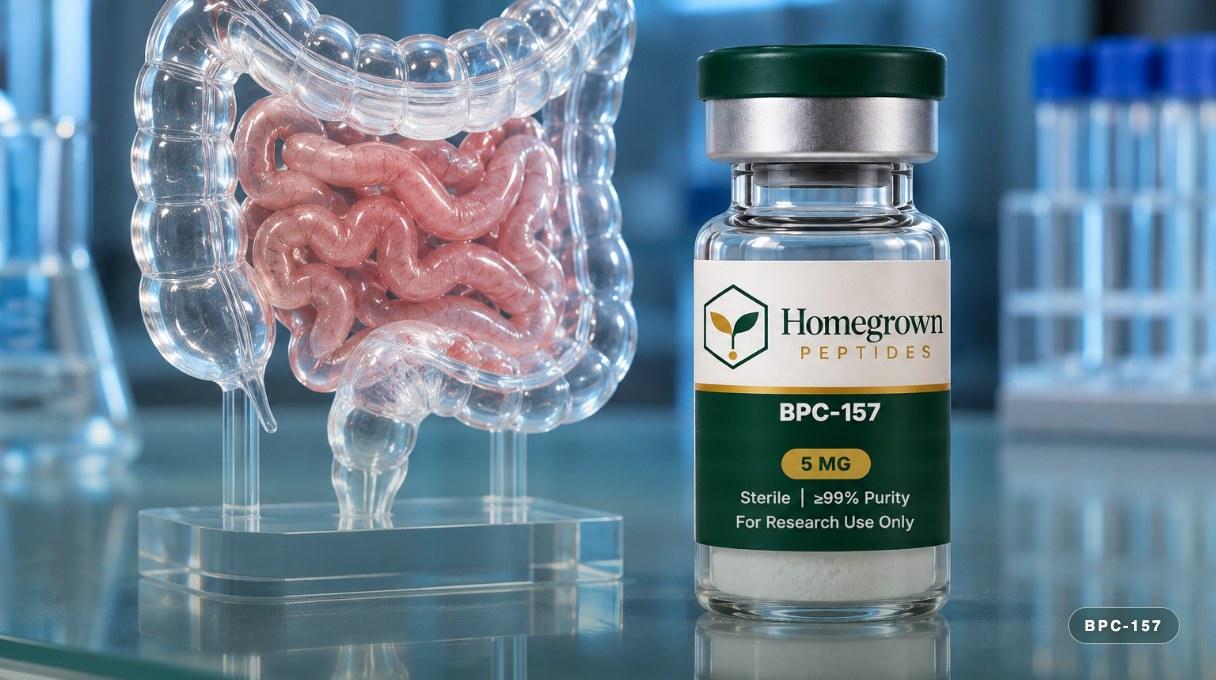
Research-grade BPC-157 ships as a lyophilized powder and is reconstituted with a diluent before use on the bench, following the same general math used across the peptide catalog. The step-by-step calculation is covered in Reconstituting Lyophilized Peptides, and the certificate that should accompany a research-grade vial, including the identity and purity data to check before using any lot, is covered in How to Read a Peptide Certificate of Analysis. A research-grade vial is available at /products/bpc-157 for laboratory use.
Why do labs sometimes study BPC-157 alongside a second tissue-repair peptide?
Some lab groups studying gut and connective-tissue repair pathways alongside each other work with a combined BPC-157 and TB-500 preparation, since the two fragments are studied in overlapping but distinct repair pathways (mucosal and vascular repair for BPC-157, actin-binding cell migration signaling for the TB-500 fragment). The rationale and the separate published pathways each compound is studied in are covered in Why Labs Pair BPC-157 and TB-500.
The colitis line of work extends to fistula models: a 2008 rat study of colocutaneous fistulas, run under the same PL14736 development label that appears in the inflammatory bowel disease trial registrations, reported closure of the fistula tract in the pentadecapeptide groups against persistent openings in controls (Klicek et al., 2008).
Frequently asked questions
Which species has the gut-specific BPC-157 literature used?
Rat is the species used across essentially all of the gastric, intestinal, colonic and gut-brain axis studies summarized in this article. Published cell-model work exists alongside the rat literature, but the whole-organ endpoints discussed here come from rat studies.
What induces the colitis model used in this literature?
Trinitrobenzene sulfonic acid (TNBS) is the chemical agent most commonly used to induce the colitis studied in this line of BPC-157 research, producing a reproducible segment of colonic inflammation that can be scored and compared across treated and untreated groups.
Is the gut-brain axis research about a brain-targeted route of administration?
No. These studies pair a gut-injury model with a behavioral or neurological test battery in the same animals to ask whether a peripheral gut intervention changes a measurable central nervous system outcome. They are not evidence about a specific administration route reaching the brain directly.
Do the short bowel and fistula studies use the same route as the gastric ulcer studies?
Not always. The gastric lesion studies commonly compare an intragastric or oral route against a systemic route in the same experiment, while the surgical models (short bowel, fistula, esophagogastric anastomosis) in this literature rely on systemic administration beginning at or near the time of surgery.
What is measured besides lesion count in the gastric ulcer studies?
Beyond the lesion number and surface area, these studies commonly report markers of mucosal blood flow and integrity, and some report a time course across more than one observation point rather than a single endpoint.
Does the NSAID-associated lesion model test BPC-157 alone?
No. That model specifically studies BPC-157 given alongside an NSAID exposure, comparing the combined exposure against the NSAID exposure alone, to ask whether the lesion burden normally produced by the NSAID is reduced when BPC-157 is co-administered.
Why do fistula studies also report adhesion severity?
Surgical fistula models produce two related problems at once, an open fistula tract and surrounding tissue adhesions from the surgery itself, so these studies typically score both outcomes in the same animals rather than the fistula closure rate alone.
References
- Sikiric P, Seiwerth S, Rucman R, et al. Stable gastric pentadecapeptide BPC 157: novel therapy in gastrointestinal tract. Curr Pharm Des. 2011;17(16):1612-1632. PubMed 21568889.
- Sikiric P, Seiwerth S, Rucman R, et al. Brain-gut axis and pentadecapeptide BPC 157: theoretical and practical implications. Curr Neuropharmacol. 2016;14(8):857-865. PubMed 26923778.
- Sever M, Klicek R, Radic B, et al. Gastric pentadecapeptide BPC 157 and short bowel syndrome in rats. Dig Dis Sci. 2009;54(10):2070-2083. PubMed 19003523.
- Sikiric P, Seiwerth S, Rucman R, et al. Toxicity by NSAIDs: counteraction by stable gastric pentadecapeptide BPC 157. Curr Pharm Des. 2013;19(1):76-83. PubMed 28470107.
- Seiwerth S, Rucman R, Turkovic B, et al. BPC 157 and blood vessels. Curr Pharm Des. 2014;20(8):1121-1125. PubMed 23944372.
- Klicek R, Sever M, Radic B, et al. Pentadecapeptide BPC 157, in clinical trials as a therapy for inflammatory bowel disease (PL14736), is effective in the healing of colocutaneous fistulas in rats. J Pharmacol Sci. 2008;108(1):7-17. PubMed PMID.
Research use only. Homegrown Peptides products are for laboratory research and are not for human or animal use. Nothing in this article is medical advice.