Published BPC-157 studies report amounts spanning roughly ten nanograms per kilogram to ten milligrams per kilogram, delivered intraperitoneally, subcutaneously, intragastrically or applied locally to tissue, depending on the model. There is no standardized amount in the literature: each laboratory selects its own range for its own endpoint, and almost no two papers use identical study designs.
| Key fact | Detail | Source |
|---|---|---|
| Compound class | Synthetic 15-residue (pentadecapeptide) fragment related to a human gastric juice protein | Sikiric P, et al. Eur J Pharmacol. 1997 |
| Amount range reported | Approximately 10 nanograms per kilogram to 10 milligrams per kilogram across rodent models | Study table below |
| Routes reported | Intraperitoneal, subcutaneous, intragastric (oral), and local or topical application | Study table below |
| Most common study animal | Rat (Wistar strain in most Zagreb-group papers) | Staresinic M, et al. J Orthop Res. 2003 |
| Human trial data | No completed systemic human trial results appear in the reviewed record; the literature is animal and in vitro | Reference list below |
| Publication span reviewed here | 1997 to 2014 | Reference list below |
What amounts has published BPC-157 research used?
Most of the BPC-157 literature comes from a single research group at the University of Zagreb (Sikiric, Seiwerth and collaborators), with a smaller independent body of tendon-fibroblast work from a Taiwanese group (Chang, Tsai, Pang). Because the compound originated as a gastric-protection candidate, the earliest amounts were set to test mucosal and vascular endpoints in the stomach, not musculoskeletal repair. Later orthopedic papers borrowed those same amount ranges rather than re-deriving them from a dedicated amount-finding study. That is a structural feature of this literature worth stating plainly: there is no published amount-ranging (Phase 1-style) trial that establishes a minimum effective or maximum tolerated amount in any species. Each paper reports what it used and what it measured, and the amounts repeat across papers more because they were copied forward than because they were independently optimized.
A recurring design choice in the Zagreb-group papers is to test two or more amounts that differ by several orders of magnitude side by side, often a microgram-per-kilogram amount next to a nanogram-per-kilogram amount, and to report that both produced a similar effect on the measured endpoint. The studies describe this as evidence of a flat amount-response curve rather than a classic rising amount-response curve. That pattern appears repeatedly enough across the gut, tendon and muscle papers that it reads as a genuine, reported feature of the lines of evidence, not an artifact of one experiment.
Which routes of administration appear in the BPC-157 literature?
Four routes recur across the published record. Intraperitoneal administration is the default in Zagreb-group rodent work, used in the Achilles tendon, quadriceps muscle and gastrointestinal papers. Subcutaneous administration appears in a subset of the same group's chronic studies. Intragastric administration (the oral route, delivered directly into the stomach by gavage in rats) is reserved almost entirely for gastrointestinal models, where the stated premise of the research is that the peptide is stable in gastric juice and therefore does not need to bypass the gut to act locally. Local or topical application, where the peptide solution is placed directly at a surgical site or wound bed rather than given systemically, appears in several of the tendon and skin papers as a secondary arm alongside a systemic route.
The route a given paper used tracks its model closely. No paper in this review compared all four routes against each other in the same experiment; route comparisons have to be reconstructed across papers rather than read from a single head-to-head trial. A reader looking for oral-versus-injectable evidence specifically should see our companion piece on route comparisons in the rat gut, tendon and muscle literature, linked below, which lays the intragastric and intraperitoneal findings side by side.
How do the amounts compare across tendon, muscle and gut models?
Tendon papers (Achilles tendon transection, tendon-to-bone detachment) and muscle papers (quadriceps transection, crush injury) cluster around microgram-per-kilogram intraperitoneal amounts given once daily for one to four weeks, measured against histology, tensile strength or fibroblast outgrowth. Gastrointestinal papers (ulcer, mucosal integrity) use a wider spread, often testing both microgram and nanogram amounts per kilogram in the same experiment, intraperitoneally or intragastrically, over a single administration or a short repeated course. In vitro tendon-fibroblast work uses concentrations expressed in the culture medium rather than a per-kilogram amount, which is not directly convertible to the in vivo numbers; a cell-culture concentration and a rat intraperitoneal amount are not equivalent figures.
Study table: amounts, routes and models by paper
| Study | Model and n | Amount and route (as reported) | Endpoint | Finding |
|---|---|---|---|---|
| Sikiric et al., 1997 (PubMed) | Rat, stomach mucosa model, group sizes of 8 to 10 per arm | 10 micrograms per kilogram and 10 nanograms per kilogram, intraperitoneal and intragastric arms, single administration | Mucosal integrity, blood pressure response to L-arginine and NG-nitro-L-arginine methyl ester | Both amounts and both routes produced a comparable protective effect on mucosal integrity |
| Staresinic et al., 2003 (PubMed) | Rat, transected Achilles tendon, n reported per time point across a multi-week course | 10 micrograms per kilogram, intraperitoneal, every 24 hours for the full observation period | Tendon tensile strength, histology, fibroblast outgrowth from explants | Faster recovery of tensile strength and greater fibroblast outgrowth versus untreated controls |
| Krivic et al., 2008 (PubMed) | Rat, Achilles tendon-to-bone detachment, multiple study arms including a corticosteroid-exposed arm | 10 micrograms per kilogram, intraperitoneal, every 24 hours for the study period | Functional recovery of the tendon-to-bone unit | Recovery proceeded despite corticosteroid or NSAID co-administration that otherwise slowed the recovery timeline in controls |
| Staresinic et al., 2006 (PubMed) | Rat, transected quadriceps muscle, group sizes reported per time point | 10 micrograms per kilogram and 10 nanograms per kilogram, intraperitoneal, every 24 hours | Muscle tensile strength, histological repair markers | Both amounts were associated with faster early functional recovery of the transected muscle |
| Novinscak et al., 2008 (PubMed) | Rat, muscle crush injury model | 10 micrograms per kilogram, intraperitoneal, every 24 hours for the observation window | Muscle structure recovery, functional testing | Reported acceleration of structural and functional recovery versus untreated crush-injury controls |
| Pevec et al., 2010 (PubMed) | Rat, muscle injury with concurrent systemic corticosteroid administration | 10 micrograms per kilogram, intraperitoneal, every 24 hours | Muscle repair under corticosteroid-impaired conditions | Muscle repair measures were higher relative to corticosteroid-only controls |
| Chang et al., 2011 (PubMed) | Rat Achilles tendon plus tendon-fibroblast cell culture from explants | In vivo arm: microgram-per-kilogram range, subcutaneous; in vitro arm: nanomolar concentrations in culture medium | Cell survival, migration and outgrowth; in vivo tendon histology | Increased fibroblast survival, migration and outgrowth; consistent tendon histology improvement in vivo |
| Chang et al., 2014 (PubMed) | Tendon fibroblast cell culture, in vitro only | Nanomolar range in culture medium (no in vivo arm) | Growth hormone receptor expression in tendon fibroblasts | Receptor expression increased in a concentration-related pattern in culture |
| Sikiric et al., 2010 (PubMed) | Rat, multiple gastrointestinal injury models reviewed together | Microgram and nanogram per kilogram range, intraperitoneal and intragastric, varying by sub-study | Mucosal protection and lesion scoring across models | Consistent protective pattern reported across the amount range and both routes |
What do these amounts have in common across three decades of papers?
Three patterns hold across the table. First, the amounts cluster in a microgram-per-kilogram to nanogram-per-kilogram band regardless of model, which is unusually wide and unusually flat compared with most peptide pharmacology, where effect typically rises and then plateaus or reverses within a much narrower window. Second, intraperitoneal administration dominates outside the gastrointestinal papers, even in studies where a topical or oral route would seem more directly relevant to the tissue being studied; this reflects the Zagreb group's standard rat-handling protocol more than a deliberate route-finding exercise. Third, almost every paper in this line of work uses the phrase "stable gastric pentadecapeptide" in its own title or abstract, which signals the original premise of the whole research program: a peptide the authors proposed to be resistant to degradation in gastric juice, a property relevant to the oral and gut studies but not established by the tendon and muscle papers, which do not re-test stability under those conditions.
How is BPC-157 handled in a research setting?
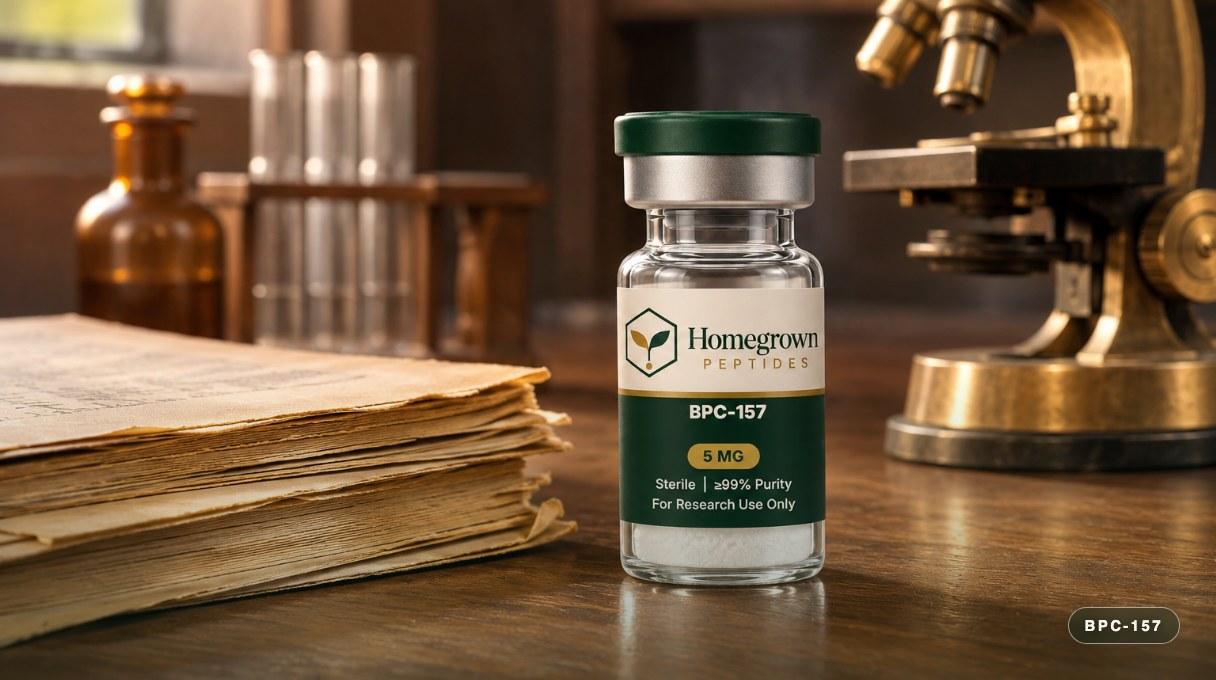
Lyophilized BPC-157 is reconstituted with bacteriostatic water immediately before use on the bench and is not stable indefinitely once in solution; the concentration math and storage conditions used across these studies follow the same reconstitution principles covered in our guide to reconstituting lyophilized peptides. A certificate of analysis for a research lot reports identity, purity and net peptide content, which determines the actual amount of peptide delivered once a vial is reconstituted; see how to read a peptide certificate of analysis for what each value on that document means. Homegrown's BPC-157 research vials and the combined BPC-157 / TB-500 vials ship with a matching lot-specific COA for exactly this reason.
Frequently asked questions
Is there a standard amount used across BPC-157 studies?
No. Amounts vary by laboratory and by model, clustering in a microgram-per-kilogram to nanogram-per-kilogram range, but no published amount-ranging study establishes a standard figure.
Which route of administration is most common in the published record?
Intraperitoneal administration is the most common route in the rodent tendon, muscle and gastrointestinal literature. Intragastric administration appears mainly in gastrointestinal models.
Do higher amounts produce a larger effect in these studies?
Not consistently. Several papers report that amounts differing by three orders of magnitude produced similar results on the same endpoint, which the authors describe as a flat amount-response relationship rather than a classic rising curve.
Are there human trial amounts reported anywhere in the literature?
Not in the papers reviewed here. The published record for BPC-157 is animal and in vitro; no completed systemic human trial results appear in this body of work.
Is BPC-157 the same compound in every paper cited here?
The papers refer to the same 15-residue sequence, sometimes under the designation PL 14736, but synthesis source and purity are not reported identically across papers, which is one reason amounts are not directly comparable study to study.
What is the difference between an in vitro concentration and an in vivo amount in this literature?
An in vitro concentration is the amount of peptide in the culture medium bathing cells and is reported in molar units; an in vivo amount is a per-kilogram figure given to a whole animal. The two are not interchangeable and should not be compared directly.
Does any paper compare BPC-157 against TB-500 directly?
Not within the amount-and-route papers reviewed here. Labs that study the two peptides together typically run them as separate study arms rather than a single combined-amount experiment; see our explainer on why labs pair BPC-157 and TB-500 for how that pairing is usually structured.
References
- Sikiric P, Seiwerth S, Grabarevic Z, et al. The influence of a novel pentadecapeptide, BPC 157, on NG-nitro-L-arginine methylester and L-arginine effects on stomach mucosa integrity and blood pressure. Eur J Pharmacol. 1997;332(1):23-33. PubMed PMID.
- Staresinic M, Sebecic B, Patrlj L, et al. Gastric pentadecapeptide BPC 157 accelerates healing of transected rat Achilles tendon and in vitro stimulates outgrowth of fibroblasts from tendon explants. J Orthop Res. 2003;21(6):976-983. PubMed PMID.
- Krivic A, Majerovic M, Jelic I, Seiwerth S, Sikiric P. Modulation of early functional recovery of Achilles tendon to bone unit after transection by BPC 157 and anti-inflammatory agents. Inflamm Res. 2008;57(10):485-492. PubMed PMID.
- Staresinic M, Petrovic I, Novinscak T, et al. Effective therapy of transected quadriceps muscle in rat: gastric pentadecapeptide BPC 157. J Orthop Res. 2006;24(5):1109-1117. PubMed PMID.
- Novinscak T, Brcic L, Staresinic M, et al. Gastric pentadecapeptide BPC 157 as an effective therapy for muscle crush injury in the rat. Surg Today. 2008;38(8):716-725. PubMed PMID.
- Pevec D, Novinscak T, Brcic L, et al. Impact of pentadecapeptide BPC 157 on muscle healing impaired by systemic corticosteroid application. Med Sci Monit. 2010;16(3):BR81-88. PubMed PMID.
- Chang CH, Tsai WC, Lin MS, Hsu YH, Pang JH. The promoting effect of pentadecapeptide BPC 157 on tendon outgrowth, cell survival, and cell migration. J Appl Physiol (1985). 2011;110(3):774-780. PubMed PMID.
- Chang CH, Tsai WC, Hsu YH, Pang JH. Pentadecapeptide BPC 157 enhances the growth hormone receptor expression in tendon fibroblasts. Molecules. 2014;19(11):19066-19077. PubMed PMID.
- Sikiric P, Seiwerth S, Brcic L, et al. Revised Robert's cytoprotection and adaptive cytoprotection. Curr Pharm Des. 2010;16(10):1226-1238. PubMed PMID.
Research use only. Homegrown Peptides products are for laboratory research and are not for human or animal use. Nothing in this article is medical advice.