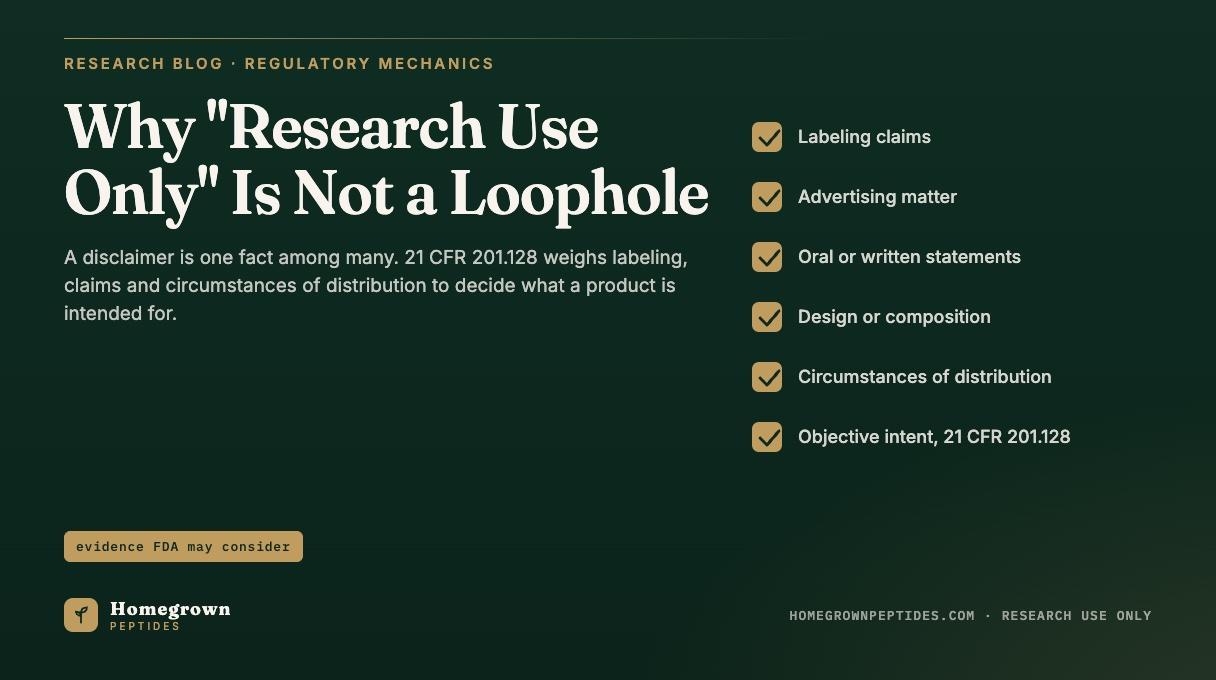
"Research use only" is a statement of intended use, and under 21 CFR 201.128 intended use is judged by objective intent: labeling, advertising, statements, composition and circumstances of distribution. A label cannot override the rest of the evidence, which is what FDA said in its 2026 warning letters to two peptide sellers.
As of November 7, 2026. This article describes United States federal law and published agency actions as of that date. It is general information, not legal advice; the rules differ by state and change over time, and anyone with a specific question should consult a lawyer licensed in their jurisdiction.
| Provision or action | What it establishes | Source |
|---|---|---|
| 21 CFR 201.128 | Intended use is "objective intent," shown by labeling, advertising, statements, composition and circumstances of distribution | law.cornell.edu/cfr/text/21/201.128 |
| 21 CFR 809.10(c)(2)(i) | The only regulatory definition of "Research Use Only," written for in vitro diagnostics | law.cornell.edu/cfr/text/21/809.10 |
| 21 U.S.C. 321(g)(1) | Definition of "drug": intended to diagnose, cure, mitigate, treat or prevent disease, or affect body structure or function | law.cornell.edu/uscode/text/21/321 |
| 21 U.S.C. 355(a) | Bars introducing a "new drug" into interstate commerce without an approved application | law.cornell.edu/uscode/text/21/355 |
| Warning Letter, Peptide Partners LLC | August 24, 2026: intended use for human drug use found despite "research use only" labeling | fda.gov, 735063 |
| Warning Letter, Wholesale Peptide | June 17, 2026: same finding, different products | fda.gov, 729447 |
| FTC Health Products Compliance Guidance | Claims require "competent and reliable scientific evidence"; vague qualifiers do not cure a claim | ftc.gov |
Where does the phrase "Research Use Only" come from?
The exact phrase has one home in FDA's regulations, and it is not about chemicals. 21 CFR 809.10(c) exempts a shipment of an in vitro diagnostic product from certain labeling requirements when marked, under (c)(2)(i), "For Research Use Only. Not for use in diagnostic procedures." A sibling statement exists under (c)(2)(ii): "For Investigational Use Only. The performance characteristics of this product have not been established." Both must be "prominently placed." That is the full regulatory text; no equivalent definition exists anywhere in the Code of Federal Regulations for a research chemical, a peptide, or a compounding ingredient. A peptide vendor printing "Research Use Only" on a vial is borrowing a phrase FDA defined for diagnostic test kits, not adopting a status chemicals qualify for on their own.
FDA's November 2013 guidance, "Distribution of In Vitro Diagnostic Products Labeled for Research Use Only or Investigational Use Only," explains the intent behind the label: "Research Use Only (RUO) products are IVDs intended for use in research and not for clinical diagnostic purposes." It lists conduct FDA treats as inconsistent with that labeling, including "Soliciting or marketing the product for clinical diagnostic use," "Providing clinical performance data or analytical validation studies," and "Assisting customers with clinical validation efforts." That logic, a label must match everything else the firm does, is what later gets applied to chemical sellers under 201.128. A companion article, What "Research Use Only" Means, and Why It Is on Every Vial, covers the plain-language version of this category; this piece stays with the legal mechanics underneath it.
What does 21 CFR 201.128 actually say?
21 CFR 201.128, "Meaning of intended uses," defines intended use as "the objective intent of the persons legally responsible for the labeling of an article." The word "objective" does the work: the rule asks what the evidence shows, not what a seller privately believes. Intent "may be shown by" several kinds of evidence, named specifically in the text.
The first category is "labeling claims, advertising matter, or oral or written statements," which for a research peptide listing covers the product page, catalog copy, and anything a representative says or writes by email, chat, or phone. The second is "design or composition": a product's formulation and packaging are themselves evidence. The third is "circumstances surrounding the distribution of the article," reaching what else is sold alongside it and what instructions travel with a shipment even if absent from the label itself.
A carve-out cuts the other way: "a firm would not be regarded as intending an unapproved new use for an approved drug based solely on that firm's knowledge that such drug was being prescribed or used by health care providers for such use." Knowing a third party misuses a product is not, by itself, enough to make the seller's own intent unlawful.
Two statutory pieces connect directly to 201.128. Under 21 U.S.C. 321(p)(1), a "new drug" is one whose composition is "not generally recognized, among experts qualified by scientific training and experience to evaluate the safety and effectiveness of drugs, as safe and effective for use under the conditions prescribed, recommended, or suggested in the labeling thereof." If the evidence under 201.128 shows intent to treat or prevent a condition in people, the product falls inside the 321(g)(1) drug definition, and an unapproved use makes it a "new drug" under 321(p)(1). Separately, 21 U.S.C. 352(a)(1) makes a drug misbranded "if its labeling is false or misleading in any particular," which is what a "research use only" label becomes once the record points elsewhere.
How did FDA apply the rule to peptide sellers in 2026?
Two 2026 warning letters show 201.128 applied to companies selling research peptides, and both reach the same conclusion through the same structure.
On August 24, 2026, FDA's Center for Drug Evaluation and Research sent a warning letter to Peptide Partners LLC over a line of GLP-1 class compounds, SS-31, a TH9507 product, PT-141, and a "Reconstitution Solution (BAC)." FDA pointed to website statements describing effects in people, including claims about bone health, brain cell activity, blood sugar and lipid levels, appetite and metabolism, retinal protection, liver health, and sexual function, as evidence of intended use. The letter cited FD&C Act sections 201(g)(1), 201(p), 505(a) and 301(d), codified at 21 U.S.C. 321(g)(1), 321(p), 355(a) and 331(d). Its sentence on the label: "Despite statements on your product labeling marketing your products 'for research use only' and 'not for human or veterinary use,' evidence obtained from your website establishes that your products are intended to be drugs for human use." Fifteen business days to respond was given.
On June 17, 2026, the same center sent a warning letter to Wholesale Peptide over Prostamax and Gonadorelin, quoting claims about prostate inflammation and bladder control tied to one product and testosterone production and testes function tied to the other, again as evidence of intended use rather than as fact this article is repeating. The same four sections were cited, and the disclaimer sentence tracks the one above almost word for word: "Despite statements on your product labeling marketing your products for, 'RESEARCH USE ONLY' and 'not for human consumption,' evidence obtained from your product labeling, including your website establishes that your products are intended to be drugs for human use." Fifteen business days to respond was given here too.
One detail in the Peptide Partners letter maps onto the third category in 201.128. The product list included a reconstitution solution sold alongside the peptide line. Under the regulation's own language, what a firm sells together with a product counts as a "circumstance surrounding the distribution of the article," independent of any claim on a web page.
What does FTC add on top of FDA?
FTC regulates advertising under Sections 5 and 12 of the FTC Act, and its Health Products Compliance Guidance sets a substantiation standard that applies whether or not FDA has acted. The standard is "competent and reliable scientific evidence," defined as "tests, analyses, research, or studies that (1) have been conducted and evaluated in an objective manner by experts in the relevant disease, condition, or function to which the representation relates; and (2) are generally accepted in the profession to yield accurate and reliable results." A claim lacking that evidence is a problem under FTC's rules independent of FDA's drug-definition analysis.
The guidance also addresses the defense that a disclaimer fixes a problematic claim: "vague qualifying terms are inadequate," and qualifying information must be "clear and conspicuous, so it is difficult to miss (i.e., easily noticeable) and easily understandable by ordinary consumers." Testimonials get the same treatment: they need "a clear and conspicuous disclosure of the results a typical consumer can actually expect," and "Results not typical" does not cure deception. A seller faces two independent federal tests, and a disclaimer satisfying neither is a safe harbor under neither.
What does consistent RUO conduct look like for a vendor?
201.128 is a two-sided rule: every category of evidence it names can point toward research use or away from it.
| Evidence type in 201.128 | Consistent with RUO | Inconsistent with RUO |
|---|---|---|
| Labeling and advertising | Chemical name, sequence, purity and certificate of analysis data | A claim about an effect in the human body or a named condition |
| Oral and written statements | Describing assay methods, synthesis route, or literature citations | Responding to a customer about personal use or how it is administered |
| Design and composition | Packaging and format built around laboratory handling | Packaging or accessories that only make sense for administering a substance to a person |
| Circumstances of distribution | Sold as a standalone research chemical with a lot-specific certificate of analysis | Bundled with items, instructions, or support services that only serve a human-use purpose |
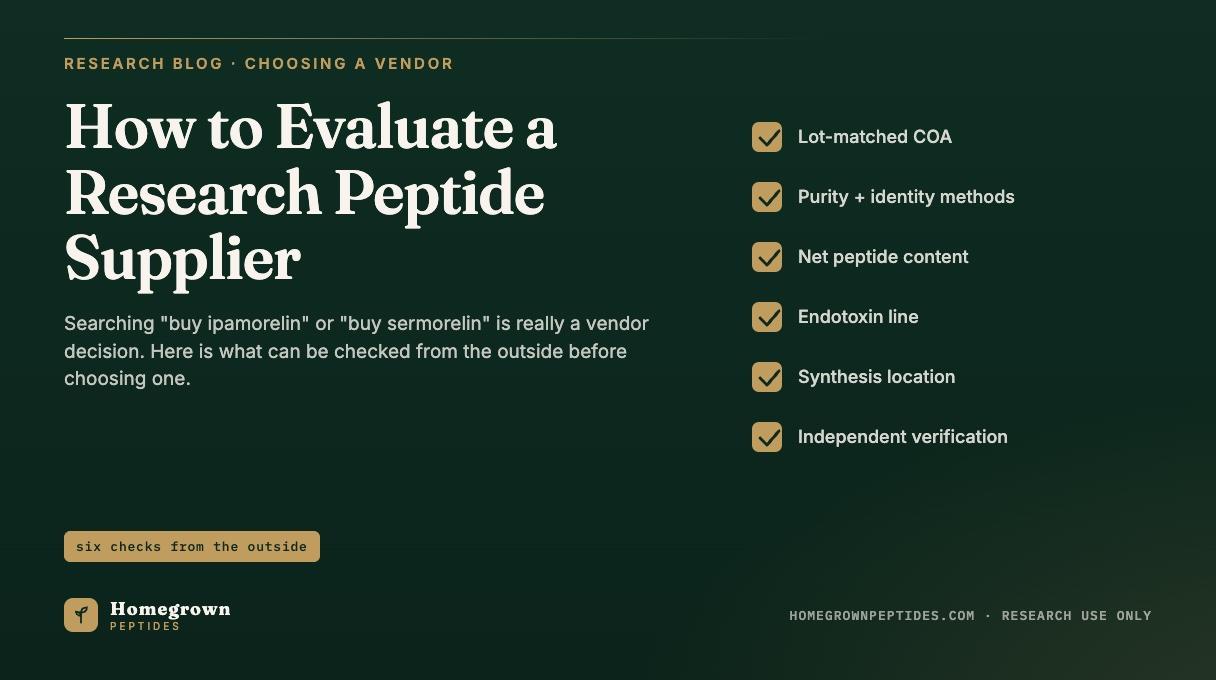
A listing that stays in the left-hand column reads like a chemistry page: a sequence, a purity figure, a lot number, and a certificate of analysis a buyer can check independently. A listing for Selank (/products/selank) that states its sequence, purity figure and lot-matched certificate of analysis is describing chemistry and documentation, the kind of record 201.128 treats as neutral. For evaluating any vendor's listings against this table, see How to Evaluate a Research Peptide Supplier and How to Spot a Bad Peptide Vendor, which catalogs the language and conduct that moves a listing into the right-hand column.
What does the purchaser's attestation do, legally?
Many research chemical storefronts ask a buyer to attest that a purchase is for laboratory, research or forensic use and not for human consumption. That attestation is honest and serves a purpose, but under 201.128 it is one circumstance surrounding the distribution of the article, not a separate shield operating outside the rule.
201.128 does not rank its categories of evidence; labeling claims, advertising, statements, composition and circumstances of distribution are all evidence of the same question, objective intent. An attestation page is a circumstance of distribution and sits alongside everything else a firm says and does. The warning letters to Peptide Partners and Wholesale Peptide make this concrete: both companies had their own disclaimer language, "research use only," "not for human or veterinary use," "not for human consumption," and FDA still found the opposite intended use once it weighed the website claims and product mix as a whole. A purchaser's attestation is the same kind of fact: real, but it does not override labeling claims or sales conduct pointing the other way.
Frequently asked questions
Is "not for human consumption" the same as "research use only"?
Both are labeling statements FDA and FTC treat as evidence of intended use, not categories defined in the regulations the way the IVD-specific phrase in 21 CFR 809.10(c)(2)(i) is. Both warning letters above quote one or both phrases and explain that other evidence overrode them.
Can a disclaimer protect a seller from FDA action?
Not on its own. 201.128 weighs a disclaimer against labeling claims, advertising, statements, composition and circumstances of distribution together. The Peptide Partners and Wholesale Peptide letters both state the disclaimer did not change FDA's intended-use finding once the rest of the record was considered.
Can a buyer be prosecuted under these statutes?
The provisions quoted here, 331(a) on introducing an article into interstate commerce and 331(k) on acts done "while such article is held for sale... after shipment in interstate commerce," are written around introduction into commerce and conduct while held for sale. Nothing in the text addresses a buyer's personal use specifically, and this article does not speculate beyond what those sections say.
Does "research use only" labeling apply to animal use?
21 CFR 809.10(c)(2)(i) is written for diagnostics and does not address animal use. The drug definition at 321(g)(1) separately covers articles "intended for use in the diagnosis, cure, mitigation, treatment, or prevention of disease in man or other animals," so an intended-use finding is not limited to human scenarios.
Is "research use only" a formal regulatory category for chemicals?
No. The only place FDA's regulations define the phrase is 21 CFR 809.10(c)(2)(i), written for diagnostics. For a research chemical or peptide, the phrase borrows that rule's meaning and carries no independent definition or safe-harbor status in the Code of Federal Regulations.
Why do serious vendors refuse to answer questions about human use?
Under 201.128, "oral or written statements" are themselves evidence of intended use. A vendor declining to discuss human use keeps its own statements inside the research-use category of evidence, the same category FDA quoted from both sellers' websites.
References
- Cornell LII. 21 U.S.C. 321, definitions, (g)(1) "drug" and (p)(1) "new drug." Current as of November 7, 2026. law.cornell.edu
- Cornell LII. 21 U.S.C. 331, prohibited acts. Current as of November 7, 2026. law.cornell.edu
- Cornell LII. 21 U.S.C. 352, misbranded drugs and devices. Current as of November 7, 2026. law.cornell.edu
- Cornell LII. 21 U.S.C. 355, new drugs. Current as of November 7, 2026. law.cornell.edu
- Cornell LII. 21 CFR 201.128, meaning of intended uses. Current as of November 7, 2026. law.cornell.edu
- Cornell LII. 21 CFR 809.10, in vitro diagnostic products labeling. Current as of November 7, 2026. law.cornell.edu
- FDA. Distribution of In Vitro Diagnostic Products Labeled for Research Use Only or Investigational Use Only. November 2013. fda.gov
- FDA. Warning Letter to Peptide Partners LLC. August 24, 2026. fda.gov
- FDA. Warning Letter to Wholesale Peptide. June 17, 2026. fda.gov
- Federal Trade Commission. Health Products Compliance Guidance. ftc.gov
For the broader legal landscape this single rule sits inside, see Are Research Peptides Legal in the United States?
Research use only. Homegrown Peptides products are for laboratory research and are not for human or animal use. Nothing in this article is medical advice.