Every synthetic research peptide in a vial was assembled one residue at a time on a polymer bead. The method is solid-phase peptide synthesis, introduced by Bruce Merrifield in 1963, and it is still the basis of essentially all commercial peptide production. Understanding it is practical: the impurity peaks on a chromatogram, the price gap between a short peptide and a long one, and the trifluoroacetate in the powder all follow from how the chain was built.
The core idea
Classical solution chemistry runs into a purification problem when building a chain. After each bond is formed, the product has to be isolated from reagents and byproducts, and doing that dozens of times destroys the yield. Merrifield's insight was to anchor the growing chain to an insoluble support. The chain stays on the bead, every reagent is in solution around it, and purification collapses into a filtration and a wash.
The chain is built from the C-terminus toward the N-terminus, the opposite direction from biological translation. The C-terminal residue goes onto the resin first, and each new residue is added at the free amino end.
The resin
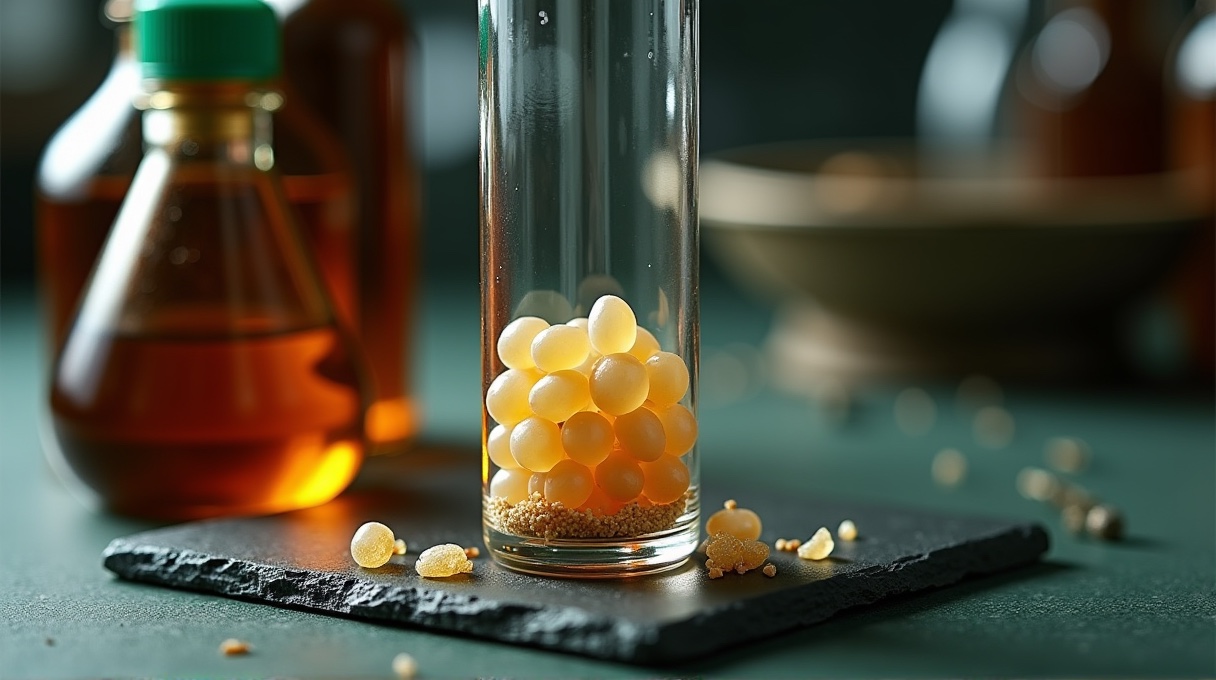
The support is a bead of cross-linked polystyrene, roughly the size of a grain of fine sand, functionalized with a chemical linker that holds the first residue. The bead swells in organic solvent so reagents reach chains anchored inside as well as on the surface. Loading, in millimoles of chain per gram of resin, is a deliberate choice: high loading yields more per batch, low loading spaces the chains apart and reduces the aggregation that makes couplings fail in difficult sequences.
Fmoc chemistry and the alternative
Each incoming amino acid arrives with its own alpha-amino group blocked, so it can only react at one end. Two blocking strategies dominate. Boc chemistry, the original, uses an acid-labile group removed with trifluoroacetic acid at every cycle and requires hydrogen fluoride for the final cleavage. Fmoc chemistry uses a base-labile group removed with piperidine, and reserves acid for the final step only.
Fmoc is the standard for commercial synthesis today. It avoids hydrogen fluoride entirely, it is milder on sensitive side chains, and the deprotection step releases a strongly ultraviolet-absorbing byproduct that can be monitored in real time.
The cycle
Every residue is added by the same repeating loop.
- Deprotection. Piperidine in solvent removes the Fmoc group, exposing a free amine at the end of the chain.
- Wash. Solvent flushes the reagent and byproduct away.
- Coupling. The next Fmoc amino acid, activated by a coupling reagent, is added in excess and forms the amide bond. Activation turns the carboxyl group into something reactive enough to join at room temperature.
- Wash. Excess reagent is flushed out.
- Optional capping. Acetic anhydride acetylates any chain that failed to couple, permanently stopping it.
Repeat for every residue. A seven-residue peptide such as Selank runs six of these cycles after the first residue is loaded. A forty-four-residue peptide such as tesamorelin runs forty-three of them. Capping shapes the impurity profile. Without it, a chain that missed a residue keeps growing into a deletion sequence close in mass and retention time to the target. With it, the chain stops and becomes a short truncation, far easier to separate.
Protecting groups
The alpha-amino group is not the only reactive site. Lysine, aspartate, glutamate, serine, threonine, tyrosine, cysteine and arginine all carry side chains that would react during a coupling. Each is blocked with its own protecting group for the duration of the synthesis.
The strategy is called orthogonal protection. The alpha-amino group comes off with base at every cycle. The side-chain groups are acid-labile and stay on until the very end. Two removal conditions that do not interfere with each other, which is what makes stepwise assembly possible at all.
Cleavage
When the last residue is coupled, the peptide is still on the bead with every side chain protected. A concentrated trifluoroacetic acid cocktail does both remaining jobs at once: it cuts the linker and strips the side-chain protecting groups. The cocktail includes scavengers such as water and triisopropylsilane, because the protecting groups leave as reactive carbocations that would otherwise attack tryptophan, methionine and tyrosine.
The peptide is then precipitated in cold ether, collected and dried. What comes out is crude peptide, and it is also the point at which trifluoroacetate becomes part of the product. It pairs to the basic side chains and stays through freeze-drying, which is why the powder in the vial is a TFA salt and why net peptide content sits below 100 percent.
Crude purity versus final purity
Crude purity is what the cleaved material measures before any cleanup. It depends on length and sequence difficulty, landing anywhere from below 40 percent for a long problem sequence to above 80 percent for a short clean one. The arithmetic is unforgiving. If every coupling runs at 99.5 percent completion, a 15-residue peptide such as BPC-157 keeps about 93 percent of chains intact, while a 44-residue chain keeps about 81 percent. Drop the per-step efficiency to 99 percent and the long peptide falls to roughly 65 percent.
| Chain length | Couplings | Intact at 99.5% per step | Intact at 99% per step |
|---|---|---|---|
| 7 residues | 6 | Around 97% | Around 94% |
| 15 residues | 14 | Around 93% | Around 87% |
| 30 residues | 29 | Around 86% | Around 75% |
| 44 residues | 43 | Around 81% | Around 65% |
Purification by preparative reverse-phase HPLC then takes the crude to the final specification. The crude is loaded onto a large C18 column, a gradient separates the target from the deletions and the modified species, and fractions are collected, checked by analytical HPLC and mass spectrometry, pooled and lyophilized. Every fraction rejected is yield lost, so a low crude purity is expensive twice: once in a harder separation, once in the material thrown away.
Where the impurities come from
- Deletion sequences. A coupling that did not go to completion on an uncapped chain. Differs from the target by exactly one residue mass.
- Truncations. Capped chains that stopped early. Shorter and usually well separated on the column.
- Incomplete deprotection. A side-chain protecting group that survived cleavage, adding its own mass.
- Aspartimide formation. A ring closure at aspartate during repeated base treatment, seen as a loss of water and often as a pair of peaks.
Every one of those has a mass signature, which is why the identity test matters as much as the purity test. The shifts are tabulated in our guide to mass spectrometry for peptide identity, and how they show up on a chromatogram is covered in HPLC purity explained.
Why longer peptides cost more
Three costs compound with length. More cycles means more reagent and more instrument time. Lower crude purity means a harder separation and more material discarded. And long chains fold on the resin as they grow, burying the reactive end and making later couplings slower and less complete, which sometimes forces double couplings, elevated temperature or specialized building blocks. The full range of chain lengths sits in the research peptide catalogue.
Frequently asked questions
Are research peptides synthetic or extracted from tissue?
Synthetic. Solid-phase synthesis gives a defined sequence with a documented impurity profile, which extraction cannot match. Very long chains and proteins are made by recombinant expression instead.
Why is there trifluoroacetate in the powder at all?
It is used in the cleavage cocktail and as an ion-pairing agent in preparative HPLC, and it survives lyophilization. An acetate salt form can be requested when an assay is sensitive to it.
Does a lower purity number always mean worse synthesis?
Not on its own. A long or difficult sequence purified to 98 percent can represent more work than a short one at 99.5 percent. What matters is what the remaining percent consists of, which the chromatogram and the mass spectrum answer together.
References
- Merrifield RB. 1963. Solid phase peptide synthesis I: the synthesis of a tetrapeptide. Journal of the American Chemical Society.
- Carpino LA, Han GY. 1972. The 9-fluorenylmethoxycarbonyl amino-protecting group. Journal of Organic Chemistry.
- Amblard M, et al. 2006. Methods and protocols of modern solid phase peptide synthesis. Molecular Biotechnology.
- Behrendt R, White P, Offer J. 2016. Advances in Fmoc solid-phase peptide synthesis. Journal of Peptide Science.
Research use only. This article describes synthetic chemistry and manufacturing. Homegrown Peptides products are not for human or animal use, are not drugs, and nothing here is medical advice or a protocol.