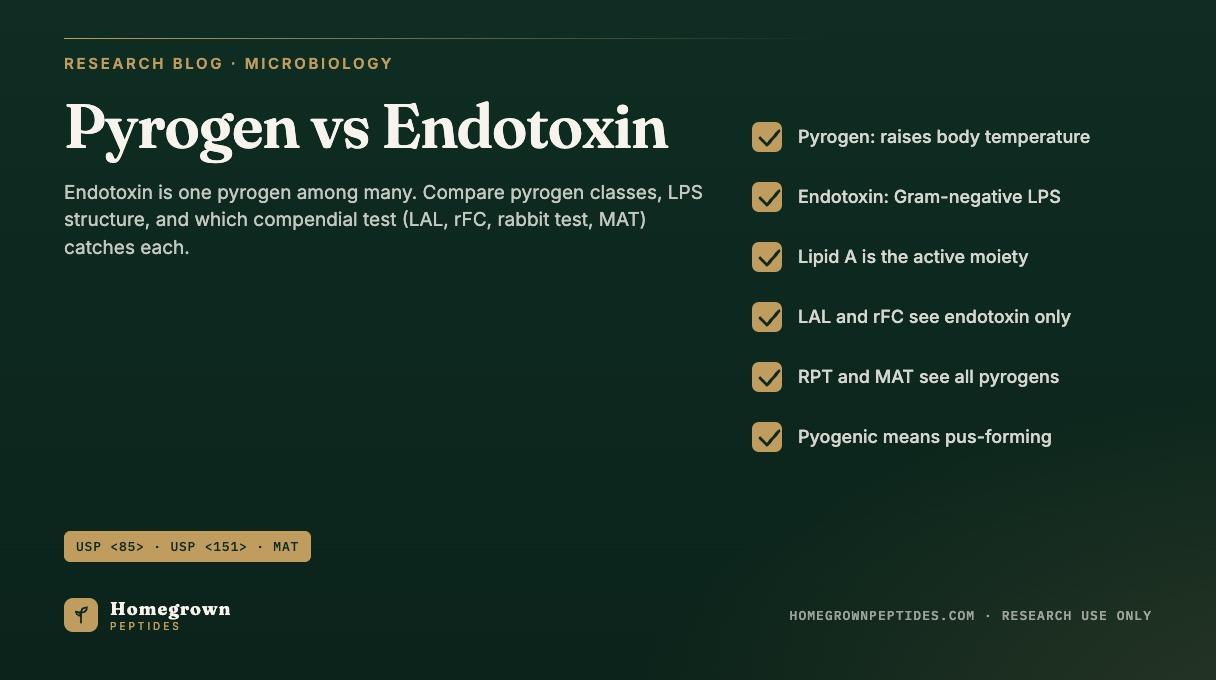
A pyrogen is anything that raises body temperature once it reaches the bloodstream. Endotoxin is one specific pyrogen: the lipopolysaccharide (LPS) making up the outer membrane of Gram-negative bacteria. Every endotoxin is a pyrogen, but not every pyrogen is an endotoxin, and the compendial tests differ. LAL and recombinant Factor C detect only endotoxin; the rabbit pyrogen test and the monocyte activation test detect pyrogens as a class.
| Property | Pyrogen (class) | Endotoxin (LPS) | Source |
|---|---|---|---|
| What it is | Any substance triggering fever once it reaches circulation; chemically diverse | Lipid A linked to a core oligosaccharide and, in smooth strains, an O-antigen chain | Raetz and Whitfield, 2002 |
| Source organisms | Gram-negative and Gram-positive bacteria, fungi, viruses, synthetic materials, and the body's own cytokines | Outer membrane of Gram-negative bacteria only | Rockel and Hartung, 2012 |
| Receptor recognized | Varies by class: TLR2 for lipoteichoic acid and peptidoglycan, other receptors for viral RNA and fungal glucans | TLR4, in complex with MD-2 and CD14 | Park et al., 2009 |
| Heat stability | Mixed; lipoteichoic acid and peptidoglycan are heat-stable, some protein pyrogens are not | Heat-stable; standard autoclave cycles do not destroy its pyrogenic activity | Ding and Ho, 2001 |
| Detected by LAL or recombinant Factor C | No, these reagents are endotoxin-specific | Yes | Ding and Ho, 2001 |
| Detected by the rabbit test or monocyte activation test | Yes, as a class | Yes, as one trigger among several | Hartung, 2021 |
What is a pyrogen?
A pyrogen is any agent that, once it reaches the bloodstream, shifts the hypothalamic temperature set point upward and produces fever. The field splits pyrogens into two categories. Exogenous pyrogens originate outside the body: bacterial cell-wall components, fungal cell-wall polysaccharides, and viral nucleic acids are the main examples relevant to a research lab. Endogenous pyrogens are the cytokines the body's own immune cells release in response to an exogenous trigger, principally interleukin-1, interleukin-6 and tumor necrosis factor. These cytokines act on the hypothalamus, where they raise local prostaglandin E2 synthesis, which is the signal that actually resets the thermoregulatory set point.
This two-step structure matters for testing. A rabbit-temperature test or a human monocyte cytokine assay reads the downstream, endogenous side of that cascade; LAL reacts to the exogenous trigger directly through an unrelated biochemical pathway and has nothing to do with fever physiology at all. Dinarello's review of exogenous and endogenous pyrogens lays out the cascade in detail for a lab that wants the mechanism rather than the summary.
What is endotoxin, chemically?
Endotoxin is lipopolysaccharide, a large amphipathic molecule built from three parts: lipid A, a core oligosaccharide, and (in smooth-type LPS) a repeating O-antigen polysaccharide chain. Lipid A is the toxic and pyrogenic moiety: a glucosamine-based glycolipid anchored in the bacterial outer membrane and the part of the molecule pattern-recognition receptors actually detect. The core oligosaccharide and O-antigen extend outward from the membrane and vary by species and strain, which is why LPS structure differs across Gram-negative genera even though the pyrogenic signal converges on lipid A.
Recognition runs through a receptor complex: LPS binds LPS-binding protein in plasma, is handed to CD14, and is presented to the TLR4-MD-2 complex on monocytes and macrophages. The crystal structure of that complex, solved by Park and colleagues, showed how lipid A seats into a hydrophobic pocket on MD-2 and how that engagement triggers TLR4 dimerization and the cytokine cascade described above. LPS is also notably heat-stable: because lipid A is a lipid anchored in a large aggregated structure rather than a protein with a fragile fold, standard dry-heat or steam sterilization that kills the bacterium does not remove the pyrogenic activity of the LPS left behind. That is the chemical reason sterility and freedom from pyrogens are two different claims, covered further in the FAQ below.
What are non-endotoxin pyrogens?
Endotoxin is the best-studied pyrogen because Gram-negative contamination in water systems is the dominant historical risk in manufacturing, but it is not the only pyrogen worth knowing. Gram-positive bacteria contribute peptidoglycan and lipoteichoic acid (LTA), recognized largely through TLR2 rather than TLR4 and shown directly to trigger cytokine release from human monocytes in whole-blood assays. Fungal cell walls contribute beta-glucans and zymosan, detected through a different receptor set. Viral RNA can act as a pyrogen through yet another receptor family, and synthetic adjuvants and particulates add to the list.
For a peptide made by chemical synthesis, the relevant question is not whether the peptide backbone is pyrogenic (it is not, by the mechanisms above) but whether anything introduced during synthesis, purification, lyophilization or reconstitution carried a non-endotoxin pyrogen into the vial. Water is again the common vector, this time for Gram-positive skin and environmental flora rather than Gram-negative organisms. A systematic review by Rockel and Hartung catalogs which Gram-positive membrane components are consistently pyrogenic in monocyte assays, and a study by Morath and colleagues on Staphylococcus aureus LTA demonstrates a non-LPS bacterial component reproducing the cytokine-induction profile of endotoxin. Careful handling during reconstitution, covered in the post on aseptic technique and sterile filtration in peptide labs, is the practical control point here.
Pyrogenic vs pyogenic: why the words get confused
The two words share a root but describe different things, and the overlap in spelling causes genuine confusion in search queries. Pyrogenic comes from the Greek pyro (fire) plus gen (producing): fever-producing. Pyogenic comes from the Greek pyon (pus) plus gen: pus-forming. A pyrogenic substance raises body temperature; a pyogenic organism causes pus formation, typically by recruiting and then lysing neutrophils at a site of infection.
The two properties are not mutually exclusive, and the same organism often has both. Staphylococcus aureus is the textbook pyogenic organism, named for its role in abscess formation, and its lipoteichoic acid is also a well-documented pyrogen in monocyte activation assays, as shown directly by Gimenes and colleagues, who ran purified LTA through both the MAT and the rabbit pyrogen test and recorded a positive response in both. A single bacterium can be pyogenic and a source of pyrogenic material, but those are two separate effects, and neither word is a synonym for endotoxin or LPS.
Which test detects which?
The compendial landscape splits along the exogenous/endogenous distinction above: two tests are endotoxin-specific because they rely on a cascade only LPS triggers, and two detect pyrogens as a class because they measure a fever-response surrogate instead.
| Test | Compendial chapter | Detects | Readout | Typical sensitivity |
|---|---|---|---|---|
| LAL (gel-clot, turbidimetric or chromogenic) | USP <85>, Ph. Eur. 2.6.14 | Endotoxin only | Horseshoe-crab clotting cascade read as a clot, turbidity change, or color change | Commonly 0.03 to 0.25 EU/mL |
| Recombinant Factor C (rFC) assay | USP <85> alternative method | Endotoxin only | Fluorogenic or colorimetric cleavage by a single recombinant enzyme, no lysate | Broadly comparable to LAL |
| Rabbit pyrogen test | USP <151> | All pyrogens, endotoxin included | Rectal temperature rise in rabbits after intravenous injection | Qualitative pass/fail against a group temperature-rise threshold |
| Monocyte activation test (MAT) | Ph. Eur. 2.6.30 | All pyrogens, endotoxin included | Cytokine release (IL-6 or IL-1beta) from human monocytes or whole blood, by immunoassay | Comparable to LAL, plus Gram-positive and fungal pyrogens |
The monocyte activation test was developed to close the gap the other two leave open: the rabbit test detects any pyrogen but is an animal test with biological variability, and LAL is fast and quantitative but blind to anything that is not LPS. Hoffmann and colleagues ran the international validation study that established MAT performance against both reference tests, and Schindler and colleagues published the whole-blood version of the assay most current MAT protocols build on. Hartung's 2021 retrospective traces how the method moved from a research tool to an accepted compendial alternative.
Why does a peptide COA usually report endotoxin rather than pyrogens?
A finished research peptide is a lyophilized cake made by chemical synthesis and brought into contact with water only during purification, formulation and reconstitution at the bench. The dominant contamination risk in that process is Gram-negative organisms in process water and on contact surfaces, since water systems are the classic reservoir for endotoxin and LPS survives the purification steps that eliminate the organisms themselves. A general pyrogen test does not target that risk any more precisely than LAL; it is simply slower, more variable if run in rabbits, and harder to quantify.
LAL is also more sensitive than a general pyrogen assay needs to be here, fast enough to run on every lot, and the test regulators have built acceptance limits around; the bacterial endotoxins test (BET) framework is covered in the post on what endotoxin testing with LAL actually measures. A lot certificate for a peptide like BPC-157 reports an endotoxin value in EU per mL or EU per mg because that test matches the manufacturing risk, not because non-endotoxin pyrogens are assumed impossible. If a process introduced a plausible non-endotoxin risk, a lab would add a monocyte activation test on top of the routine LAL result rather than in place of it.
How much endotoxin is 1 EU, in mass terms, and how do the units map?
An endotoxin unit (EU) is a potency unit defined against a reference standard, not a fixed mass of molecule, because different LPS chemotypes have different pyrogenic potency per unit mass. Assay documentation has long used an approximate benchmark of roughly 0.1 ng per EU for the reference standard endotoxin used to calibrate LAL lysates, though the exact potency of any given reference lot is stated on that lot's own certificate rather than being a fixed universal constant. The full conversion a finished peptide COA actually uses, including how an EU/mL result on a reconstituted solution becomes an EU/mg result on a lyophilized mass, how that interacts with dose volume, and where the compendial limits come from, is worked through with real numbers in the post on endotoxin limits in EU per mL vs EU per mg, which this post will not repeat.
Frequently asked questions
Is endotoxin the same as a pyrogen?
No. Endotoxin is one specific pyrogen, the lipopolysaccharide of Gram-negative bacteria. Pyrogen is the broader category that also includes Gram-positive peptidoglycan and lipoteichoic acid, fungal glucans, some viral components, and the body's own cytokines. Every endotoxin molecule is pyrogenic, but plenty of pyrogenic material is not endotoxin.
Can a sterile product contain pyrogens?
Yes. Sterility means no viable microorganisms are present; it says nothing about dead cell fragments or the molecules those cells shed beforehand. LPS survives sterilization intact and remains pyrogenic, which is why sterility and endotoxin testing are run as separate, independent release tests.
Does filtration remove endotoxin?
Standard sterilizing-grade filtration (commonly 0.2 micron) is sized to retain bacteria, not to remove endotoxin. LPS monomers are far smaller than the filter's rated pore size, and even larger LPS aggregates can pass through or shed fragments under flow. Removing endotoxin requires a dedicated step, such as ultrafiltration or adsorptive resins, or starting from water and equipment that never introduced it. General handling practice is covered in the aseptic technique post linked above.
What is the monocyte activation test?
The monocyte activation test (MAT), described in Ph. Eur. chapter 2.6.30, measures cytokine release from human monocytes or whole blood exposed to a test article. Because monocytes respond to the same receptor pathways that drive fever in a person, MAT detects endotoxin and non-endotoxin pyrogens in a single assay, which is why it was developed as a human-relevant alternative to the rabbit pyrogen test.
Are peptides themselves pyrogenic?
The peptide backbone itself is not a pyrogen by the mechanisms above; peptides are not structurally related to lipid A, peptidoglycan or lipoteichoic acid, and they are not ligands for TLR4 or TLR2. Any pyrogenic result on a peptide lot reflects contamination introduced during synthesis, purification or handling, not a property of the molecule itself, which is why endotoxin testing is a release test on the finished lot rather than an assumption based on sequence.
What does "non-pyrogenic" on a label mean?
It means the article passed a defined pyrogen or endotoxin test against a stated acceptance limit, most commonly the bacterial endotoxins test at a calculated EU limit. It is a pass/fail result against a threshold, not a claim of literally zero pyrogenic material; a result below the limit of detection and below the compendial limit is reported as passing.
References
- Raetz CR, Whitfield C. Lipopolysaccharide endotoxins. Annu Rev Biochem. 2002;71:635-700. PubMed PMID 12045108.
- Park BS, Song DH, Kim HM, Choi BS, Lee H, Lee JO. The structural basis of lipopolysaccharide recognition by the TLR4-MD-2 complex. Nature. 2009;458(7242):1191-1195. PubMed PMID 19252480.
- Dinarello CA. Infection, fever, and exogenous and endogenous pyrogens: some concepts have changed. J Endotoxin Res. 2004;10(4):201-222. PubMed PMID 15373964.
- Hoffmann S, Peterbauer A, Schindler S, et al. International validation of novel pyrogen tests based on human monocytoid cells. J Immunol Methods. 2005;298(1-2):161-173. PubMed PMID 15847806.
- Schindler S, von Aulock S, Daneshian M, Hartung T. Development, validation and applications of the monocyte activation test for pyrogens based on human whole blood. ALTEX. 2009;26(4):265-277. PubMed PMID 20383472.
- Morath S, Geyer A, Hartung T. Structure-function relationship of cytokine induction by lipoteichoic acid from Staphylococcus aureus. J Exp Med. 2001;193(3):393-397. PubMed PMID 11157059.
- Rockel C, Hartung T. Systematic review of membrane components of gram-positive bacteria responsible as pyrogens for inducing human monocyte/macrophage cytokine release. Front Pharmacol. 2012;3:56. PubMed PMID 22529809.
- Gimenes I, Caldeira C, Presgrave OA, et al. Assessment of pyrogenic response of lipoteichoic acid by the monocyte activation test and the rabbit pyrogen test. Regul Toxicol Pharmacol. 2015;73(1):356-360. PubMed PMID 26232706.
- Ding JL, Ho B. A new era in pyrogen testing. Trends Biotechnol. 2001;19(8):277-281. PubMed PMID 11451451.
- Hartung T. Pyrogen testing revisited on occasion of the 25th anniversary of the whole blood monocyte activation test. ALTEX. 2021;38(1):3-19. PubMed PMID 33452528.
Research use only. Homegrown Peptides products are for laboratory research and are not for human or animal use. Nothing in this article is medical advice.